
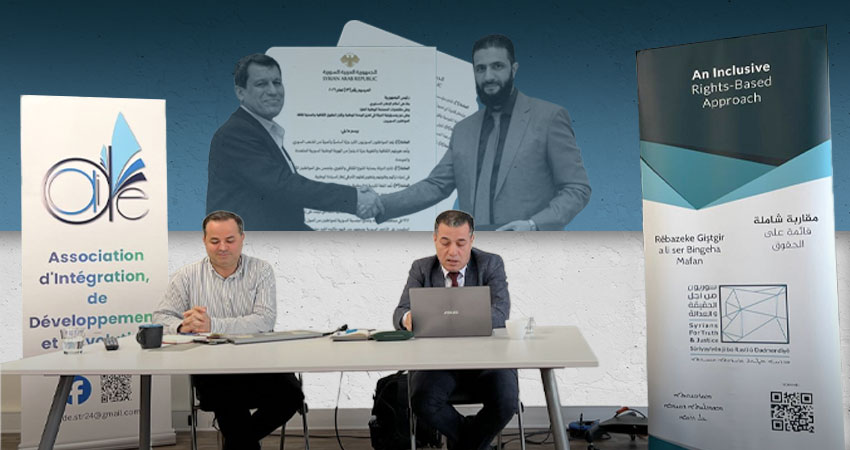
In partnership with the AIDÉ (Association d’Intégration, de Développement et d’Évolution) in Strasbourg, Syrians for Truth and Justice (STJ) hosted a panel discussion on Sunday, 15 March 2026, focusing on Decree No. 13 issued by the President of the Transitional Phase in Syria, Ahmed al-Sharaa, concerning Kurdish rights in Syria. The event was part of the ongoing activities of the Monitoring Group to Follow Up on the Implementation of Decree 13, which STJ launched in late January 2026, following the presidential decree’s issuance.
The event began with an overview of Decree No. 13 and its main provisions, which include “recognizing Kurdish Syrian citizens as an essential and indigenous part of the Syrian people” and acknowledging their cultural and linguistic identity “as an integral part of the diverse and unified Syrian national identity” (Article 1). Furthermore, it emphasized the commitment of the new Syrian state to “protecting cultural and linguistic diversity, ensuring the right of Kurdish citizens to revive their heritage and arts, and developing their mother tongue within the framework of national sovereignty” (Article 2). It also recognized the Kurdish language as a “national language, permitted to be taught in public and private schools in regions where Kurds constitute a significant proportion of the population.” (Article 3).
The event also covered the details of “abolishing all extraordinary laws and measures resulting from the 1962 census in al-Hasakah governorate,” and granting Syrian citizenship to “all citizens of Kurdish origin residing on Syrian territory, including those Maktumi al-Qayd/maktumeen (unregistered), with full equality in rights and duties” (Article 4). Regarding the Nowruz holiday, the presidential decree designated it as a “national holiday representing spring and brotherhood,” and 21st March was declared an official paid public holiday nationwide (Article 5). The decree emphasized the commitment of “state media and educational institutions to adopting an inclusive national discourse” (Article 6), and assigned “relevant ministries and authorities with issuing the necessary executive regulations” (Article 7).
Historic Injustices Against Kurds in Syria
The panel discussion started by recounting the injustices suffered by Kurds in Syria since the founding of the Syrian Republic. This began with decades of Kurds being deprived of education in their native language, and the “cultural genocide” faced by hundreds of thousands of Kurds through systemic targeting and deprivation based on their ethnic and national identity.
The discussion also addressed the unjust exceptional census of 1962, through which tens of thousands of Syrian Kurds were stripped of their citizenship, falling into the categories of Ajanib al-Hasakah/ajanib (foreigners) and Maktumi al-Qayd/maktumeen (unregistered).
The discussion also addressed other grievances not covered by Decree 13, with the Arab Belt (Al-Hizam al-Arabi) project being a primary concern. This project aimed at the demographic makeup of Kurdish regions in Syria, reaching about 15 kilometers deep in some areas and stretching nearly 300 kilometers along the Turkish-Syrian border, from the far northeast in the al-Malikiyah/Derik area to the borders with Raqqa governorate, west of Ras al-Ayn/Serê Kaniyê.
This policy was effectively implemented in the 1970s by bringing in members of Arab tribes, about 4,000 families, from the rural areas of Raqqa and Aleppo, specifically those whose lands were submerged by waters behind the Euphrates Dam/Tabqa Dam. These families were then settled in model villages within the Kurdish-majority regions.
The event explained the key differences between Legislative Decrees, which carry the force of law, and Administrative or Executive Presidential Decrees, which are limited to the powers granted to the President by the Constitution and existing laws. It also discussed Promulgation Decrees, which are official procedures for issuing and publishing laws passed by the People’s Assembly.
Furthermore, the discussion highlighted a constitutional dilemma within the 2025 Syrian Constitutional Declaration. The Declaration did not grant the Transitional President the authority to issue legislative decrees, leading many to argue that Decree No. 13 is unconstitutional. However, given the absence of Parliament (the People’s Assembly) for over a year, others contended that the Transitional President possesses this authority amid the legislative and constitutional vacuum. This power, they argue, is necessary to ensure the continued functioning of state institutions and the protection of fundamental rights, thereby avoiding a cycle of violence and counter-violence. This ongoing debate emphasizes the need to enshrine the provisions of this decree in the upcoming Constitution.
The participants also discussed the procedural package, which includes circulars and ministerial decisions issued by the Ministries of Interior and Education. These measures aim to implement the principles outlined in Decree No. 13, especially regarding the expedited granting of citizenship to the two categories mentioned in the decree (Ajanib al-Hasakah/ajanib and Maktumi al-Qayd/maktumeen), and the development of educational curricula to include the Kurdish language.
Finally, the discussion covered the communiqué issued by the General Secretariat of the Presidency, which confirmed Nowruz as an official public holiday throughout Syria. It was emphasized that these decrees and circulars are a transitional step toward full and comprehensive “constitutionalization” that ensures redress for victims and strengthens transitional justice within the upcoming social contract.
This event is part of a series of activities that STJ plans to carry out following the formation of the Monitoring Group to Follow Up on the Implementation of Decree 13, which was launched by the organization in late January 2026, after the issuance of Presidential Decree No. 13. These Syrian-Syrian dialogues are expected to continue within Syria, as well as in neighboring countries and among the diaspora.