
1. Introduction:
The military escalation in the Sheikh Maqsoud and Ashrafieh neighborhoods in Aleppo city, between 6 and 12 January 2026, led to large-scale displacement of civilians, occurring in circumstances characterized by danger and fear, the absence of safe alternatives, and the lack of effective protection for housing and property.
This report documents large-scale displacement that took place under coercive and dangerous conditions, carried out through unsafe exit routes, during which civilians were forced to leave their homes in haste and without their basic belongings, within the context of an armed conflict inside populated areas.
The report also demonstrates —according to what is documented by victim testimonies— that the periods of forced absence of the population were accompanied by large-scale pillage of homes and commercial shops, along with acts of destruction to private property, amidst a security vacuum and the absence of any effective measures to protect private property.
Furthermore, the report shows —based on direct testimonies— that the displacement and pillage constituted an interconnected process, as the depopulation of the neighborhoods of their Kurdish residents exposed properties to grave violations, constituting a compound violation of the right to housing, property, and safe living.
For the purpose of preparing this report, Syrians for Truth and Justice (STJ) conducted in-depth interviews with 22 witnesses and victims, and also relied on testimonies collected in cooperation with the Kurdish Lawyer’s Union, which contributed to supporting the documentation of the events addressed in this report. Informed consent was obtained from all participants after explaining the voluntary nature of their participation and how the information they provided would be used, including its publication in this report. Participants chose to conceal their identities or any identifying details due to fear of reprisals against them or their families. Accordingly, pseudonyms have been used to refer to individuals whose testimonies are cited in this report.
2. Background:
In early January 2026, Aleppo city witnessed a military escalation that reignited clashes between the Syrian Transitional Government forces and the Syrian Democratic Forces (SDF), according to what was published by the Syrian Arab News Agency (SANA). Meanwhile, the SDF denied in a statement any presence of its forces inside Aleppo city, stating that it had handed over the security file in the two neighborhoods to the Internal Security Forces (Asayish) in a public and documented manner.
This escalation rapidly extended to the Sheikh Maqsoud and Ashrafieh neighborhoods, two areas with a high Kurdish population density. According to United Nations estimates, more than 250,000 individuals reside in these two neighborhoods, including an estimated 40% of internally displaced persons (IDPs) from the Kurdish Afrin region. This significantly increased the likelihood of civilians being subjected to harm and deepened the vulnerability of livelihoods already predicated on the reality of protracted displacement.
The Transitional Government, led by Ahmed Al-Sharaa, announced on 7 January 2026 a military operation in Aleppo city, which was followed by extensive field movements within residential neighborhoods. As hostilities escalated, security and service conditions deteriorated, and the area witnessed exchanges of shelling, along with power and water outages, rendering it dangerous for residents to remain in their homes.
This escalation resulted in the displacement of an estimated 148,000 individuals. In addition to human casualties, the Media Director of the Aleppo Health Directorate reported on 12 January that the number of civilian casualties had risen to 24 killed and 129 injured. Furthermore, essential civilian infrastructure, including schools and health facilities, sustained damage, which exacerbated the vulnerability of the humanitarian situation in the city.
Despite the de-escalation and the signing of a ceasefire and integration agreement between the Syrian Transitional Government and the Syrian Democratic Forces (on 18 January) a number of residents returned to neighborhoods lacking basic services and exhibiting the impacts of large-scale displacement, amidst the absence of clear guarantees for property protection or reparation, and with the recording of pillage and destruction incidents that targeted homes and commercial shops during the period of their owners’ absence. In this context, the report focuses on documenting the forced displacement operations and the property pillage that accompanied the displacement, characterizing them as interconnected violations that affected civilians during the escalation period.
It is worth noting that the Sheikh Maqsoud and Ashrafieh neighborhoods had witnessed a total power outage and crises in heating materials, as a result of the ongoing siege imposed on them since late December 2025. The controlling forces prevented the entry of fuels, including diesel, gas, and basic heating materials, concurrently with preventing the entry of flour and vegetables. This led to a severe shortage of medicines and medical supplies, and directly impacted the daily lives of civilians.
3. “Leaving Was Not an Option”: Testimonies on Displacement in Sheikh Maqsoud and Ashrafieh:
The Syrian Transitional Government urged residents to leave the three contested neighborhoods -Sheikh Maqsoud, Ashrafieh, and Bani Zeid- announcing the opening of humanitarian corridors and accommodation centers for the displaced to facilitate their exit. The Syrian Army reported that it would commence military operations against the Syrian Democratic Forces (SDF) after the specified deadline expired. The evacuation took place in a context characterized by urgency and the absence of adequate guarantees, which compelled large numbers of civilians to leave their homes without the ability to secure their properties or arrange suitable alternative housing.
The testimonies documented in this report demonstrate that the military escalation left civilians with no genuine option but to leave their homes immediately. The shelling and the encroachment of clashes upon residential neighborhoods rendered remaining in homes a direct threat to life, forcing families into displacement under the pressure of fear, without the ability to assess risks or plan ahead.
Saeed (from Sheikh Maqsoud neighborhood – displaced to the outskirts of Aleppo city) describes the moment of making the decision to leave:
“That day, the shelling got very close to our home, and we could hear continuous gunfire. There was no longer any room for thinking; we felt that any delay might expose us to death. We left immediately, and we did not know where we would go or what we would do next.”
According to the testimonies collected by STJ from residents of the Sheikh Maqsoud neighborhood, the danger inside residential neighborhoods escalated from the first hours of the escalation. This was accompanied by intense fear and an inability to take shelter or leave homes, before this reality transformed into forced displacement to preserve life.
Mustafa (from Sheikh Maqsoud neighborhood – displaced to Aleppo city) states that the sounds of heavy and continuous gunfire began on the afternoon of Tuesday, 6 January 2026, from multiple directions inside and around the neighborhood. He adds:
“As the intensity of the sounds increased, we resorted to hiding in the bathroom, away from the windows, for fear of being hit by the shells that were raining down on the neighborhood, and we were unable to leave. This situation continued until night, with intermittent and sometimes intense shelling, in addition to continuous gunfire. That night was one of the harshest nights we have lived through, especially with the power outage, the difficulty of communication, and the constant fear of the house being hit at any moment.”
The witness continues:
“The next day, 7 January, the situation deteriorated further and the clashes continued, so we were forced to displace to preserve our lives. We left the house in haste, and we could not take anything with us, heading towards the Shari’ al-Zuhour crossing. There was a huge crowd including women, children, and the elderly, all trying to leave the neighborhood amidst tension and fear. After a long wait, we managed to cross and reach Aleppo city.”
Most testimonies concurred that families left their homes without their basic necessities, including clothing, documents, and money, as a result of the sudden departure and under the pressure of imminent danger. Furthermore, clear housing alternatives were not available, which placed civilians before a reality of open-ended and unstable displacement.
Abdullah (from Sheikh Maqsoud neighborhood – displaced to the Aleppo countryside) describes the harsh conditions of displacement, saying:
“We left the house very quickly, taking nothing with us except what we were wearing. We left everything behind because the shelling did not give us a chance to gather any belongings. We left the neighborhood on foot towards Aleppo city without any means of transportation, in extremely difficult conditions amidst the cold weather and the constant threat of shells and heavy machine gunfire. We had to take long and difficult routes to avoid direct clash zones, with a constant feeling of fear and anxiety for our lives… We went through extremely difficult times, especially during the freezing cold and snowfall, which exacerbated our suffering.”
One testimony reflects the magnitude of the imminent danger faced by civilians, which compelled them to make the decision to displace under the pressure of fear and trauma resulting from the shelling and gunfire inside residential neighborhoods. Jiyan (from Sheikh Maqsoud neighborhood – displaced to Halab al-Balad [Old Aleppo]) says:
“I left the institute hurrying towards home in a state of extreme terror due to the intensity of the gunfire and shelling we were hearing and seeing. On the way, I saw a corpse lying in the street covered with a blanket, and blood was flowing from it. I was deeply shocked… In the streets, the scene was tragic; people were fleeing the neighborhood on foot and in cars, in a state of mass panic and severe overcrowding. When I reached home, my family was waiting for me, and they had decided to leave the neighborhood immediately out of fear for our safety.”
The testimonies also documented extremely harsh humanitarian conditions during displacement, including sleeping in the open and exposure to extreme cold, amidst the absence of any shelter or basic services, reflecting the magnitude of the suffering faced by civilians following their forced exit from the neighborhoods.
Yasser (from Sheikh Maqsoud neighborhood – displaced to Aleppo city) describes the displacement conditions:
“We found ourselves stranded inside Aleppo city, without a clear destination or a safe place to seek refuge. I did not have any cash that would enable me to rent a place to sleep or secure a means of transportation. Due to this harsh situation, we could not find a place to sleep. We slept in the open, and the night was freezing cold. We had no blankets or anything to protect us from the cold. The children were shivering, and we didn’t know how we would spend the following night.”
Hevin (a widow from Ashrafieh neighborhood – displaced to Al-Rashideen neighborhood in Aleppo, then to Afrin) affirms the same suffering, saying:
“I headed towards Aleppo city, and reached the Al-Rashideen area, but I did not find a place to shelter me, and I was forced to sleep in the open for an entire night, in harsh conditions during which I suffered from extreme cold, hunger, and fear, especially being a lone woman without any protection, spending the night in the street amidst the sounds of bullets and the anxiety of being subjected to any harm.”
Several testimonies documented in this report indicate that leaving the neighborhood was not possible for everyone from the first day the crossings were opened. Several factors prevented residents from passing through, including severe overcrowding, lack of organization, and fear of arrest after witnessing detention incidents at checkpoints, in addition to intermittent shelling during certain periods. Nader, a resident of the western part of Sheikh Maqsoud neighborhood, described one attempt to leave, stating:
“The scene felt like the Day of Judgment. People packed everywhere, on foot, in cars, and in different vehicles, and the numbers were overwhelming. We were unable to cross toward Afrin after the checkpoint was closed and the passage of pedestrians and vehicles was stopped. We turned back and had to spend another night in the neighborhood under danger.”
In the same context, Mohammad, a resident of Sheikh Maqsoud neighborhood, recounted one of these attempts, which ultimately ended with his arrest, stating:
“When we learned that the humanitarian crossing had been opened, we headed to Al-Zuhour Street in Ashrafieh. However, after noticing that men attempting to cross were being arrested, we decided to turn back. A few days later, a new corridor was announced, so we tried again and found a long line of civilians. During that time, the area came under shelling, and we saw bodies and wounded people, so we took shelter in the entrance of a nearby building until the situation calmed down.”
He added that after they proceeded toward the checkpoints, they were searched and questioned before being allowed to move on; however, the process ultimately ended with the witness and several others being arrested.
The impact of the forced displacement was not limited to the direct risks and humanitarian suffering that accompanied it during the exit; rather, it extended to include what followed the depopulation of the neighborhoods, as the forced absence of the residents led to their homes and commercial shops being subjected to widespread violations affecting private property, within a context characterized by an absence of protection and accountability.
4. Property Pillage and Destruction During the Displacement Period:
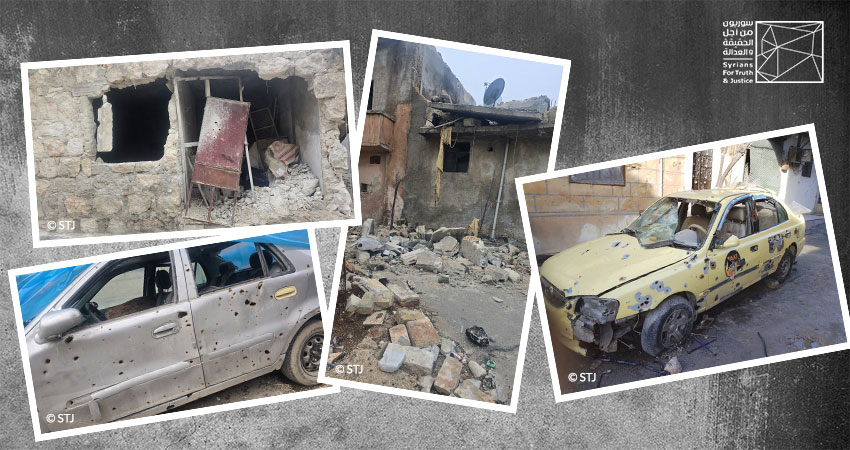
The testimonies documented in this report demonstrate that the forced displacement of the residents of the Sheikh Maqsoud and Ashrafieh neighborhoods was accompanied by large-scale pillage of homes and commercial shops, in addition to deliberate acts of destruction to private property. These violations occurred during the period of the residents’ forced absence and amidst a conspicuous security vacuum. Given that the concerned neighborhoods were under the control of the Government forces during the period when the pillage acts took place, the Syrian Transitional Government bears responsibility for these violations, whether committed by its affiliated elements or as a result of its failure to fulfill its obligations to prevent pillage and protect property.
Several witnesses interviewed by STJ reported that, upon returning to the neighborhoods, they found their homes looted or damaged, with the loss of furniture and basic contents, and the appearance of traces of break-ins and deliberate tampering. This transformed the temporary displacement into a significant material loss, and exacerbated the difficulty of return and stabilization. Tariq (from Sheikh Maqsoud neighborhood), describing what he found upon his return, says:
“I returned to the house, and nothing was as it used to be. Apart from the destruction, everything of material value was stolen from it. Also, the electrical cables were stolen from the walls, the internet cable was cut, and the solar panel and its battery were stolen from the roof of the house. Moreover, a tin of oil was stolen.”
Mustafa (from Sheikh Maqsoud neighborhood) also reported the theft of his motorcycle parked in the street near his house. Furthermore, other testimonies documented the pillage of commercial shops and the confiscation of their contents, which inflicted direct economic losses on their owners and severed their sources of livelihood. In some cases, the pillage was accompanied by the destruction of the internal structure of the homes, including smashing doors and windows and damaging property.
Dilyar (a resident of Sheikh Maqsoud neighborhood) reported in his testimony about the acts of destruction and pillage that targeted his home and shop, saying:
“Upon my arrival, I found clear signs of breaking and entering on the doors of my home and the shop I own for selling cigarettes, and it became clear that they had been subjected to a complete robbery. I lost all the contents of the home. As for the shop, all of its supplies were looted, with the value of the stolen goods estimated at around eight thousand dollars. There were also obvious destruction and chaos inside the home and shop.”
In the same context, Halima, a resident of eastern Sheikh Maqsoud neighborhood, described the harsh circumstances surrounding her family’s departure from the area under intense shelling. She explained that they were forced to flee with their children amid heavy gunfire and scenes of civilians killed in the streets. She further noted that what followed their displacement was the complete loss of their property after their home was looted and then deliberately set on fire. Halima said:
“When I returned, I found that the house had been looted, and everything that had not been stolen had been burned. We lost all our belongings and personal possessions.”
The testimonies documented in this report indicate the absence of any effective measures to protect private property after control was established over the area, in a context characterized by a lack of security and power outages. Saeed (from Sheikh Maqsoud neighborhood) describes what he found upon returning to his home after the situation had relatively calmed down, saying:
“I returned to my home in the Sheikh Maqsoud neighborhood only to be surprised that the door of the house was broken open. It turned out that the house was subjected to theft during the period of our forced absence, amidst the absence of security and the lack of electricity in the neighborhood, and the absence of any authority protecting civilians’ property.”
In another testimony, Abdullah (from Sheikh Maqsoud neighborhood) recounts similar details upon returning to his home days after displacement:
“On 15 January 2026, we returned to our home despite the poor security situation, only to be surprised that the house had been subjected to theft, as we lost some pieces of furniture, in addition to the presence of damage resulting from the shelling, such as shrapnel on the windows and outer doors.”
In the same context, another testimony documented homes being subjected to additional acts of destruction and tampering following the return of their owners from displacement, reflecting the widening scope of violations that affected property during the absence period. Renas (from Sheikh Maqsoud neighborhood) recounts what he faced upon returning to his home days after displacement, saying:
“We returned to our home after the displacement, only to be surprised that the main door was broken, and it turned out that the house had been broken into and ransacked, in addition to the destruction of the solar panels.”
Other testimonies demonstrate that the acts of pillage were not limited to homes containing property of material value, but also targeted homes of individuals in extremely precarious economic situations. This indicates the indiscriminate nature of thefts, characterized by tampering with homes and seizing any available belongings, however limited they might be. Regarding this, Maher (from Western Sheikh Maqsoud neighborhood and displaced to Qamishli) recounts what he was informed about his home after the return of one of his family members, saying:
“After I arrived in Qamishli, I contacted my daughter-in-law who had stayed in Afrin and then returned to our home in Sheikh Maqsoud. She confirmed to me that the house had been broken into, and some things were stolen from it, such as three tins of olive oil and a few kilograms of olives. They also stole a small bouzouq [musical instrument] and two gas cylinders from my house. I am financially destitute and there are no electrical appliances in my house, yet the little I own was stolen.”
Other testimonies indicate that the recurrence of pillage incidents during the displacement period created a general feeling of insecurity and caused residents to lose faith in the possibility of protecting their property. This led some of them to hesitate in returning despite the cessation of hostilities, demonstrating that the impacts of displacement were not instantaneous or temporary, but extended to undermine the conditions for a safe and dignified return.
In a testimony documented by STJ, Raghad expresses the state of helplessness and exhaustion experienced by many residents after returning to their homes following displacement, amidst security chaos and the lack of ability to protect property or even know what happened to it during the absence period. Raghad, whose home was subjected to theft after she left the Ashrafieh neighborhood, says:
“Up to this moment, we do not know who committed the theft nor the entity behind it, especially amidst the security chaos that [the neighborhood] witnessed during that period. We had no ability to protect our home or monitor it due to the force majeure circumstances. We are currently trying, like the rest of the residents, to recover what was stolen and continue living.”
It is worth noting that the “Afrin Now” website, on 2 February 2026, documented the continuation of theft incidents in the Ashrafieh and Sheikh Maqsoud neighborhoods in Aleppo city, following the Syrian Transitional Government establishing its control over the two neighborhoods. According to local sources quoted by the website, theft operations were recorded targeting private properties and commercial facilities, among which an exchange office in the western section of the Sheikh Maqsoud neighborhood was subjected to a robbery where the stolen amount was estimated at about eight hundred million Syrian Pounds (approximately seventy thousand US dollars). The theft also targeted a home near the Ali bin Abi Talib Mosque in the western section of the neighborhood, where household properties including tins of olive oil, a gas cylinder, and electrical batteries were seized.
In addition to the above, some testimonies documented by this report indicate that the acts of theft did not occur in isolation from more severe violations, but were accompanied in some cases by instances of killing. This occurred in a context characterized by an absence of security protection and a lack of basic guarantees to protect civilians and their properties after the residents’ exit from the affected neighborhoods. This highlights the vulnerability of the civilians who remained in the neighborhoods to protect their sources of livelihood, and raises serious questions regarding the authorities’ responsibility to prevent acts of pillage, ensure the protection of civilians, and effectively investigate the killings associated with them.
Razan (from Sheikh Maqsoud neighborhood) recounts the details of her son’s killing while he remained in the neighborhood to protect his shop from theft, saying:
“With the start of the broad military escalation in Aleppo, I left the neighborhood with my son’s children and his wife, while he stayed to protect his shop and our home from theft. The next day, I received a call from my son’s own phone; a person speaking Arabic told me that my son, who was thirty-eight and a father of four children, had lost his life after being hit by a gunshot, and that he had handed the body over to the Civil Defense.”
She adds:
“Later, his eldest son received a call from a friend of his father’s confirming that his father was killed while he was in front of his shop, and that the gunfire came from a sniper in one of the nearby buildings, without knowing the entity that fired… And all the food supplies that my son was selling in his shop were stolen.”
5. Legal Analysis: Forced Displacement and Property Pillage:
The facts documented in this report demonstrate that the impact of the military escalation witnessed in the Sheikh Maqsoud and Ashrafieh neighborhoods was not limited to exposing civilians to a direct threat to their lives; rather, it resulted in large-scale displacement accompanied by grave violations affecting private property during the period of the residents’ forced absence. This interconnectedness between the displacement and property pillage raises serious legal questions regarding the extent of the controlling authorities’ compliance with their duties to protect civilians and their fundamental rights.
5.1. Forced Displacement from the Perspective of International Law and Syrian Legislation:
The large-scale displacement of the population from the Sheikh Maqsoud and Ashrafieh neighborhoods, under the brunt of military operations and the absence of security guarantees, is classified as “forced displacement or transfer,” an act absolutely prohibited under International Humanitarian Law (IHL). Article 17 of Additional Protocol II of 1977 affirmed that “the displacement of civilians shall not be ordered for reasons related to the conflict unless the security of the civilians involved or imperative military reasons so demand. Should such displacements have to be carried out, all possible measures shall be taken in order that civilians may be received under satisfactory conditions of shelter, hygiene, health, safety and nutrition.” This was also affirmed in the customary rules of International Humanitarian Law (Rules 129-131). However, the Transitional Authority failed to provide this for the forcibly displaced, as many victims reported spending their night in the open despite the freezing and snowy weather.
From the perspective of International Criminal Law, the Rome Statute of the International Criminal Court includes the “deportation or forcible transfer of population” as a crime against humanity in Article 7 if committed against any civilians as part of a widespread or systematic attack, and as a war crime in Article 8 when ordering the displacement of civilians without legal justification. The interconnectedness of the displacement operations with the systematic pillage of property, as documented in the report, reinforces indications of criminal intent to depopulate the area and undermine their right to security of tenure, which guarantees protection against forced eviction, harassment, and other threats, as affirmed by the Committee on Economic, Social and Cultural Rights in its thirteenth session in 1995. Accordingly, the authorities’ failure to secure genuinely safe corridors or ensure the immediate return of the displaced represents a grave breach of their international obligations and requires accountability for those responsible.
As for domestic Syrian laws, there is a severe legislative deficiency; these legislations are devoid of the crime of “forced displacement or forcible transfer,” and they entirely omit the “command and superior responsibility” presumed in armed conflicts as stipulated in the Rome Statute of the International Criminal Court. This necessitates amending Syrian legislation in accordance with its international obligations, by incorporating the crime of forced displacement as a standalone crime, and characterizing the committed crimes with their correct legal description.
5.2. Property Pillage in the Constitutional Declaration and the General Penal Code:
The Syrian Constitutional Declaration of 2025 guarantees the protection of private property, as Article 16 explicitly states that “private property is inviolable.” This provision establishes a positive obligation on the authorities to protect private property and prevent infringement upon it, especially in contexts of conflict or emergency where owners are forced to leave their homes.
In this context, the facts documented in this report, which included the pillage of homes and commercial shops, and the destruction of private property during their owners’ absence, constitute a direct violation of the constitutional protection of private property, and are linked to the authorities’ responsibility to take effective measures to prevent or mitigate these violations.
Furthermore, the Syrian Penal Code No. 148 explicitly criminalizes acts of theft and pillage, and aggravates the penalties when these acts are committed under circumstances involving special gravity, such as unrest, armed conflicts, or the targeting of residential areas. Article 621 defines theft as “taking the movable property of another without their consent,” and subjects this act to aggravated penal provisions when it occurs in specific contexts.
In this context, Article 627(1) stipulates punishing anyone who commits theft “in a state of rebellion, unrest, war, or any other disaster” with temporary hard labor, a characterization that applies to the context witnessed by the Sheikh Maqsoud and Ashrafieh neighborhoods, where the acts of pillage occurred during a period of military escalation, security unrest, and large-scale displacement of civilians. Paragraph (2) of the same Article also criminalizes acts of collective pillage carried out through raids on or destruction of the property of others.
Other articles of the law aggravate the penalty when the theft occurs in residential places or their annexes, or by unlawful means of forced entry. Article 625 imposes temporary hard labor on anyone who commits theft in enclosed places protected by walls, whether inhabited or uninhabited, regardless of the means of entry. Article 626 also stipulates the same penalty if the theft is committed at night by two or more persons, or if one of them is carrying an openly displayed or concealed weapon, or if the theft is committed by an armed person in a place intended for human habitation.
In the most severe cases, Article 622 aggravates the penalty to life or temporary hard labor for a period ranging between fifteen and twenty years, when a set of aggravating circumstances is present, including the theft occurring at night, or by more than one person, or by entering residential places through breaking and entering or impersonating an official capacity, or upon threatening with a weapon or using violence.
Accordingly, the facts documented in this report, which indicate the pillage of homes and commercial shops during their owners’ absence in the context of unrest and military escalation, represent an assault on private property and fall under criminalized acts pursuant to explicit articles of the Syrian Penal Code. They necessitate investigation and individual criminal accountability, as well as the adoption of effective measures to prevent their recurrence and ensure the protection of property, particularly if the involvement of elements affiliated with the Syrian Transitional Government in committing, facilitating, or condoning these acts is proven.
5.3. Property Pillage in International Law:
In addition to the provisions of national law, International Human Rights Law guarantees the protection of housing against unlawful interference. The International Covenant on Economic, Social and Cultural Rights (ICESCR) stipulates in Article 11(1) the right to adequate housing, which encompasses security of tenure and protection against unlawful interference with homes. In this context, the facts documented in this report, which included the pillage of homes and the destruction of private property during the absence of their owners, undermine this right, and weaken security of tenure and the possibility of returning homes in safe and dignified conditions.
International Humanitarian Law absolutely prohibits pillage, regardless of its motives or context. Article 33 of the Fourth Geneva Convention of 1949 explicitly prohibits pillage or theft. Pillage, when committed in the context of an armed conflict, constitutes a grave breach of International Humanitarian Law.
In this context, the recurrence of pillage incidents during the absence of civilians, as documented by this report, indicates a failure to fulfill due protection obligations, and exacerbates the humanitarian impacts of displacement by undermining the possibility of a safe return and the restoration of livelihoods.
6. Recommendations:
Based on the documented facts and the legal analysis presented in this report, and considering the sensitivity of the security context that accompanied the escalation in the Sheikh Maqsoud and Ashrafieh neighborhoods, the following recommendations are provided as practical steps aimed at mitigating violations, enhancing the protection of civilians and their properties, and creating safer conditions for return and stabilization:
6.1. To the Syrian Authorities:
- Initiate effective and impartial investigations into the incidents of property pillage and destruction that occurred during the displacement period, and ensure that those responsible are held accountable before an impartial and independent judiciary in accordance with the provisions of the Syrian Penal Code.
- Secure clear mechanisms for receiving complaints from the affected residents regarding incidents of pillage or destruction, and ensure their access to effective remedies without fear of reprisal.
- Take appropriate compensation or reparation measures for those affected by forced displacement and property pillage, in accordance with the national legal framework, and in a manner that takes into account the actual scale of the losses.
- Refrain from any practices that would facilitate or condone acts of pillage, and ensure respect for private property during and after security operations.
- Enhance oversight and discipline within the units deployed in the affected areas, and adopt clear measures to prevent any violations against the properties of civilians.
- Review the national legislative framework to ensure the inclusion of the crime of forced displacement and forcible transfer of population as standalone crimes, and characterize the committed violations within their proper context as crimes against humanity and war crimes, while adopting the principle of command and superior responsibility for international crimes in accordance with international standards.
6.2. To Humanitarian Organizations and Relevant International Actors:
- Support monitoring and documentation efforts related to property and housing violations and forced displacement, and provide legal and relief assistance to the affected individuals.
- Advocate for the respect of the rules of law, particularly the absolute prohibition of pillage and forced displacement, and work to integrate property protection into humanitarian response programs.