
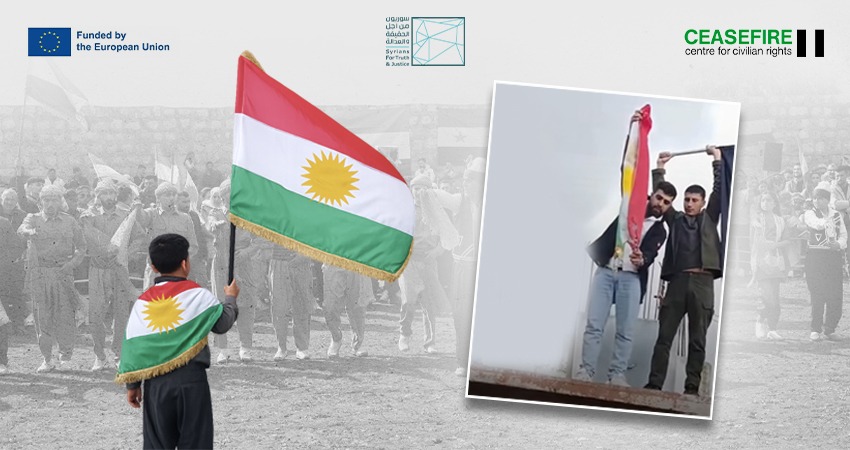
This publication was funded by the European Union, and in partnership with the Ceasefire Centre for Civilian Rights. The contents of this publication are the sole responsibility of Syrians for Truth and Justice – STJ/ the publisher and do not necessarily reflect the views of the European Union or the Ceasefire Centre for Civilian Rights.
1. Introduction
Nowruz represents one of the most significant national, cultural, and social occasions for Kurds, carrying deep historical symbolism linked to identity, belonging, and collective memory. In 2026, the occasion acquired additional significance in Syria following the issuance of Presidential Decree No. 13, which, for the first time, recognized Nowruz as a national holiday, acknowledged the Kurdish language, and prohibited discrimination on ethnic or linguistic grounds. This legal framework contributed to the broader and more public nature of the celebrations.
Despite this, several areas in northern Syria witnessed a wave of attacks and violations targeting Kurdish civilians as they returned from celebration sites. These incidents included physical assaults, verbal abuse, attacks on vehicles, and the coercion of civilians to insult their own national symbols, particularly the Kurdish flag.
The repercussions of the Nowruz 2026 events were not confined to a single area. However, violations were concentrated against Kurdish civilians in Afrin and its surroundings, with similar patterns reported in Aleppo and its countryside, including Sheikh Maqsoud and Azaz. In parallel, cities in northeast Syria, such as Qamishli and al-Hasakah, experienced security tensions and acts of violence and vandalism.
Within this context, this report focuses specifically on Afrin and its environs as a case study illustrating the most prominent patterns of violations that accompanied the Nowruz 2026 celebrations. Drawing on available testimonies and verified information, the report analyzes these violations, the enabling context in which they occurred, and the response of public security forces, including the extent to which they fulfilled their obligations to protect civilians and prevent violence.
2. Background
Nowruz 2026 in Syria took place within an unprecedented context of official recognition of Kurdish cultural rights, following the issuance of Presidential Decree No. 13 of 2026. The decree formally recognized Nowruz, stipulating in Article 5 that it constitutes “an official paid holiday throughout the Syrian Arab Republic, as a national celebration symbolizing spring and fraternity.” It further affirmed, in Article 2, the protection of Kurdish cultural and linguistic diversity, providing that the State shall “committed to protecting cultural and linguistic diversity and guarantees Kurdish citizens the right to preserve their heritage, arts, and to develop their mother tongue within the framework of national sovereignty.” In addition, Article 6 prohibits discrimination and exclusion, and criminalizes incitement against Kurds, stating that “any discrimination or exclusion based on ethnicity or language is legally prohibited, and incitement to ethnic strife will be punishable under existing laws.”
In principle, this legal development marked a significant step toward the formal recognition of cultural pluralism in Syria and contributed to opening public space for the peaceful and public expression of Kurdish identity.
The decree was issued, however, within a complex political and security context. In January 2026, areas in northern and northeastern Syria witnessed a large-scale military escalation, particularly during the first half of the month. Intense clashes erupted across multiple fronts, including Aleppo, Raqqa, Deir ez-Zor, and al-Hasakah, amid escalating hostilities between the Syrian Democratic Forces (SDF) and forces affiliated with the Syrian transitional government, alongside tribal groups aligned with the latter.
On 30 January 2026, the Syrian government and the SDF announced that they had reached a comprehensive agreement providing for a ceasefire and the gradual integration of military forces and administrative structures into Syrian state institutions.
Despite this legal framework, the events of Nowruz 2026 demonstrated a clear failure to translate these guarantees into effective protection on the ground. The exercise of these rights was met with direct violations, forming the core focus of this report.
3. Methodology
For the purposes of this report, STJ conducted six in-depth interviews with witnesses and victims who directly experienced the events in Afrin and its surrounding areas on 20 and 21 March 2026. The testimonies include both women and men from diverse professional and social backgrounds, including journalists, civil society activists, farmers, and business owners. Interviews were carried out between 22 and 28 March 2026.
Researchers obtained the informed consent of all participants after clearly explaining the voluntary nature of participation and the intended use of the information provided, including its publication in this report. At the request of participants, pseudonyms were used and any identifying details were withheld due to potential security risks.
The report also draws on a review of selected open-source materials, including media reports and official statements, to better contextualize the events and to corroborate recurring patterns identified in the testimonies. These sources were not relied upon as sole evidence of facts. Testimonies were analyzed comparatively to identify consistent patterns, including with respect to the locations of violations, the conduct of alleged perpetrators, and the role of security authorities.
4. Incident of Lowering the Syrian Flag in Kobani/Ain al-Arab
On 21 March 2026, during Nowruz celebrations, a video circulated widely on social media showing an individual lowering the Syrian flag from a public location in the city of Kobani (Ain al-Arab).
The footage triggered swift and widespread reactions. Official actors characterized the act as an affront to a sovereign symbol and a breach of a “red line,” contributing to heightened tensions and public anger across several areas in northern and northeastern Syria. The rapid and extensive dissemination of the video amplified the incident and fueled inciteful rhetoric, prompting various actors to mobilize in response, including through calls for protest and, in some instances, subsequent acts of violence.
Testimonies documented by STJ, corroborated by multiple media reports, indicate that the incident did not remain confined to Kobani. Rather, it became a catalyst that contributed to escalating tensions in other areas, where incidents of violence and attacks targeting Kurdish civilians and their national symbols were recorded. These included the removal of Kurdish flags and assaults on individuals participating in Nowruz celebrations.
At the official level, the Internal Security Forces (Asayish) in Kobani announced the arrest of the individual responsible for lowering the flag, stating that the act was isolated and did not reflect the policy of any authority. However, this measure proved insufficient to curb the incitement and subsequent violence directed against Kurdish communities.
5. Attacks on Celebrants and Humiliation of the Kurdish Flag
Testimonies documented by STJ indicate that Nowruz 2026 celebrations in the Afrin area initially unfolded in a calm and ordinary atmosphere, particularly at main gathering sites such as Midanki. Families gathered in large numbers, and the celebrations included customary activities such as dancing, singing, and lighting fires, without any notable tensions within the celebration sites themselves.
Signs of tension began to emerge as celebrants made their way back to Afrin city, particularly at its entrances and along main roads, where initial points of friction were recorded and rapidly escalated into direct attacks.
Multiple testimonies consistently indicate that the first restrictive measures were imposed by members of the General Security forces, who requested that returning celebrants lower or conceal Kurdish flags without providing justification. Witnesses described this as an early indication of imposed limitations on the expression of identity in public spaces. One witness, Jihan, described the moment as follows:
“We were returning by car from the Nowruz celebrations in Midanki, and the situation was calm and normal… When we reached the checkpoint at the entrance to Afrin, General Security asked us to lower the Kurdish flag without any explanation… When we arrived at the Afrin garage, two masked men approached us and one of them said, ‘Take down the flag,’ then they violently pulled it off, breaking the car window.”
As individuals proceeded further into the city, the intensity of the incidents increased. Groups of young men —often masked— were reported to have positioned themselves at specific points, particularly near transport hubs, bridges, and major roundabouts, where they intercepted celebrants returning from the festivities. Testimonies indicate that these groups used tools such as sticks and sharp objects, and in some instances motorcycles, to carry out the attacks.
In one documented incident, a witness named Ismail, who was returning from a Nowruz celebration in the village of Maydān Akbis, reported that after passing the Afrin checkpoint and reaching the Rajo road, he was attacked by individuals wearing blue camouflage military uniforms. He stated:
“Three vehicles blocked my way, carrying men dressed in blue camouflage uniforms and with their faces covered… One of them climbed onto my car, forcibly removed the flag without saying a word, and threw it to the ground… Meanwhile, a General Security patrol was only a few meters away, watching without intervening.”
Additional testimonies collected by STJ confirm that the attacks extended beyond individuals to include deliberate damage to vehicles, including the smashing of windows and attacks on car doors. In some cases, vehicles were pursued, particularly those carrying families or a higher number of women. As Jihan further noted:
“Everyone returning from Nowruz celebrations was subjected to beatings and insults. They would violently climb onto the cars, smash them, attack the flags, and try to intimidate civilians. They were targeting vehicles carrying more women. These groups were spread along the main road, from the Afrin garage to Nowruz roundabout.”
Testimonies further document a recurring pattern whereby the Kurdish flag was placed on the ground at specific points, and passersby were coerced into stepping on it in exchange for being allowed to proceed. This reflects a form of collective symbolic humiliation targeting Kurdish identity and belonging.
In this context, the witness Sherzad recounts how the first indicators of danger emerged as he approached Afrin with his family. There, they encountered a large group of men who had established temporary control over the road and engaged in coercive and humiliating practices centered on the Kurdish flag, which quickly escalated into physical violence against family members. Sherzad stated:
“We stayed in Midanki until around 5:30 p.m., then decided to return to Afrin. When we reached the city entrance, at the second bridge near al-Ghawi car wash, we were surprised by a group of young men, around 30 to 40 individuals, some masked and others not. They placed a Kurdistan flag on the ground and asked me to drive over it. I firmly refused, but they insisted, saying I had to do so by force, and a verbal confrontation ensued.”
He continued:
“When I tried to turn back, one of them started directing offensive remarks at my family. Then they attacked me and threatened to smash my car. They forcibly pulled me out, demanding that I step on the flag, and continued pressuring me despite my refusal. As tensions escalated, four of them physically assaulted me. My wife and daughters got out of the car to defend me, but they were also beaten with sticks, especially on their backs. One of my daughters tried to remove the flag from the ground, but one of them stopped her and stepped on her hand, saying the flag must not be lifted, while another struck her on the back with a stick.”
This testimony indicates that refusal to comply with coercion did not merely result in verbal abuse but led to direct physical assault, causing injuries. The witness later reported that he had to seek medical attention due to a leg injury that impaired his ability to walk.
This account is corroborated by another testimony documented by STJ, in which the witness Jihan stated:
“When we reached the bridge, we saw a large group of young men, most of them masked, who had placed a large Kurdish flag on the ground and were forcing people to step on it in order to pass with their cars… Anyone who refused to drive over the flag was subjected to beatings and insults.”
In a separate testimony, a civil society activist who witnessed the violations confirmed that this conduct was not isolated but repeated across multiple locations within the city. He stated:
“Organized groups spread across the city’s streets, intercepting celebrants and forcing them to remove flags… In some cases, the flag was placed on the ground and residents were forced to walk over it, with threats directed at anyone who refused.”
In the same context, circulated video footage showed a group of individuals assaulting a Kurdish man and burning the flag at al-Shatt checkpoint in the city of Azaz in northern Aleppo countryside. Commenting on this, the witness Jwan stated:
“A group of young men attacked a Kurdish man near Azaz, severely beating him after taking the flag from him. They then burned his motorcycle and set the Kurdish flag on fire at al-Shatt checkpoint.”
These accounts indicate that the humiliation of the Kurdish flag was not an isolated act but a repeated and public practice, often accompanied by violence or threats thereof. This suggests the use of national symbols as a direct tool of intimidation and control over public space.
According to testimonies, these attacks continued for several hours before limited containment efforts began, whether through the intervention of community figures or subsequent security measures. These measures included imposing restrictions on gatherings and the arrest of a limited number of individuals, without clear indications of a comprehensive response or meaningful accountability for those responsible.
6. Failure of General Security to Protect Civilians and Indicators of Non-Neutral Conduct
Testimonies documented by STJ reveal a recurring and concerning pattern in the conduct of General Security personnel during the events accompanying Nowruz 2026 celebrations in Afrin and its surrounding areas. This pattern extends beyond a mere failure to protect civilians to include, in some instances, indications of non-neutral conduct or direct contribution to the restriction of rights rather than their protection.
At a stage preceding the attacks, several witnesses reported that General Security personnel requested that Kurdish flags be lowered or concealed from vehicles at city entrances, without providing clear justification. Sherzad described this as follows:
“At the first checkpoint at the entrance to Afrin, General Security stopped us and asked us to hide the Kurdish flags inside the car. After passing the checkpoint, I saw groups throwing flags on the ground and trying to force people to step on them, while General Security remained indifferent to the entire scene.”
As the situation escalated, the majority of testimonies indicated that security personnel were present at or in close proximity to the sites of the attacks, without this presence translating into effective intervention to halt the violence or protect civilians. In one account, the witness Jihan stated:
“We saw General Security personnel standing at Kawa roundabout without taking any action, even though everything was happening in front of them… some of them even appeared to be mocking the situation.”
Other testimonies document instances in which security personnel were within immediate proximity of the attacks but failed to intervene. Ismail stated:
“A General Security patrol was no more than five meters away, watching without taking any action, while they were attacking cars and passengers.”
Beyond inaction, some testimonies point to conduct suggesting a lack of neutrality, or a tendency to treat victims as responsible for the situation. In this context, Sherzad reported:
“A General Security patrol was very close… it was not performing its duty; on the contrary, it stood alongside the attacking group, and one of the officers cocked his weapon while pointing it at me.”
Other accounts indicate that, where intervention occurred, it was limited to instructing civilians to leave the area rather than dispersing attackers or securing safe passage. Jihan stated:
“General Security acted as though it was unable to control the situation due to the large number of groups described as ‘protesters,’ even though they were armed, organized, and engaged in acts of vandalism.”
In the same context, the witness Samir stated:
“These groups reached the entrances of Afrin city and set up temporary checkpoints in full view of General Security, where civilians were subjected to insults and physical assaults, including women, children, and Kurdish civilians entering or leaving the city… all without any effective intervention by security forces.”
At the same time, some testimonies reflect limited variation in the conduct of individual officers, with a small number reportedly attempting to de-escalate or contain the situation. However, such efforts did not amount to a coordinated or sufficient response capable of stopping the attacks or preventing their recurrence.
Additional accounts indicate that the authorities’ response came at later stages and remained limited or selective, including partial containment measures or the arrest of a small number of individuals, without clear evidence of a comprehensive response or meaningful accountability for the violations as a whole, including the conduct of security personnel themselves.
Overall, these findings point to a failure by the authorities to discharge their duty of protection, whether due to inaction, lack of capacity to maintain control, or instances of non-neutral conduct. This raises serious concerns regarding the extent to which security institutions are fulfilling their obligations to protect civilians and ensure the exercise of rights without discrimination.
7. Patterns of Documented Violations and Legal Characterization
Testimonies documented by STJ reveal a set of recurring patterns of violations that accompanied the Nowruz 2026 celebrations in Afrin and its surrounding areas. These violations were neither isolated nor random; rather, they displayed similar modalities across multiple locations and directly targeted Kurdish civilians and their national symbols.
Returnees from the celebrations were subjected to physical and verbal assaults, including beatings, insults, threats, and harassment. Recurrent practices of degrading national symbols were also documented, particularly through the forcible removal or tearing of Kurdish flags, placing them on the ground, and coercing civilians to step on them as a condition for passage. These acts were carried out in a context marked by coercion and collective humiliation. In parallel, vehicles were targeted through acts of vandalism and forced obstruction, and families were directly affected, with some individuals assaulted while attempting to defend themselves or their relatives.
Testimonies further indicate that groups of men established temporary control over certain roads by setting up informal checkpoints to intercept passersby and impose conditions for passage. This reflects a pattern of de facto, albeit temporary, territorial control and reinforces indications that these violations were not limited to individual acts but rather assumed a repeated and relatively organized character.
Taken together, these acts constitute violations of a range of fundamental rights, including the right to freedom of expression —particularly the expression of cultural identity— the right to non-discrimination on the basis of ethnicity or cultural affiliation, and the right to physical integrity.
These violations acquire particular significance in light of Presidential Decree No. 13 of 2026, which explicitly recognizes the right of Kurdish citizens to celebrate their heritage and express their cultural identity, and prohibits discrimination on ethnic or linguistic grounds. Accordingly, the documented practices constitute a direct breach of this national legal framework. They also contravene the fundamental principles set out in the 2025 Constitutional Declaration, particularly those relating to equality, non-discrimination, and the protection of public rights and freedoms.
At the international level, these acts are inconsistent with Syria’s obligations under the International Covenant on Civil and Political Rights —as reaffirmed in the Constitutional Declaration— particularly with respect to freedom of expression, the protection of minority rights, the prohibition of discrimination, and the State’s duty to protect individuals from violence and ensure their safety.
In this context, the authorities bear an obligation to take the necessary measures to prevent such violations, to intervene promptly to halt them, and to ensure accountability for those responsible. Failure to do so constitutes a breach of these obligations.
8. Recommendations
In light of the documented violations affecting fundamental rights, there is a pressing need to adopt urgent measures to ensure accountability and the protection of rights. Accordingly, STJ recommends the following:
8.1. To the Syrian Transitional Authorities
- Initiate an independent and transparent investigation into the violations accompanying Nowruz 2026 celebrations, and hold those responsible accountable, including in cases involving failure to act or non-neutral conduct by General Security personnel.
- Ensure the full implementation of Presidential Decree No. 13 of 2026 and refrain from restricting the exercise of cultural rights, including the peaceful expression of identity and the display of Kurdish symbols.
- Prevent the establishment of informal checkpoints and guarantee freedom of movement without coercion or threat.
- Adopt clear and prompt measures to protect civilians and halt acts of violence, including through training security personnel on principles of neutrality and non-discrimination.
- Take effective steps to curb ethnic or national incitement and publicly condemn hate speech.
8.2. To the United Nations and Relevant International Actors
- Monitor the situation of Kurds in Syria and exert pressure to ensure accountability for violations committed against them.
- Support documentation efforts and the protection of cultural and minority rights.