
1. Introduction
This report examines the restrictions imposed by the Autonomous Administration of North and East Syria (AANES) on public gatherings and celebrations related to the anniversary of the fall of the Syrian regime, following the issuance of Circular No. 7 by the AANES Internal Security Authority. The circular banned public events and gatherings marking the fall of the “Baathist regime,” citing “security circumstances.” The report draws on first-hand testimonies collected by Syrians for Truth and Justice (STJ) from civilians and local actors in Northeast Syria, in addition to open-source materials, media reporting, and a legal analysis grounded in the AANES Social Contract and international human rights standards. It concludes that the blanket nature of the ban —accompanied by arbitrary arrests and the use of force, including against children— constitutes a violation of the rights to personal liberty, freedom of opinion and expression, and peaceful assembly, and is inconsistent with applicable procedural safeguards.
For the purposes of this report, STJ conducted five in-depth interviews with witnesses and individuals who either participated directly in the events or had direct knowledge of them. Informed consent was obtained from all interviewees after clarifying the voluntary nature of their participation and the ways in which the information they provided might be used, including the inclusion of excerpts from their testimonies in this report. All witnesses requested that their identities and any identifying details be withheld due to fears of reprisals against themselves or their families. Accordingly, the report uses pseudonyms when referring to people whose testimonies are cited.
2. Circular No. 7: A blanket ban grounded in a generalized security narrative
On 6 December 2025, the Internal Affairs Authority of the AANES issued Circular No. 7, stating: “On the occasion of the first anniversary of the fall of the Baathist regime, we extend our congratulations to the people of North and East Syria, as well as to all the peoples of Syria.”
The statement further noted that “the Co-Presidency of the Internal Affairs Authority in the Region of North and East Syria hereby circulates the following: All mass, public, or social gatherings or events are prohibited across all areas of the Region of North and East Syria on the 7th and 8th of this month [December]. The firing of live ammunition and fireworks is prohibited and shall be subject to legal accountability. All security bodies are instructed to take the necessary measures to ensure the implementation of this circular.”
According to the Authority, the ban was imposed “in view of the current security circumstances, namely the increased activity of terrorist cells seeking to incite discord, undermine social cohesion, and carry out terrorist operations by exploiting the anniversary of the fall of the former regime; and in order to preserve the safety of citizens and protect public security and civil peace; and pursuant to the requirements of the public interest and based on Circular No. 19 issued by the Co-Presidency of the Executive Council of the Autonomous Administration.”
A review of the text of the circular shows that the prohibition was based on a security narrative centered on the presumed risk that gatherings might be exploited by hostile actors and on potential security threats. The decision was applied in a comprehensive and indiscriminate manner, covering cities, public spaces, and civilian gatherings without any specific temporal or geographic limitation.
This type of restriction raises clear concerns with respect to the tests of legality, necessity, and proportionality. Instead of adopting a limited and temporary restriction targeting a clearly defined risk, the authorities enacted a broad ban encompassing various forms of peaceful assembly. Such an approach results in an unjustified contraction of civic space and effectively elevates security considerations to a dominant governing standard at the expense of the fundamental rights of the population.
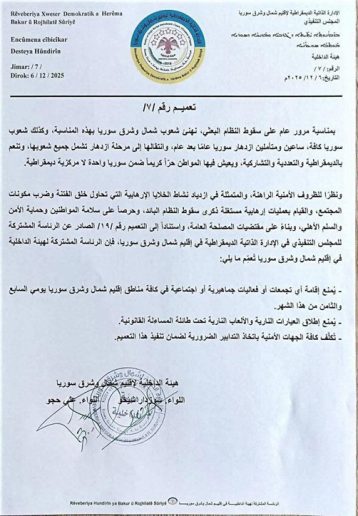
Image 1: Circular No. 7 issued by the Internal Affairs Authority of the AANES, prohibiting the organization of any gatherings or celebrations marking the fall of the regime.
3. Recurrent Restrictions on Expression and Arrests Linked to Symbolic Participation
Arrests related to the expression of political views during events marking the fall of the regime are not isolated incidents, nor are they confined to the period of enforcement of Circular No. 7 (7–8 December 2025). Rather, they form part of a broader and recurring pattern of restrictions that has emerged on multiple occasions, most notably in the period immediately following the fall of the regime and after the announcement of the political agreement between the AANES and the Transitional Government on 10 March 2025.
In the weeks following the fall of the regime, security forces affiliated with the AANES arrested a number of civilians for participating in celebratory gatherings, raising the Syrian flag, or otherwise engaging in symbolic expressions of political views regarding the ongoing transition. These cases included the arrest of Odai al-Ali in al-Hasakah on 12 December 2024 for raising the Syrian flag during a public gathering. He remained in detention for several months before being released in September 2025, without any public judicial decision or legal clarification regarding the grounds for his arrest.
In March 2025, following the announcement of the political agreement between the AANES and the Syrian Transitional Government, several arrests were documented against civilians, including children, on the basis of their participation in celebratory gatherings, criticism of the Syrian Democratic Forces (SDF) on social media, or raising the Syrian flag in public spaces. These incidents included the detention of six children in the city of al-Hasakah after they took part in a celebration related to the agreement.
It should be noted that arrests related to raising the Syrian flag continue to be reported up to the time of writing, in clear violation of the right to freedom of opinion and expression.
4. Implementation on the ground: Heavy security deployment, use of force, and arbitrary arrests
The enforcement of the ban on gatherings and celebrations took on an intensified security character. In many instances, it was accompanied by the dispersal of gatherings with live fire, searches at checkpoints, restrictions on access to public squares, and arrests carried out on the basis of participation, filming, or expressing an opinion.
STJ spoke with “Imad,” from Raqqa, who witnessed the arrest of Ahmad al-Boush on 8 December 2025 at the Clock Junction in central Raqqa, after he raised a sign reading: “It is our right to celebrate, SDF.” The witness stated:
“I saw Ahmad being physically assaulted by members of the Syrian Democratic Forces, after which he was violently arrested. During the incident, the members accused him of fueling ‘sedition’ and repeatedly asked him who ‘was behind him,’ in an effort to link his participation to external agendas.”
A statement issued by the Raqqa Bar Association also referred to the arrest of Ahmad al-Boush and to the ban on celebrations marking the anniversary of the “liberation,” describing what took place as a “violation” of residents’ rights to freedom of expression and peaceful assembly, and calling for his release and for those responsible for the violations accompanying the arrest to be held accountable.
It was further reported that members of the SDF arrested Raji Abdel-Karim al-Khalaf, from Al-Bukamal and residing in Raqqa, after he recorded the arrest of Ahmad al-Boush on his mobile phone.
In addition, local Syrian platforms documented arrest campaigns targeting children and young men who engaged in symbolic expressions related to the occasion, or who were accused of opposing the Syrian Democratic Forces. For example, on 7 December, SDF arrested the child Abdullah Jumaa al-Ghadhban and his friend Sobhi after they took a photograph holding an anti-SDF slogan in the city of al-Tabqa in rural Raqqa; the fate of both children remains unknown. The child Rudwan Osama al-Faqi was also arrested on 8 December after being beaten by members of the forces for carrying a revolution flag while playing. On 10–11 December 2025, entities affiliated with the Autonomous Administration carried out an arrest campaign targeting five young men in the town of Tal Brak, northeast of al-Hasakah, on the basis of accusations that they had written slogans critical of AANES policies on the town’s walls. In this context, Asharq al-Awsat reported on 7 December 2025 that Syrian social media accounts had circulated information about simultaneous arrest campaigns in parts of the Jazira region, allegedly affecting 17 people from al-Hasakah and Qamishli on accusations of supporting the Syrian Government and collaborating with external actors.
These incidents illustrate a coercive security pattern directed against civilians, including children, marked by the absence of adequate procedural safeguards, continued detention outside judicial oversight, and the risk that some cases may amount to enforced disappearance, in addition to the use of physical violence against minors.
This converging pattern of arrests suggests that the prevailing security-driven approach creates space for arbitrary restrictions on freedom of expression and peaceful assembly, while undermining the principles of legality and proportionality in the application of security measures.
5. Divergent views, shared concerns regarding the security-driven approach
The witnesses interviewed by STJ expressed differing political views regarding the AANES decision to ban public gatherings and celebrations related to the fall of the regime. Their assessments of the decision’s motives and underlying rationale varied: some regarded it as a precautionary, security-driven measure, while others viewed it as an unjustified restriction on freedoms. Nevertheless, their accounts converge in describing how the decision was implemented on the ground, highlighting the predominance of a security-oriented approach to managing public space during the ban, and the accompanying constraints on symbolic expression and peaceful participation. This convergence indicates that disagreement among witnesses centered primarily on interpreting the decision and its justifications, rather than on describing its practical effects, which appeared largely similar across most areas subject to the ban.
STJ spoke with “Rami,” a civil activist from Qamishli, who explained his position:
“I do not consider the ban to be justified. Any decision that contradicts the right to express one’s opinion is a wrong decision… The authorities should have protected those who wished to celebrate and respected their constitutional rights to assembly and demonstration… The security justification is unconvincing, especially since the administration has never ceased organizing gatherings in its favor. The problem is not the risk itself, but the selective way in which freedom of expression is treated.”
This testimony underscores concerns about unequal application of restrictions, whereby gatherings supportive of the authorities are tolerated, while independent or critical gatherings are restricted. From a human rights perspective, such practices raise the additional risk of discriminatory law enforcement, even where a security justification is formally invoked.
By contrast, “Mahmoud,” a resident of Qamishli, offered a more sympathetic reading of the security narrative, while nonetheless emphasizing the need for less restrictive alternatives:
“The decision may be justifiable from the standpoint of the public interest, given the sensitivity of the security situation… But it would have been possible to organize small symbolic events under the supervision of the administration instead of imposing a blanket ban… People need spaces to express themselves, and it is the authorities’ responsibility to find a safe way for that to happen.”
Similarly, “Aram,” a journalist from al-Hasakah, stated that in his view the decision may have been warranted due to possible security information and concerns associated with ISIS, but added:
“Even in the presence of potential threats, other approaches could have been pursued… such as organizing seminars or events in secure indoor spaces… A prohibition without alternatives opens the door for the decision to be perceived as a restriction on freedom of expression rather than a measure to protect public safety.”
Despite these differing perspectives, the testimonies reveal that the core human rights concern does not deny the possibility of security risks. Rather, it holds that the response adopted was not the least restrictive measure available, and that the blanket ban effectively undermined the right to peaceful assembly in the absence of demonstrated necessity.
In a similar vein, STJ spoke with “Nidal,” from Qamishli, who argued that the ban could not be justified based on broad and generalized security claims, while at the same time acknowledging that he understood some of the administration’s political and security considerations:
“What must be borne in mind is that celebrating the fall of the regime does not mean celebrating the new authorities. AANES does not want such celebrations to be interpreted as conferring legitimacy on the government in Damascus before clear political and military understandings are reached. This consideration may be understandable from a political perspective, but it does not negate people’s right to express their views on the fall of a regime that subjected Syrians to decades of suffering, without attributing to that expression other political meanings they do not intend.”
6. Legal framework: Domestic and international obligations
The sequence of events suggests a persistent pattern in which a security-first approach is prioritized at the expense of fundamental rights, whereby public gatherings and political symbols are treated as a security threat in themselves rather than as a legitimate form of civic activity that may only be restricted where a specific and verifiable risk is present. This approach effectively transforms temporary restrictions into a near-permanent condition affecting public space, expands the use of detention on the basis of political or symbolic expression, and weakens safeguards for children and minors in their interactions with security bodies.
The Social Contract of AANES guarantees a range of fundamental rights, including freedom of opinion and thought (Article 40); freedom of political thought and the rights to organization and expression (Articles 43–44); protection of children and the prohibition of violence against them (Article 55); the right to a fair trial (Article 56); the prohibition of arrest or search without judicial authorization (Article 57); and the prohibition of restricting liberty without a legal basis (Article 58). These provisions constitute a binding legal reference for local authorities and security bodies and are of particular significance given that they form an internal framework issued by the same governing structures responsible for implementing the executive decisions addressed in this report.
The human rights assessment of the documented incidents is guided by three interrelated criteria: (1) legality, meaning that any restriction must be grounded in clear and accessible law; (2) necessity, meaning that the restriction must respond to a concrete and specific risk rather than a generalized assumption; and (3) proportionality, meaning that the measure must constitute the least restrictive option available and be limited in scope, duration, and geographic application.
Based on the facts presented in this report, the blanket ban on public gatherings —combined with arrests linked to peaceful expression and the imposition of measures outside judicial oversight— does not meet the tests of necessity and proportionality. It is inconsistent with the substance of the Social Contract provisions cited above and contravenes obligations arising under the International Covenant on Civil and Political Rights, particularly Article 21 on the right of peaceful assembly and Article 19 on the right to freedom of expression. It also runs counter to the general principles set out in the Universal Declaration of Human Rights (Articles 19 and 20), which serves as a foundational normative reference for human rights at the international level.
7. Recommendations
Building on the testimonies and incidents documented in this report and the demonstrated impact of these measures on freedom of expression and peaceful assembly in areas under AANES, Syrians for Truth and Justice (STJ) considers it necessary to adopt a set of practical steps that would improve the governance of public space and strengthen the protection and respect of the fundamental rights of the population. STJ therefore recommends the following:
7.1 To AANES and its affiliated security bodies:
- End the blanket nature of bans on public gatherings and, only where strictly necessary, adopt context-specific restrictions that are limited in time and place and fully consistent with the principles of legality, necessity, proportionality, and non-discrimination.
- Cease arrests and detention based on peaceful expression or participation in symbolic activities; immediately release all those arbitrarily detained; ensure prompt judicial referral in all ongoing cases of detention; and guarantee the right to a fair trial.
- Conduct independent, credible investigations into allegations of the use of force and verbal/physical violence during apprehension or detention; ensure accountability for those responsible; and provide remedies for victims.
- Protect children and minors during interactions with security forces; refrain from detaining or interrogating them outside specialized judicial and oversight frameworks; and ensure full compliance with Article 55 of the Social Contract and relevant international child-rights standards.
- Strengthen transparency in security policies and field procedures, and issue clear guidance to security personnel on respecting fundamental rights when managing gatherings or responding to public events.
7.2 To local judicial and oversight bodies:
- Ensure effective judicial oversight of arrest, search, and security-related restriction orders, and prevent any form of detention carried out outside the law or without a reasoned judicial warrant.
- Duly consider complaints submitted by victims and their legal representatives, and enable effective and independent access to remedies mechanisms.
7.3 To civil society organizations and local media actors:
- Continue documenting cases of arrest and restrictions on freedom of expression and peaceful assembly, with particular attention to groups most at risk, including children and peaceful participants.
- Promote public awareness campaigns on fundamental rights and available legal protection mechanisms, and encourage responsible discourse that reduces polarization and hate speech related to public events.