

1. Introduction and Background:
In July 2025, Sweida Governorate witnessed a large-scale military escalation accompanied by grave violations against members of the Druze community, amidst a severe deterioration of the humanitarian situation and a simultaneous collapse of several basic services. The widespread attack resulted in mass summary executions, outrages upon personal dignity, abductions, and the displacement of up to 187,000 individuals.
The military operations were accompanied by power outages, in addition to widespread and repeated shutdowns of internet, landline, and cellular communication services. This blackout coincided with critical phases of the attack, including periods of bombardment, military incursions, and mass displacement, thereby contributing to the digital isolation of the governorate and depriving the population of access to information and communication at a highly critical time.
In armed conflict contexts, internet and communication services are not viewed merely as technical services, but rather as an essential means for civilian protection. They enable civilians to stay informed about field developments, identify safer routes, request assistance, and check on family members, as well as empowering journalists and local actors to document the truth and violations, and report them to the public. Consequently, the impact of cutting off these services during military operations is not limited to restricting access to information; it can also multiply the risks threatening the right to life and personal security.
In this report, Syrians for Truth and Justice (STJ) documents the context of the internet and communication blackouts in the Sweida Governorate during July 2025, and analyzes their humanitarian, media, and legal impacts. This analysis is based on direct testimonies from civilians, journalists, activists, and technical experts, in addition to a review of specialized open sources. Furthermore, this report seeks to assess the extent to which these blackouts comply with the State’s obligations under the law, particularly its duty to protect civilians, ensure their access to information, and uphold their right to the truth in times of conflict.
This report aims to highlight digital isolation as a dangerous pattern of practices accompanying armed conflicts, and to emphasize that ensuring the continuity of communication and internet services is a legal and humanitarian obligation directly linked to protecting lives and preventing further violations.
2. Methodology:
This report relies on an analytical approach to document the internet and communication blackouts in the Sweida Governorate during the July 2025 attack, and to assess their impacts.
The report is based on in-depth interviews with eight witnesses, conducted in person or via secure communication channels. Informed consent was obtained from the witnesses after clarifying the voluntary nature of their participation and how the information they provided would be used, including in the publication of this report. Six of the eight participants requested anonymity and the omission of identifying details, fearing reprisals against themselves or their families. Accordingly, this report uses pseudonyms to refer to them when quoting excerpts from their testimonies.
The report corroborated these testimonies through a review of specialized open sources, including reports and updates issued by the United Nations Office for the Coordination of Humanitarian Affairs (OCHA), as well as analyses and data from digital rights organizations such as Access Now and SMEX. These sources were utilized to establish the timeline and scope of the blackouts.
Furthermore, the report includes a technical analysis of the nature of the blackouts, distinguishing between disruptions resulting from potential infrastructure damage and blackouts of a centralized or systematic nature, without asserting unsubstantiated causes. The report also employs a legal analysis in light of the rules of International Human Rights Law (IHRL) and International Humanitarian Law (IHL) relevant to the protection of civilians and the right to access information.
3. Timeline and Scope of Internet and Communication Blackouts:
Cross-referenced data indicates that the Sweida Governorate experienced a recurring pattern of internet and communication blackouts between July 12 and 20, 2025. This coincided with critical phases of the military escalation, including bombardment, military incursions, killings, abductions, and mass displacement. According to testimonies from civilians and journalists inside the governorate documented by STJ, a near-total blackout began in some areas on July 12, encompassing cellular internet, broadband (ADSL), and both cellular and landline voice communications, with limited and weak periods of restoration that did not enable effective communication. Accounts indicate that the blackout varied temporally and geographically, yet it was characterized by its recurrence and the minimal level of service upon its return, particularly during peak hours of field operations.
These accounts align with technical monitoring data, which demonstrated a sharp and simultaneous drop in connectivity in Sweida during the same days (see Figure 1). In this context, digital rights organizations (including Access Now and SMEX) documented recurring patterns of internet and communication shutdowns, emphasizing that their impacts go beyond the disruption of a technical service; practically, they lead to the isolation of affected communities, undermining their ability to access vital information, request assistance, and communicate safely. Furthermore, these organizations warned that cutting off communications during periods of escalation obstructs humanitarian work, prevents the direct documentation of violations, and weakens public oversight and accountability, thereby exacerbating the vulnerability of civilians in moments of peril.
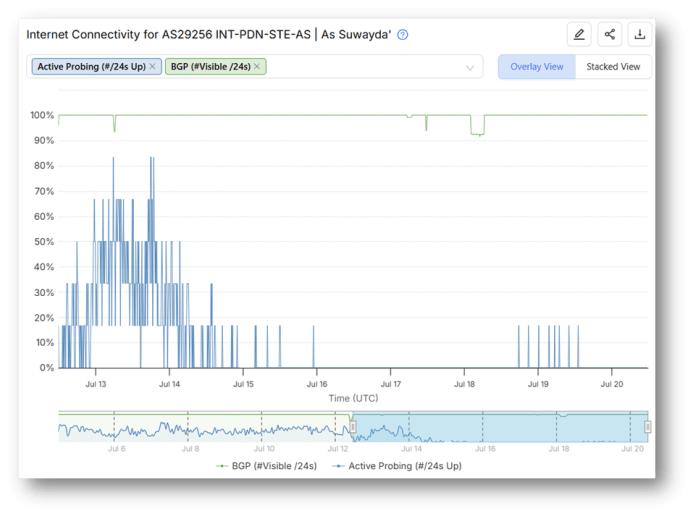
Figure 1: Monitoring of internet and communication blackouts in Sweida from July 12 to 20, 2025. Source: IODA platform for measuring and monitoring internet outages worldwide.
While the Syrian Ministry of Communications and Technology, headed by Abd al-Salam Haykal, attributed the communication blackouts to being “exclusively the result of technical and logistical difficulties,” particularly fuel shortages, testimonies and technical analysis reveal strong indicators that undermine this explanation. In his testimony, based on direct monitoring during the blackout period, a communications and information security expert stated that the simultaneous disruption of independent communication systems —including cellular and landline internet, as well as voice communications— is difficult to justify by a single technical factor or fuel shortages alone. This is particularly true given the reliance of large segments of the communication infrastructure on solar power, and the partial restoration of services during daylight hours. In this context, communications and information security expert Alaa Ghazal told STJ:
“A near-total and simultaneous blackout in internet and communication services was recorded, encompassing systems that are supposed to be technically independent. Landline and cellular internet networks via the ‘Syriatel’ and ‘MTN Syria’ networks were suspended, in addition to the disruption of landline telephone systems. Technically, landline telephones are supposed to operate independently of internet services, and the Syriatel and MTN networks are separate systems. This makes the disruption of all these services at a single moment a clear indicator of a centralized shutdown, rather than the result of a local malfunction or a shortage of fuel or power.”
Ghazal added that the pattern of internal disconnection within the telephone network reinforces this hypothesis, explaining that:
“During the monitoring period, it became apparent that landline telephone services were disabled at the governorate level. It was not possible to make calls outside the area, while communication remained possible only between lines connected to the same telephone exchange. This demonstrates that the exchanges were operating, and that the blackout occurred by disabling the connection between the exchanges, not as a result of a technical malfunction or power shortage. According to these data, the landline telephone blackout was most likely executed by a centralized decision.”
In this context, independent sources documented the persistent weakness of the service following its official restoration, with recurrent prolonged outages. The “Active Probing” signal on the IODA platform, which monitors global internet outages, reveals that the connectivity level in Sweida —on July 29, 2025— did not exceed a maximum of 50% of normal rates. This indicates that internet access remained heavily disrupted or practically unusable in the Sweida Governorate.
The convergence of testimonies and technical monitoring concludes that the internet and communication blackout in Sweida during July 2025 was not a short-term, incidental event. Rather, it assumed a recurring pattern concurrent with the military operation, thereby contributing to deepening the information isolation of the governorate during a critical period.
Furthermore, the internet and communication blackouts in the Sweida Governorate cannot be viewed in isolation from a broader context. Analyses demonstrate that communication shutdowns are frequently employed by governments in situations of conflict or internal disturbances as a tool of control, to isolate populations, control the flow of information, and restrict documentation and communication during critical moments. These practices are often accompanied by security or military escalations and contribute to creating a closed information environment that exacerbates the vulnerability of civilians and undermines protection and accountability mechanisms, in contravention of States’ obligations under International Human Rights Law (IHRL).
4. The Humanitarian Impact of Internet and Communication Blackouts:
According to the analysis of the testimonies documented by STJ and what it monitored on specialized digital platforms, the internet and communication blackout in Sweida Governorate during the July 2025 attack constituted a decisive factor in exposing civilians to grave risks. Its impact was not limited to disrupting communication; rather, it extended to affecting the ability to make critical decisions regarding survival, displacement, family reunification, and requesting assistance amidst a large-scale military escalation. This blackout occurred at a highly sensitive time, coinciding with the bombardment, military incursions, and mass displacement, making digital isolation a multiplier of humanitarian harm.
Multiple testimonies reported that the communication blackout created a state of “ignorance” [an information void], where residents were unaware of what was happening beyond the direct hearing range of the shelling, and were unable to determine the directions of the attack or the areas that had become unsafe. Witness “Hanadi” (from Sweida city) stated:
”Because of the internet and electricity blackout, the attackers reached the city while its residents knew nothing. We could hear the sounds of shells and tanks, but we did not know what was happening.”
She explained that this lack of knowledge about unfolding events prompted some civilians to remain in their homes despite the imminent danger, a fact corroborated by most of the witnesses STJ spoke with. Hanadi added:
”Because people did not know what was happening, many of them stayed in their homes and did not leave, so they were executed inside their houses.”
Samih, a human rights and civil activist from the village of Dhibin, confirms this, saying:
”Cutting off communications played a major role in causing massacres that targeted civilians, including women and children. The victims were killed inside their homes because they did not know what was happening around them, and because no party was able to warn them of the danger in a timely manner.”
Furthermore, in the absence of communications, residents were forced to displace in a disorganized and chaotic manner, without knowing the safe routes or the areas witnessing clashes. Witness Youssef (from Sweida city) reported that the withdrawal of residents began chaotically due to fear, and that the city appeared “as if devoid of life,” amidst the smoke and continuous shelling, without any ability to exchange information or warn of dangers.
Communications and information security expert Alaa Ghazal affirmed that the impact of the internet and communication blackout was not limited to disrupting communication, but left broad humanitarian repercussions that affected the safety of civilians and their ability to protect themselves and make safe decisions during the escalation. In this context, Ghazal stated:
”Cutting off communications produced direct humanitarian impacts. Civilians were unable to communicate to check on their families, and residents of dozens of villages were forced to displace during the attack without the ability to know the safe routes or the locations of clashes. The absence of real-time information raised levels of fear, anxiety, and rumors, leaving civilians without any reliable source to follow developments.”
Likewise, the communication blackout led to widespread family separation during displacement, whether within the governorate or between them and relatives in other areas or abroad. Hanadi said:
”As a family, we were scattered, and due to the lack of communication, we were separated and could not find one another.”
She noted that the continued internet blackout after returning home, or its weak restoration, exacerbated psychological harm, especially with expatriate relatives who later saw video clips of the violations without being able to communicate and check on their loved ones:
“The internet shutdown caused significant psychological distress to our relatives abroad… they feared for our safety and were unable to contact us in any way.”
For her part, lawyer Reem (from Salkhad city) described the experience of losing daily communication in detail, saying:
”No one knew the condition of others except those they saw right in front of them. When my phone started picking up very weak coverage that did not allow for calls, I would go up to the roof of the house, and only in a specific corner could I catch a weak signal to send a short message to reassure my siblings… A WhatsApp message would take five minutes to be sent.”
She added that this experience left a long-lasting psychological impact:
”Today, six months later, an internet or communication blackout has become a bad omen in every sense of the word, because it brings back the fear of a recurrence of what happened.”
In addition to the above, the absence of communications also affected the ability to request assistance and transport the wounded. Witness Ammar (from Samma Al-Bardan village) reported:
”The internet was completely cut off, and it was not limited to just this, but also included cellular coverage networks… No one knew anything about anyone else anymore.”
He explained that the lack of information forced residents to search for the missing themselves:
”When someone went missing, the residents were forced to go out into the streets and search among the corpses… Many people died because they were delayed in knowing the reality of the situation in the areas close to the fighting.”
He pointed out that this blackout “increased the death toll,” asserting:
”I believe that the availability of internet and communications at that time would have saved many lives.”
These testimonies demonstrate that the internet and communication blackout during the attack on Sweida Governorate was not a neutral occurrence; rather, it contributed to exposing civilians to direct risks, prevented them from making informed decisions, and led to chaotic displacement, delayed medical rescue, and ongoing psychological trauma. This confirms that communications, in the context of armed conflict, constitute an essential means of protection, and that cutting them off during moments of escalation is a dangerous factor that exacerbates the vulnerability of the population and undermines their right to life and personal security.
5. The Impact of Internet and Communication Blackouts on Media, Documentation, and the Spread of Disinformation:
Internet and communication blackouts during crises and conflicts constitute a primary factor hindering the ability of journalists and civic actors to relay and verify information, and to document violations in real time. International organizations concerned with human rights and freedom of expression have warned that network shutdowns undermine the media’s capacity to perform its fundamental functions, including disseminating reliable information, fact-checking, monitoring the actions of warring parties, and providing vital information to affected communities. They also restrict freedom of expression and civic organizing, and prevent the documentation of gross human rights violations, especially in times of conflict, when the real-time broadcasting of information relies on digital connectivity.
Furthermore, the United Nations Educational, Scientific and Cultural Organization (UNESCO) warned that internet blackouts weaken the capacities of public information systems to provide people with news and verify it, which facilitates the spread of unreliable content and disinformation, and increases confusion and uncertainty among the public.
The member states of the Freedom Online Coalition (a coalition of states committed to advancing internet freedom and human rights in the digital space, including freedom of expression, access to information, and opposing internet shutdowns) also expressed in a joint statement their concern that blackouts during armed conflicts impede access to vital information, restrict independent reporting and international monitoring of the conduct of parties to the conflict, exacerbate humanitarian crises, and complicate the coordination of aid.
In the context of Sweida Governorate, where the internet blackout coincided with the peak of military operations in July 2025, there was a significant paralysis in the capacity of local media and human rights activists to relay developments and verify facts in real time. This allowed a portion of the violations to remain undocumented concurrently, and event coverage suffered delays that caused the spread of misleading and inflammatory information, as reported in the testimonies of local journalists involved in documenting the events.
Likewise, local journalists reported that the internet and communication network blackout forced them to rely on alternative and limited means, such as satellite internet or intermittent text messages. Media professional Diaa Al-Sahnawi, editor-in-chief of the local Al-Rased network, stated:
”The attack coincided with the internet blackout and the degradation of communication and electricity services. I was forced to go to a hall where the owner had satellite internet, and rely on what correspondents from Sweida city sent intermittently… I would send breaking news via messages to a person outside the governorate to publish it before the network went completely cut off.”
It was not possible to broadcast photos, videos, or regular updates, leading to an absence of real-time coverage of the events. In this information vacuum, rumors spread widely regarding the fall of villages or the entry of forces into specific areas, without the local media being able to verify or correct them. Al-Sahnawi explained:
”The internet and communication blackout created a state of terror among the residents… Rumors acted as a force multiplier for the attacking forces, as rumors circulated about villages having fallen, while in reality they were still under the control of Sweida’s residents. This situation misled many residents and pushed them to make decisions based on unconfirmed information, which exacerbated the state of panic, displacement, and danger.”
This disruption led to delays in documentation, with images and video footage emerging only after connectivity was restored. Journalists noted that this delay allowed for the obfuscation of some facts, and hindered efforts to verify casualty numbers and the sequence of events during the first days of the attack. Journalist Karim (from Sweida city) said that what had happened began to surface after a partial and delayed restoration of connectivity:
”When the internet service returned weakly, we began to see the traces of destruction and corpses in the streets. However, it was not possible to relay or document what we were seeing immediately.”
In the context of the impact on documentation, communications and information security expert Alaa Ghazal provided an analytical reading based on his previous experience in Syria, considering that cutting off the internet in areas witnessing tensions or military operations does not occur in isolation from restricting the transfer of information and direct documentation. In this framework, Ghazal stated:
”Cutting off communications is not a new behavior in Syria. Since 2011, this pattern has accompanied numerous military operations, most notably during the Assad forces’ incursions into Daraa, Eastern Ghouta, and Homs, as well as during the Turkish military operations in the north under ‘Olive Branch’ and ‘Peace Spring’.”
Ghazal continued:
”The internet, particularly the live broadcasting service, is considered a central tool for documenting violations and conveying the voices of the victims. When networks are cut off, information remains the monopoly of official or auxiliary media, which operates in Syria as state media unconcerned with the voices of civilians. The materials that emerged after the service was restored demonstrate that the blackout effectively contributed to preventing the real-time documentation of violations and restricting the dissemination of information in real time, which limits the possibility of generating local or international pressure.”
These testimonies demonstrate that the internet and communication blackout in Sweida was not limited to the disruption of a technical service but constituted a direct restriction on the freedom of the media and documentation. It contributed to obscuring violations from public opinion at the time, and allowed the spread of rumors and disinformation. This confirms that cutting off communications during armed conflicts undermines the citizens’ right to the truth, and obstructs subsequent accountability efforts.
6. The Limitation of Communication Alternatives: Satellite Internet in the Context of a Fragile Infrastructure:
Documented testimonies reveal that the internet and communication blackout was accompanied by a severe limitation in communication alternatives, foremost among them satellite internet, within the context of a telecommunications infrastructure that has already suffered from fragility for years. Witness “Reem” reported that communication was almost non-existent, explaining:
“The information that did reach us came through Starlink services, not local networks. Had the population not been cut off from the internet, far more atrocities might have come to light than those that later emerged.”
This account indicates that very limited sources of satellite internet constituted an almost exclusive window for the circulation of information during the blackout period; however, it remained confined to a narrow scope and inaccessible to the majority of the population. In the same context, witness “Ammar” stated:
”There were only a very small number of people in Sweida who possessed satellite internet.”
These testimonies gain significance when placed within the broader context of the telecommunications reality in Syria. According to technical expert Alaa Ghazal:
“The telecommunications infrastructure in Syria suffers from widespread deterioration accumulated over 14 years as a result of military operations, the destruction of towers and telephone exchanges, and the theft of cables. Furthermore, the Ministry of Communications in the Transitional Government has not made any substantial improvements to the services; rather, it has moved toward restricting internet access by criminalizing the use of satellite internet for both individuals and commercial entities. These restrictions increase the difficulty for civilians to access information and restrict their ability to communicate during crises —moments when communications are supposed to be a tool of protection, not a tool of blocking.”
The Transitional Government had criminalized the use of satellite internet without obtaining a special license, particularly the “Starlink” service, justifying these measures with regulatory and security considerations. It confiscated satellite internet stations during specific confiscation and inspection campaigns, and asserted that the use or importation of satellite internet devices constitutes a legal violation subject to accountability.
7. Legal Characterization of Internet and Communication Blackouts During the Attack:
The internet and communication blackout in Sweida Governorate during the July 2025 attack is evaluated in light of International Human Rights Law (IHRL) and International Humanitarian Law (IHL), as a measure that directly impacted fundamental rights, particularly within the context of an armed conflict and a large-scale military escalation.
7.1. International Human Rights Law:
International Human Rights Law guarantees the right to freedom of expression, which includes receiving and imparting information without unjustified restrictions. Today, the internet and modern means of communication constitute primary tools for exercising this right. Consequently, any comprehensive or large-scale restriction on communications must satisfy strict conditions: legality, necessity, and proportionality. The International Covenant on Civil and Political Rights (ICCPR) guarantees this right, including the freedom to seek, receive, and impart information, under Article 19(2). Furthermore, Article 19(3) permits restrictions on this right only if they are provided by law, and are necessary and proportionate to achieve a specific legitimate aim. As a State Party to the aforementioned Covenant, Syria is bound by it, particularly as Article 12 of the Constitutional Declaration affirms that all rights and freedoms stipulated in the international human rights treaties, covenants, and conventions ratified by Syria constitute an integral part of this Constitutional Declaration. This is in addition to the provision of Article 13 of the said Declaration, which asserts that “the State guarantees the freedom of opinion, expression, media, publishing, and the press.”
In the case of Sweida, the broad scope of the blackout, its coincidence with the military operations, and its extension to encompass independent communication systems, point to a general and collective restriction of the right to access information, without the announcement of a clear legal framework or specific measures demonstrating the fulfillment of the necessity and proportionality requirements. This pattern indicates a collective and indiscriminate restriction of the right to access information, placing it in contravention of the requirements of Article 19 of the Covenant.
This assessment is reinforced in light of General Comment No. 34 on Article 19 (2011) issued by the Human Rights Committee, which affirmed in paragraph (43) that the Covenant protects all forms of expression and the means of their dissemination, including electronic and internet-based communication systems, and that States parties may not prohibit or impede internet access, whether completely or partially. Accordingly, the large-scale disruption of the internet during the military escalation in Sweida is deemed a measure that contravenes the binding official interpretation of Article 19.
The legal impact of the blackout is not confined to freedom of expression alone, but extends to the right to life enshrined in Article 6 of the Covenant. General Comment No. 36 on Article 6 (2018) affirmed that States’ obligations are not limited to refraining from the arbitrary deprivation of life, but also include positive obligations to take measures to address the general conditions that may threaten life. In light of the documented facts, the communication blackout prevented receiving warnings, identifying danger zones, requesting medical rescue, or making safe displacement decisions, which contributed to exposing civilians to grave risks. Therefore, the blackout in this context infringes upon the conditions for protecting the right to life and undermines the positive obligations incumbent upon the State.
7.2. International Humanitarian Law:
In the context of armed conflicts, International Humanitarian Law imposes a positive duty on parties to the conflict to protect the civilian population and take all feasible precautions to minimize harm to them. Article 57 of Additional Protocol I to the Geneva Conventions stipulates a fundamental principle: the necessity of taking constant care to spare civilians the dangers of military operations. This obligation is not limited to the moment an attack is executed, but extends to the planning phase and the choice of means and methods.
Article 57(2)(c) assumes particular importance in this context, as it requires that effective advance warning be given of attacks which may affect the civilian population, unless circumstances do not permit. This obligation implies that the provision of effective means of communication is an essential element in enabling civilians to receive warnings, take precautionary measures, and flee danger zones. Consequently, cutting off the internet and communications during military operations, particularly when coinciding with bombardment or military incursions, practically undermines the ability to implement this obligation and weakens the effectiveness of any potential warning.
Cutting off the internet and communications during military operations, when imposed in a general and indiscriminate manner, raises serious concerns regarding its compliance with the principle of the protection of civilians. This is reinforced in light of Article 27 of the Fourth Geneva Convention, which guarantees protected persons the right to respect and protection from all acts of violence or threats. Digital isolation, which prevents warnings, communication, and requesting assistance, can be viewed as a measure that exacerbates the risks of violence rather than mitigating them, especially in an environment witnessing a large-scale military escalation.
Furthermore, cutting off communications and the internet network represents a direct undermining of the legal obligation to take constant care in the conduct of military operations to avoid inflicting harm on the civilian population. This measure deprives the parties to the conflict of the ability to take all feasible precautions to avoid civilian casualties or injuries, which constitutes a clear contradiction of the requirements of Rule 15 of Customary International Humanitarian Law. ‘Digital isolation’ leads to the creation of an operational environment lacking transparency and prevents civilians from taking precautionary measures for survival, thereby increasing the likelihood of indiscriminate or disproportionate attacks.
Moreover, the Special Rapporteur on the promotion and protection of the right to freedom of opinion and expression, Irene Khan, affirmed that access to diverse and verifiable sources of information is a fundamental human right. It is a fundamental necessity for people in conflict-affected societies, and is, in fact, a “right to survival.” It is also crucial for resolving conflicts, exposing human rights violations, and pursuing investigation and accountability. Access to the internet is considered vital, particularly in conflict-affected contexts where it may be the only means of connecting with the outside world.
7.3. The Right to the Truth and the Right to Access Information:
In addition to the above, the Human Rights Council, in its resolution A/HRC/RES/32/13 of 2016 on “The promotion, protection and enjoyment of human rights on the Internet,” affirmed its unequivocal condemnation of measures aiming to intentionally prevent or disrupt access to or dissemination of information online. This resolution assumes particular importance in the case of Sweida, where the communication blackout hindered real-time documentation and the transmission of information during the first days of the attack, which impacted the right to the truth and consequently violated the right to life and personal security.
The right to the truth is an internationally recognized right, particularly in the context of gross violations and acts of violence associated with armed conflicts. The United Nations has enshrined this right through successive resolutions issued by its various bodies, considering that victims, their families, and society as a whole have an inherent right to know what happened, its circumstances, and the identity of those responsible. This right is not limited to post-conflict phases or judicial accountability; rather, it extends to encompass the right to access information at the time the violations occur, enabling real-time documentation and preventing the obfuscation of facts.
The right to the truth is closely linked to the right to access information, as the latter is the practical and essential condition for exercising the former. Depriving the population of communication means and the internet during periods of escalation prevents the very production of the truth in its initial moment, and leads to information gaps that are difficult to fill later. This was affirmed by the Office of the United Nations High Commissioner for Human Rights (OHCHR), emphasizing the duty of States to ensure the preservation and dissemination of information related to violations, rather than restricting or blocking it.
In this framework, the internet and communication blackout in the Sweida Governorate can be viewed as a factor that impeded the exercise of the right to the truth at a critical moment. The blackout prevented the timely documentation and dissemination of violations, delayed the arrival of reliable information internally and externally, and contributed to a portion of the facts remaining invisible or unverifiable during the first days of the attack. This undermines the ability of victims and society to demand accountability, and subverts the right to an effective remedy and reparation, which in turn depend on knowing the truth as a prerequisite.
8. Recommendations:
The documented facts in this report indicate that the internet and communication blackout infringed upon the fundamental rights of the people of Sweida, which are protected under international law, particularly the right to life, freedom of access to information, and the right to the truth. It contributed to exposing civilians to grave risks and raised serious concerns regarding compliance with the duties to protect civilians and take precautions during military operations. Accordingly, this report concludes that this blackout raises potential legal responsibilities that warrant investigation and accountability. Consequently, Syrians for Truth and Justice (STJ) recommends the following measures:
8.1. To the Transitional Authorities:
- Immediately refrain from completely or repeatedly cutting off or disrupting internet and communications, particularly during military operations or security tensions, and ensure continuous access to means of communication as an essential element for civilian protection.
- Ensure the existence of a clear and public legal framework for any potential exceptional restriction on communications, provided it is time-bound, necessary, proportionate, and subject to judicial review. Ensure that documentation and media are not obstructed, and protect journalists and local actors from any measures that prevent the timely transmission of facts or documentation of violations.
- Take effective preventive measures to ensure civilians are empowered to access vital information during crises, including early warnings, safe displacement routes, and the ability to request urgent medical intervention.
- The National Commission of Inquiry into the Sweida events to conduct an independent and transparent investigation into the decisions to cut off internet and communications during July 2025, publish its findings, and determine administrative or criminal responsibilities where appropriate.
- Clarify the legal and compelling reasons for prohibiting the possession or use of satellite internet, including Starlink devices, through public and detailed decisions, rather than relying on general or vague formulas such as “regulatory or security considerations,” while specifying the scope and duration of the ban and making it subject to review and appeal in accordance with due process of law.
8.2. To the United Nations, International Mechanisms, and Donors:
- Monitor and track internet and communication blackouts in Syria, particularly in contexts of military escalation, and consider them potential indicators of grave risks to civilians.
- Include digital isolation within human rights monitoring reports and mechanisms as a multiplier of humanitarian harm, and a component affecting the right to life, freedom of expression, and documentation.
- Demand that Syrian authorities provide official clarifications regarding the reasons for any large-scale blackout and the extent of its compliance with their obligations under international law.
- Support secure and alternative communication initiatives in humanitarian contexts, in a manner that considers the safety of users and does not expose them to prosecution.
- Enhance support for independent documentation by empowering local actors with tools for the secure preservation of digital evidence and the collection of testimonies in high-risk environments.