
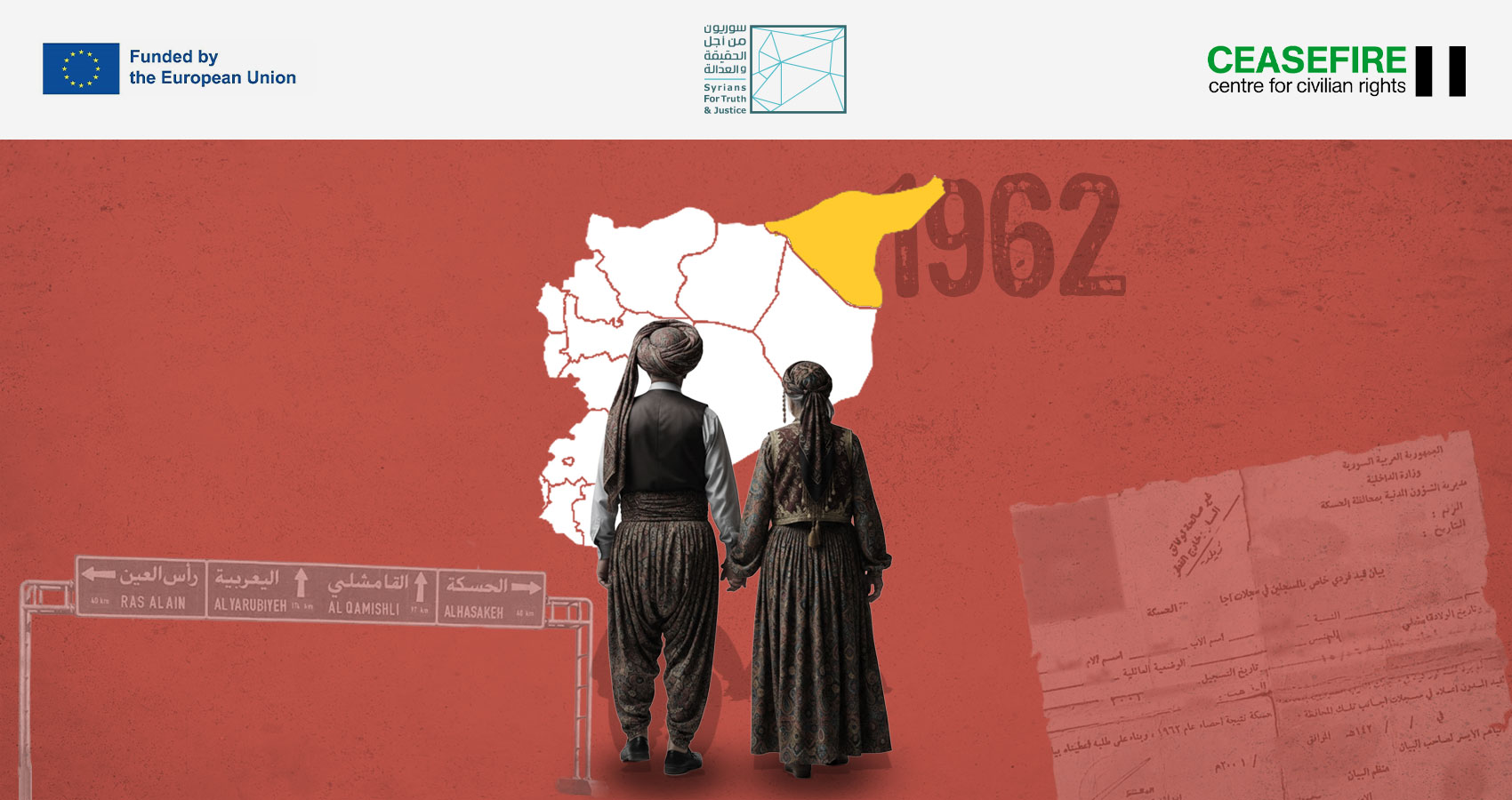
This publication was funded by the European Union, and in partnership with the Ceasefire Centre for Civilian Rights. The contents of this publication are the sole responsibility of Syrians for Truth and Justice – STJ/ the publisher and do not necessarily reflect the views of the European Union or the Ceasefire Centre for Civilian Rights.
1. Executive Summary
On 5 October 1962, the “Separation Government,” which ruled Syria following the end of the Syrian-Egyptian union, issued Legislative Decree No. 93 mandating an “exceptional census” to be carried out exclusively in al-Hasaka Governorate, under the pretext of identifying “foreign infiltrators” inside the country.
Within a single day, tens of thousands of Syrian Kurds in al-Hasaka were stripped of their nationality through an administrative process that lacked even the most basic standards of fairness and equality. Since then, this exceptional measure has remained a tragic turning point whose legal and human consequences continue sixty-three years later.
Those affected were divided into categories: individuals who retained their nationality; “al-Hasaka Foreigners” (Ajanib), registered with red identity cards; and “Unregistered” persons (Maktumeen), denied any legal recognition of their existence.
Although Legislative Decree No. 49 of 2011 granted nationality to the category of “al-Hasaka Foreigners” (Ajanib), its implementation was marred by significant obstacles and excluded the “Unregistered” (Maktumeen), leaving thousands of families outside the scope of citizenship.
In the context of the current transitional phase following the fall of the Assad regime and the beginning of institutional reconstruction, this issue has gained heightened importance. Ensuring the inclusion of those deprived of nationality —and acknowledging and remedying the harm they endured— constitutes a genuine test of the seriousness of the transitional justice process and a key benchmark for redefining Syrian citizenship on the basis of equality and non-discrimination.
This expanded report demonstrates that the census was not an isolated incident, but rather part of a systematic policy of ethnic discrimination practiced by Syrian authorities against the Kurds. This later manifested in large-scale Arabization projects —commonly referred to as the “Arab Belt”—as well as restrictions on the Kurdish language and culture, and the denial of property rights, employment, education, and military service.
The deprivation of nationality denied successive generations of Kurds fundamental rights such as access to formal education, the registration of marriages and children, property ownership, travel, and even the basic legal recognition of their existence.
The eighteen testimonies on which this report is based document the profound human impact of these policies, revealing nationality deprivation as a form of collective punishment that entrenches legal, social, and psychological exclusion across time. Many witnesses described feeling “invisible,” recounting generations born and deceased without identity, in the absence of any viable pathway to remedy their status.
The report shows that the exceptional census amounted to a mass denationalization exercise carried out in a single day without legal safeguards, creating an inherited condition across generations due to the difficulty of registering marriages and lineage. It further demonstrates that Decree No. 49 of 2011 addressed only a limited part of the problem, leaving a significant legal gap.
The report documents continued denial of education, employment, property ownership, and freedom of movement, alongside ongoing discriminatory policies, rendering those affected effectively without legal recognition in their own country.
In line with transitional justice standards and requirements for reparations and guarantees of non-recurrence, the report calls for an explicit official acknowledgment of the 1962 census as a discriminatory measure and for restoring nationality to all affected individuals and their children without security vetting or onerous procedures. It also calls for retroactive legal remedies, including the registration of marriages, lineage, and property, and for amending the nationality law to ensure full equality between men and women in conferring nationality to their children.
The report further recommends establishing an independent national mechanism for reparations and follow-up within the framework of transitional justice, ensuring redress for victims and contributing to the construction of a new social contract grounded in equality and the rule of law.
2. Introduction
Al-Hasaka Governorate represents a microcosm of Syria’s ethnic and cultural diversity, bringing together Kurds, Arabs, Syriacs, Assyrians, Armenians, Chechens, and others. Kurds constitute the country’s largest non-Arab ethnic minority.[1] Yet this diversity —historically a source of richness— gradually became a pretext for exclusion and discrimination, as successive Syrian authorities adopted policies targeting Kurds specifically in their identity and legal status.
On 5 October 1962, the Separation Government[2] conducted an “exceptional census” in al-Hasaka Governorate pursuant to Legislative Decree No. 93 of 23 August 1962, under the pretext of verifying residents’ origins and distinguishing “original Syrians” from “infiltrators” arriving from Turkey or Iraq. Carried out in a single day, the census resulted in stripping thousands of Kurds of their Syrian nationality, categorizing them as “al-Hasaka Foreigners” (Ajanib) or “Unregistered” (Maktumeen).
Far from being a mere administrative measure, the census constituted a foundational step in a systematic policy aimed at weakening the Kurdish presence in northeastern Syria, whose effects continued through later initiatives such as the “Arab Belt” project, restrictions on the Kurdish language, and the confiscation of agricultural lands.
The census deprived thousands of Kurdish families of their most basic civil, political, and social rights. Generations were born without identity, barred from formal education, unable to register marriages, own land, travel, or access public-sector employment. Over time, denationalization evolved into an inherited condition of legal and social marginalization, deepening feelings of isolation and non-belonging among large segments of Syria’s Kurds.
Although Legislative Decree No. 49 of 2011[3] granted nationality to the category of “al-Hasaka Foreigners” (Ajanib), the “Unregistered” (Maktumeen) remained excluded from any meaningful remedy, and their suffering persisted in the absence of a comprehensive legal framework to regularize their status.
This report, issued on the sixty-third anniversary of the census, seeks not merely to revisit the past but to examine its enduring legacy amid the country’s current political transition. With the start of the transitional phase and the formation of new institutions, the report underscores that addressing the legacy of nationality deprivation is not a historical exercise but an urgent transitional justice obligation, one requiring official acknowledgment, reparations, and the reintegration of affected individuals into the national registry as an essential step toward building a new Syrian state grounded in equality, non-discrimination, and the rule of law.
3. Methodology
Syrians for Truth and Justice (STJ) prepared this report on the basis of 18 in-depth interviews with individuals deprived of nationality, whether directly or as a result of their parents’ denationalization under the 1962 census. Witnesses were drawn from al-Hasaka and Qamishli, including 10 participants from al-Hasaka and 8 from Qamishli. Their ages ranged from 22 to 49, reflecting the intergenerational nature of nationality deprivation. The interviews included both women and men, allowing for observation of gender-differentiated impacts of denationalization.
The testimonies were collected through direct interviews and remote interviews conducted via secure, encrypted communication channels to safeguard participants’ confidentiality. All data and information provided by witnesses were stored within protected digital systems, and the team applied strict confidentiality and data-management protocols to ensure that no information could be accessed or shared beyond the narrow scope of the research, thereby preventing any unauthorized disclosure that could put participants at risk.
The interviews included systematic documentation of key demographic and contextual details —such as age, location, and family background— to enable an accurate understanding of the nature and recurring patterns of violations. Informed consent was obtained from all participants after explaining the voluntary nature of their involvement and how the information they shared would be used, including the inclusion of excerpts from their testimonies in this report. Sixteen witnesses requested that their identities or any identifying details be withheld. Accordingly, the report uses pseudonyms when referring to these individuals and presenting their accounts.
4. Background on the 1962 Exceptional Census and Its Implementation
The exceptional census conducted in al-Hasaka Governorate in 1962 stands as one of the most consequential administrative actions in modern Syrian history. The census was carried out in a single day, without adequate prior notice or legal safeguards, and was overseen by joint field committees from the Ministry of Interior and the Civil Registry Directorate in al-Hasaka, with the participation of the governor, local police, and village mukhtars (local village heads). Available documents and witness accounts indicate no meaningful review mechanism or judicial oversight of the committees’ work or decisions, leaving those affected with no avenue for appeal at the time.
The census was implemented through direct field visits: census teams visited towns and villages to register only those residents physically present in their homes on that day. To retain their nationality, Kurdish families were required to provide proof of residence in Syria prior to 1945, such as property deeds or ration cards, requirements that were inaccessible to most rural residents due to weak formal registration systems, lack of information, and the extremely limited timeframe.[4]
The committees also relied on statements from local mukhtars, who were granted broad discretionary authority to affirm or deny a family’s residency. These powers resulted in widespread arbitrariness and personal exploitation, as census outcomes were at times influenced by personal relations or political allegiances, further heightening the discriminatory nature of the process. By the end of that single census day, the population of al-Hasaka had been divided into three main categories:
- Syrian citizens: Those who retained full Syrian nationality and whose names remained unchanged in the civil registry.
- “Al-Hasaka Foreigners” (Ajanib): Individuals whose names were removed from the citizen registry and transferred to a separate record. They were issued distinctive red identity cards bearing the phrase “Not listed among Syrian Arabs pursuant to the 1962 census.” These cards did not grant the right to travel, own property, or access public employment, functioning instead as a marker of discrimination.
- “Unregistered” (Maktumeen): Individuals whose names were not recorded in any registry and who received no official documents whatsoever. Legally, they were not considered even as “foreigners,” but rather as persons with no civil existence, lacking national numbers, birth certificates, or death certificates.
This classification produced, in the span of a single day, a legal hierarchy within the Kurdish community in Syria’s Jazira region, rendering part of the population “citizens with diminished rights” and another part “citizens who do not exist.”
Exclusive data obtained by STJ from official sources within the Civil Registry Directorate of al-Hasaka indicate that, by 2011, more than 517,000 Kurds had been deprived of nationality: 346,242 (67%) classified as Ajanib and 171,300 (33%) as Maktumeen.[5]
5. Transitional Justice and Avenues for Redress
The deprivation of nationality that began with the 1962 al-Hasaka census constitutes one of the deepest forms of structural violence in modern Syrian history. It did not target individuals for their actions, but an entire ethnic community, transforming legal identity from a natural right into an instrument of discrimination. Accordingly, no transitional justice process in Syria can be considered complete without explicitly addressing this issue, as it represents a clear example of state-engineered exclusion and a cornerstone for reforming the concept of citizenship.
The risk of reproducing discrimination during the transitional period remains high unless corrective measures are accompanied by institutional reforms that prevent the use of nationality as a tool of domination or exclusion, regardless of changes in political authority.
As Mustafa Abdulkarim Mustafa, a researcher at Al-Furat Center for Studies, explains:
“Transitional justice in Syria cannot be achieved unless the issue of those deprived of nationality is placed among its top priorities. We are speaking of thousands of people, not a small, limited group. Some were born and died without ever knowing what citizenship means, without ever feeling it. All doors and pathways were closed before them.”
This requirement aligns with the Constitutional Declaration issued in 2025, which enshrines the principles of equality and non-discrimination. Article 10 affirms that “citizens are equal before the law in rights and duties, without discrimination on the basis of race, religion, sex, or lineage.” Article 12 further provides that: “1. The State shall safeguard human rights and fundamental freedoms and shall guarantee citizens’ rights and liberties. 2. All rights and freedoms contained in international human rights treaties ratified by the Syrian Arab Republic shall form an integral part of this Constitutional Declaration.” Accordingly, the transitional authorities are obligated to review past legislation and policies, including the effects of the 1962 census.
Thus, annulling the consequences of the census and compensating those affected serves as a genuine test of the transitional government’s commitment to constitutional justice and to upholding the supremacy of international human rights law over earlier discriminatory measures.
5.1. Official Acknowledgment of the Violation
The first step in any justice process is acknowledging that the 1962 exceptional census was not an “administrative error,” but an intentional violation of the right to nationality and of the constitutional principle of equality before the law. A formal declaration by the transitional government recognizing the census as a discriminatory measure —and describing its outcomes as mass denationalization— would serve as an entry point to justice. This acknowledgment should be accompanied by a public symbolic apology to victims and by incorporating the incident into educational curricula and national memory archives to ensure non-repetition.
Comparable international experiences —such as Canada’s 2008 acknowledgment and apology for the exclusion of Indigenous peoples from citizenship—[6] demonstrate that official recognition is not merely symbolic but an essential foundation for rebuilding trust between state and society.
5.2. Material and Moral Reparations
Redress begins with the restoration of nationality and extends beyond it. More than six decades of deprivation have produced deep economic, social, and psychological harm. The transitional justice process in Syria should therefore include a national reparations program encompassing:
- Legal rehabilitation through a special law to regularize civil status, granting nationality to all those stripped of it and to their children, without security vetting or individualized investigations.
- Material compensation for families who lost land or property due to their inability to own, or who were denied access to education and employment.
- Moral reparations through official recognition documents and symbolic certificates acknowledging their suffering and restoring their social and legal dignity.
A dedicated national committee on the rights of persons deprived of nationality could be established within the transitional justice framework to document cases and recommend mechanisms for compensation and social reintegration.
5.3. Inclusion of Affected Individuals in Transitional Justice Registers
Victims of nationality deprivation must be incorporated into official transitional justice registers as victims of systemic, structural discrimination. Such inclusion recognizes their right to truth and redress, on par with victims of torture and enforced disappearance. It also enables their participation in public hearings to document the daily hardships endured across generations.
These hearings should be designed in ways that preserve dignity and highlight the profound human dimension of the injustice experienced by individuals denied legal recognition in their own country.
5.4. Legal and Institutional Reform
Transitional justice also requires reforming the legal framework that produced discrimination. This necessitates a comprehensive review of nationality, civil registry, and property laws to ensure that:
- All provisions that discriminate on the basis of ethnicity or language are abolished.
- Mothers and fathers are granted equal rights in conferring nationality to their children, in line with international standards.
- Civil registry records are unified and all discriminatory annotations —such as “al-Hasaka Foreigner” (Ajanib), “Unregistered” (Maktumeen), or the number (8) used in national ID numbers for individuals naturalized under Decree No. 49 of 2011— are removed, with a prohibition on such markings in the future.
- Security approval requirements for any civil or legal registration procedures are abolished.
These measures aim to remedy past injustices and ensure non-repetition by transforming nationality from a tool of exclusion into a foundation of equal belonging.
5.5. Transitional Justice as a Framework for Social Justice
Addressing nationality deprivation cannot be separated from broader social justice. The absence of legal identity has led to economic marginalization and exclusion from essential services. Transitional justice policies must therefore be accompanied by social and economic reintegration programs that prioritize individuals deprived of nationality through:
- Free access to education.
- Small grants and microloans to rebuild livelihoods.
- Vocational training and access to public-sector employment.
- Redistribution of confiscated lands as part of social justice initiatives in Kurdish-majority areas.
In this sense, transitional justice becomes not merely a legal settlement but a process of reconstructing the meaning of citizenship on the basis of equality and human dignity.
5.6. Symbolic Justice and Guarantees of Non-Repetition
Beyond legal and material redress, the process must include clear symbolic measures:
- A memorial or museum documenting the exceptional census and the suffering of its victims.
- Curricular reforms that incorporate concepts of ethnic diversity and equal citizenship.
- Media and cultural programs highlighting Syria’s ethnic and cultural pluralism.
- Ensuring representation of Kurds and other communities in state institutions and national dialogues or committees.
These guarantees are essential to dismantle the entrenched legacy of discrimination and to cultivate a collective conviction that the new state will not reproduce past patterns of exclusion.
Transitional justice in Syria cannot be comprehensive without addressing nationality deprivation as a root cause of structural discrimination. Denial of legal identity was not a bureaucratic mistake, but a state policy that left behind a legacy of marginalization and inequality.
Recognition, reparations, legal reform, and reintegration are the pillars necessary for rebuilding trust between state and society. Nationality is not a document that can be granted or withdrawn at will. It is the embodiment of a new social contract that must rest on equality, dignity, and mutual recognition among all Syrians, without exception or discrimination.
6. Recommendations
More than six decades after the 1962 al-Hasaka census, its repercussions continue to shape the lives of tens of thousands of Syrians, many of whom were born in a country that does not legally acknowledge their existence. Ending this injustice requires not a set of limited administrative measures, but a political and legislative will capable of redefining citizenship and the right to nationality. STJ’s principal recommendations to relevant actors are as follows:
6.1. To the Syrian Transitional Government
- Conduct a comprehensive and updated documentation process to determine the number of individuals who remain deprived of nationality.
- Formally acknowledge the 1962 al-Hasaka census as a discriminatory measure in violation of the Constitution and international law, and incorporate it into transitional justice and reparations programs as part of the systematic violations committed by the State against a segment of its citizens.
- Enact a special law on civil status regularization that grants nationality to all those deprived of it, as well as their children, without security vetting or onerous evidentiary requirements.
- Establish an independent national committee dedicated to the rights of individuals deprived of nationality, tasked with documentation, reparations, and compensation for material and moral harm, and with guaranteeing their rights to property ownership, education, employment, and freedom of movement.
- Undertake a comprehensive review of the nationality law to ensure full equality between men and women in conferring nationality to children, and to abolish all forms of discrimination based on ethnicity or language.
- Abolish all security restrictions and approval requirements previously imposed on civil registration and legal procedures concerning those deprived of nationality.
- Ratify the 1961 Convention on the Reduction of Statelessness[7] to guarantee the right of every individual to a nationality.
6.2. To Syrian and International Human Rights Organizations
- Strengthen international advocacy for the right of all Syrians to nationality through UN mechanisms and the Human Rights Council, particularly the Working Group on Discrimination Against Women and Girls and the Committee on the Rights of the Child.
- Support legal awareness programs for affected families regarding civil registration procedures and safe documentation, in cooperation with local transitional justice bodies.
- Provide technical assistance to the transitional government in proposing amendments to the nationality law or drafting new legislation, and in designing and implementing a civil status regularization law consistent with international standards.
6.3. To Civil Society and the Media
- Promote public awareness that nationality deprivation is not solely a Kurdish issue, but a national issue that touches the core of Syrian citizenship.
- Encourage positive media narratives that restore dignity to those deprived of nationality as victims of systematic discriminatory policies, rather than as a marginal or exceptional group.
- Integrate victims’ stories into memory and transitional justice initiatives to ensure this chapter of modern Syrian history is neither erased nor forgotten.
The 1962 census stripped Kurds in al-Hasaka of one of the most fundamental human rights: recognition of their legal existence. Today, more than sixty years later, Syria stands before a rare opportunity to rectify this historic injustice. Restoring nationality is not a political concession; it is a legal and moral obligation —one that reinstates the principle of equality and lays the foundation for a new social contract that excludes no one from the definition of Syrian citizenship.
7. Human and Social Suffering Resulting from Nationality Deprivation
The right to nationality is not merely an official document; it is the embodiment of equal membership in the political community and the foundation for a rights-based relationship between the State and its citizens.
The discriminatory policies that began with the 1962 al-Hasaka census have permeated every aspect of daily life for Kurds deprived of nationality, generating multilayered deprivation spanning education, employment, marriage, property rights, freedom of movement, and personal identity. What distinguishes this suffering is its hereditary nature: its impact did not stop with the generation stripped of nationality, but extended to their children and grandchildren, born in their homeland without legal recognition of their existence.
7.1. The Right to Education
Education is a fundamental right that enables individuals to exercise other rights, develop their intellectual and professional capacities, and internalize democratic values and critical thinking from early stages. Syria is bound by international commitments —including the Universal Declaration of Human Rights, the International Covenant on Economic, Social and Cultural Rights, and the Convention on the Rights of the Child— all of which guarantee free and non-discriminatory access to basic education. Nevertheless, the 1962 exceptional census and subsequent policies resulted in the systematic denial of this right for tens of thousands of Kurds.
From childhood onward, children categorized as “al-Hasaka Foreigners” (Ajanib) or “Unregistered” (Maktumeen) faced de facto exclusion from schooling. Syrian laws linked admission to public schools with possession of a national ID number or an official birth certificate; documents they did not have.
While some elementary and middle schools occasionally admitted children based on a mukhtar’s recommendation, access to education beyond the preparatory stage was severely restricted. Even when accepted into universities, those deprived of nationality were denied graduation certificates and were barred from public employment,[8] constituting a clear violation of constitutional and international obligations regarding the right to education and equality before the law.
Hevin from al-Darbasiyah (40 years old) recounts:
“I watched my classmates receive their identity cards with pride, while I feared every official process. After middle school, the school refused to register me because I had neither a birth certificate nor any document proving who I was.”
Aram (22 years old), who left al-Hasaka for Iraq seeking dignity after losing hope in Syria, explains:
“I studied until the preparatory stage, then had to stop because the school asked for official papers I did not have. I felt the door had closed in my face and that my future ended before it began.”
Delshad (47 years old, from al-Hasaka, later a refugee in Germany) described the impact on his academic path:
“In 1996, I ranked first in the vocational school across al-Hasaka Governorate, which entitled me to join the Faculty of Mechanical Engineering. Yet to this day, I have never been able to obtain a document proving that I ranked first in the entire governorate.”
The impact of educational deprivation extended beyond individuals, producing a cycle of collective marginalization. Children of families deprived of nationality were denied opportunities for social and economic mobility, confined largely to agricultural or informal manual labor. This entrenched structural poverty across generations, excluding them from stable employment or specialized professions requiring formal skills or certifications.
7.2. The Right to Work
Nationality deprivation and the associated loss of civil rights were deeply embedded in State institutions for decades. Ajanib and Maktumeen were barred from public-sector employment and faced similar obstacles in the private sector, where employers typically required national ID cards and civil registry numbers.
Despite Syria’s ratification of key international instruments guaranteeing the right to work and prohibiting discrimination —including the Universal Declaration of Human Rights, the International Covenant on Economic, Social and Cultural Rights, and the Arab Charter on Human Rights— the lived reality starkly contradicted these commitments.
Lacking legal documents denied this entire population their right to work, restricted their career paths, and excluded them from formal employment and promotions, deepening their marginalization and hindering their ability to secure a future aligned with their qualifications.
This discrimination created an isolated social class, largely confined to agriculture and informal manual labor with no legal protections or social security. They could not register with social insurance schemes, join unions, or obtain professional licenses, as all such procedures required identity documents.
Sewar (28 years old), a laborer, explains:
“I searched everywhere for formal work, but every place asked for documents. I found only temporary jobs in agriculture and construction, paid by the day. I always feared government inspections because I had no ID.”
Dalal from al-Darbasiyah (35 years old) recounts:
“I worked in several small shops, but employers always refused to sign contracts with me because I wasn’t registered with the State. I had to work long hours without any protection just to help my family.”
7.3. The Right to Property
Discriminatory policies against Kurds were reinforced through a legal framework that deepened economic exclusion. Most significant among these measures was Legislative Decree No. 193 of 1952,[9] which granted the Ministry of Interior discretionary authority to approve —or deny— the purchase of property by foreigners in border areas, without any mechanism for appeal.[10] This power was later used against Kurds classified as “al-Hasaka Foreigners” (Ajanib).
As a result, tens of thousands of families were denied the right to register their lands and agricultural properties, even when they possessed pre-census customary ownership documents.
Decree No. 49 of 2008 subsequently required prior security approval for any real estate transaction in border governorates, including al-Hasaka. This placed all property transactions under the State’s direct control, subjecting families seeking to buy or sell property to lengthy, opaque procedures with no clear decision-making criteria. Although applied universally on paper, the decree had its harshest impact on Kurds, who constituted the majority of those living in affected areas.
Stateless individuals were also denied the right to open bank accounts, own vehicles or homes, or subscribe to essential services such as electricity, internet, or telephone lines. This forced them to register assets under the names of relatives or acquaintances, exposing them to exploitation and legal insecurity. Many ultimately lost their property due to bad faith or disputes.
Zein from Qamishli recounts:
“My father couldn’t benefit from his farmland despite his hard work. He tried to register the harvest at the Farmers’ Association to obtain seeds and diesel, but he was denied. He had to register the land under someone else’s name just to work it and keep the harvest. A year later, that person refused to return the land and denied the agreement. My father had to go to court to reclaim his rights.”[11]
7.4. The Right to Marriage and Family Life
Marriage and family formation are fundamental rights, yet stateless persons in Syria were effectively deprived of both, particularly women, who faced compounded discrimination. Syrian law does not allow mothers to confer nationality to their children on an equal basis with fathers, meaning that children of Syrian mothers married to Ajanib or Maktumeen remained stateless even if the mother held Syrian nationality.
The situation was further complicated when marriages were conducted informally because they could not be registered in courts due to the absence of identity documents. This resulted in children being born without official registration, depriving them of basic civil rights from birth.
Witnesses described resorting to unofficial marriage contracts, enduring years of security procedures, or abandoning the idea of marriage altogether. These barriers not only affected the legal status of families but also undermined social stability and limited participation in public life.
Eva (38 years old, textile worker) explains:
“When a man proposed to me, we couldn’t register the marriage because we were Maktumeen. An unregistered marriage meant my children would be born without identity, so I refused. I couldn’t continue the cycle of suffering.”
Arslan (41 years old, bricklayer) recounts how discrimination shattered his relationship:
“I was in love with a classmate. Her parents knew and initially accepted me. Then her mother told me: ‘You are one of the Maktumeen, you have no ID, and you have no future. I cannot let my daughter face such an uncertain fate.’ That was the end of our relationship.”
7.5. The Right to Travel and Freedom of Movement
For stateless Kurds in Syria, restrictions on movement represent one of the most visible forms of discrimination. Lacking official documents, they were unable to pass checkpoints or travel within or outside the country. Many were forced to move secretly between governorates, and some faced arrest or humiliation because of their status. Even when travel was possible, residency in hotels required prior security approval, making mobility difficult and risky.
One of the most important testimonies comes from Kamal (49 years old, from Qamishli):
“Our house is near the Turkish border. I had learned Turkish fluently from speaking with soldiers there. In 2007, when my work stopped, one of the gendarmes suggested that I travel to Turkey for work. I told him I was ‘Unregistered’ (Maktumeen) and had no documents. He later said he could help me cross illegally. I agreed, hoping to find work. But once I reached Nusaybin, Turkish police arrested and beat me, then tried to deport me to Syria.”
Kamal continues:
“They sent my full name to the Syrian side, but Syria replied that I ‘did not exist in the records’ and refused to receive me. I remained in Turkish prisons for four months. They tried to hand me over to Syria seven times, each time Syria refused. I was trapped between two countries that did not recognize me; the Turks did not want me, and the Syrians denied my very existence. A Turkish officer asked me: ‘Should we kill you? What do we do with someone who has no country?’ Eventually, a mukhtar in Qamishli intervened with Damascus, confirming I was Syrian but unregistered. After bribes and mediation, Syria agreed to receive me. When I returned, I was detained another four months until my identity was verified through the mukhtar and neighbors. It was unbearable. I felt like I wasn’t human, that no one in the world acknowledged my existence.”
Mustafa Abdulkarim Mustafa, researcher, described checkpoint harassment:
“They always asked for IDs, and I would give them my identification paper as one of the Maktumeen. Most officers didn’t know what it meant. They made me get off the bus every time and explain that I was Syrian but without an ID. Many didn’t believe me and insisted I was hiding my ‘real’ identity. Even bus drivers joked: ‘You’re here? They’ll stop us because of you.’ Officers mocked me saying: ‘We asked for an ID, not a family booklet.’”
He adds:
“I used to think: the same authority that stripped us of nationality is now mocking us for it. We are not living this humiliation by chance. It is the result of this regime’s policies, and now it laughs at those whose suffering it caused.”
7.6. Dignity, Identity, and Belonging
Beyond material deprivation, nationality denial inflicted profound harm on human dignity. Stateless Kurds lived under constant stigma, hearing degrading remarks in schools and public offices such as: “You have no identity,” “You are foreigners in our country,” or that their documents were “for animals” or “for cattle.”[12]
This suffering produced chronic collective isolation. Stateless individuals lived at the margins of society, deprived of belonging and citizenship. Several testimonies expressed a loss of trust in the State and a sense that nationality had been transformed from a right into a privilege. The hereditary nature of deprivation eroded hope for change: younger generations continued to inherit the fate of their parents despite political shifts.
Hevin states:
“I sometimes feel imprisoned by invisible walls. I cannot determine my future or change my reality. All I want is to be recognized as a Syrian citizen with equal rights, to hold papers proving that I was born and lived on this land.”
Aram adds:
“I carry a constant sense of absence. Sometimes I look at myself and wonder: how can a person live without legal existence? I just want an ID that proves I am human like everyone else. I want a normal life, dignity, and to be known by my name, not by a missing document.”
Bassem al-Ahmad, Executive Director of Syrians for Truth and Justice, explains:
“Without diminishing the suffering of other Syrians or denying the existence of other forms of discrimination, I believe that the denationalization imposed by the 1962 exceptional census in al-Hasaka is unlike any other injustice. You are not hanging between heaven and earth; you are in a vast prison while simultaneously being unrecognized. You have no dreams like others regarding your future, and you cannot travel to seek another homeland. You exist and yet you do not exist.”
8. The Legal and Political Context of the 1962 al-Hasaka Census
To understand the exceptional census through which tens of thousands of Kurds were stripped of their nationality, it is necessary to examine the political and legal context that preceded it. The census was not an isolated event; it was a direct outcome of the sharp upheavals Syria experienced in the early 1960s, particularly during the period known as the “Separation Government,” which followed the collapse of the Syrian–Egyptian union in 1961.
After the secession in September 1961, the country entered a period of political instability. Successive short-lived governments came to power, the last of which was the cabinet of Bashir al-Azm,[13] formed in April 1962 amid rising currents of Arab nationalism and the new authorities’ efforts to consolidate legitimacy through a discourse centered on “Arab nationalism.” In this context, Syrian Kurds —concentrated mainly in al-Hasaka, as well as parts of Afrin and Kobani/Ayn al-Arab— began to be framed as a non-Arab element requiring administrative and security “control,” and their Kurdish identity was increasingly portrayed as a threat to the vision of a unified Arab Syrian state.[14]
On 23 August 1962, the government issued Legislative Decree No. 93, whose first article provided: “A general census of the population shall be conducted in al-Hasaka Governorate on a single day, the date of which shall be determined by a decision of the Minister of Planning upon the proposal of the Minister of Interior.” The decree was based on Cabinet Decision No. 106 of 1962 and Legislative Decree No. 1, issued on 30 April 1962. Through this ostensibly procedural language, a legal cover was granted for a population screening exercise with an explicitly discriminatory character, carried out exclusively in al-Hasaka and in no other governorate.
Although officially justified as a means to identify “infiltrators,” the decision to confine the census to al-Hasaka was grounded in political and security considerations tied to the Kurdish presence. The census was conducted without adequate notice or safeguards, and classification was based on whether individuals were physically present at home on that day and whether they could prove residence before 1945,[15] criteria that left tens of thousands without nationality. This operation was accompanied by political and media campaigns portraying Kurds as outsiders arriving from Turkey and Iraq, at a time when the authorities were seeking to entrench Arab nationalism as the basis of the modern Syrian state.[16] This orientation strengthened further after the 8 March 1963 coup, which brought the Ba’ath Party to power and transformed the census into a legal tool for institutionalizing ethnic discrimination.
This background demonstrates that the 1962 census was not an administrative flaw —as later claimed by former President Bashar al-Assad—[17] but a state policy targeting a specific ethnic group on the basis of identity. It laid the foundation for an integrated system of discrimination that lasted for decades, depriving hundreds of thousands of Kurds of basic citizenship rights and producing a legal and humanitarian crisis whose consequences continue today.
The gravity of this measure becomes clearer when compared with similar international cases. Several global experiences show that mass denationalization constitutes one of the gravest forms of structural violations. The Rohingya in Myanmar were deprived of citizenship under the 1982 law, leading to decades of persecution and systematic violence,[18] while the “Bidun” in Kuwait face statelessness that has denied them basic documents, services, and legal recognition.[19] Although the contexts differ, these examples reveal the same pattern: statelessness pushes entire communities outside the protection of the law, turning discrimination into an inherited condition, mirroring the long-term impact of the 1962 census on Kurds in Syria.
9. Intergenerational Transmission of Nationality Deprivation
The number of individuals deprived of nationality increased progressively as marriages occurred within the two affected categories (Maktumeen and Ajanib). Every marriage between two stateless parents automatically produced children categorized as Maktumeen, turning deprivation from an individual condition into an inherited, generational phenomenon. Over the decades, denationalization became a hereditary status: children were born without civil registration because their parents lacked nationality, while women were unable to register their children under any circumstance since Syrian law does not allow mothers to confer nationality to their children.[20]
This produced a cascading chain of deprivation —spanning civil registration, education, employment, marriage, property ownership, inheritance, and access to healthcare— entrenching legal and social exclusion across numerous Kurdish families.
The table below illustrates how nationality deprivation is transmitted from parents to children as a result of unregistered marriages or failure to record lineage and births, affecting the categories impacted by the 1962 al-Hasaka census:
| # | Status of Husband | Status of Wife | Status of Marriage Registration | Status of Children |
| 1 | Unregistered (Maktumeen) | Unregistered (Maktumeen) | Marriage is not registered; both spouses remain legally “single” | Unregistered (Maktumeen) |
| 2 | Unregistered (Maktumeen) | Al-Hasaka Foreigners (Ajanib) | Marriage is not registered; both spouses remain legally “single” | Unregistered (Maktumeen) |
| 3 | Al-Hasaka Foreigners (Ajanib) | Unregistered (Maktumeen) | Marriage is not registered; both spouses remain legally “single” | Unregistered (Maktumeen) |
| 4 | Al-Hasaka Foreigners (Ajanib) | Al-Hasaka Foreigners (Ajanib) | Marriage can be registered and the children’s lineage recorded under their father directly, without the need for prior approval from the Ministry of Interior or the Political Security Branch | Al-Hasaka Foreigners (Ajanib) |
| 5 | Unregistered (Maktumeen) | Syrian citizen (national) | Marriage is not officially registered; however, the Sharia courts issue a ruling acknowledging the marriage and listing the children’s names. The civil registry refuses to record it, leaving the wife registered as “single” and the husband without any civil registration | Unregistered (Maktumeen) |
| 6 | Al-Hasaka Foreigners (Ajanib) | Syrian citizen (national) | Marriage is often not registered because, in most cases, neither spouse is able to obtain approval from the Political Security Branch. Only the children’s lineage is approved for registration under the father. Marriage remains undocumented, leaving both spouses legally recorded as “single” due to the absence of civil registration | Remain unregistered and classified as Maktumeen if no security approval is obtained. If a special security approval is granted for registering lineage only, the children are issued red identity cards and recorded under the al-Hasaka Foreigners registry, while the marriage itself remains unregistered[21] |
| 7 | Syrian citizen (national) | Al-Hasaka Foreigners (Ajanib) | Marriage is first registered in court, then referred to the Ministry of Interior for final approval; afterwards entered into civil records | Syrian citizens |
| 8 | Syrian citizen (national) | Unregistered (Maktumeen) | Marriage is first registered in court, then referred to the Ministry of Interior for final approval; afterwards entered into civil records[22] | Syrian citizens |
10. Systematic Discriminatory Policies Against Kurds in Syria
The discrimination against Syrian Kurds did not end with the 1962 al-Hasaka census; rather, it evolved into a long-term, institutionalized set of policies —legal, administrative, cultural, and economic— designed to reshape the demographic and cultural landscape of northeastern Syria along narrow ethno-nationalist lines. These policies were anything but incidental. They were built upon successive decrees, laws, and executive instructions that collectively formed a comprehensive system of discrimination, effectively denying Kurds full recognition of their citizenship.[23]
As noted by Bassam al-Ahmad, Executive Director of Syrians for Truth and Justice —who himself spent nearly three decades moving between the status of “Unregistered” (Maktumeen) and “Foreigners” (Ajanib) before later obtaining Syrian citizenship, yet continued to experience a form of “partial citizenship” under successive governments that never fully acknowledged his belonging:
“In Syria, living as a Kurd deprived of nationality from al-Hasaka Governorate, under the rule of the Arab Socialist Ba’ath Party, meant facing layers of compounded injustice. On one level, you share the grievances of all Syrians living under an authoritarian, repressive, and undemocratic political system. As someone from al-Hasaka and the ‘developing’ Jazira region, you also face marginalization, poverty, exclusion, and unemployment compared to residents of other ‘central’ governorates. On top of all this, you are denied recognition of your mother tongue, the right to learn it, to celebrate Newroz, to have your legal personality acknowledged, and to enjoy even the most basic cultural, linguistic, civil, and political rights—simply because you are a Kurd born to Kurdish parents in al-Hasaka.”
10.1. Restrictions on the Kurdish Language and Culture
Since the 1960s, Syrian authorities have imposed strict limitations on Kurdish cultural and linguistic expression, in clear violation of constitutional guarantees and international human rights standards protecting freedom of expression, cultural identity, and minority rights. The state prohibited the teaching of the Kurdish language in both public and private schools, banned Kurdish books and magazines,[24] and pursued teachers and writers who attempted to use Kurdish in public spaces.[25] Public officials were barred from using Kurdish while carrying out their duties. Even personal names[26] and business names with Kurdish origins were prohibited or replaced with Arabic names in official records.[27] This was accompanied by the Arabization of Kurdish village and town names.[28]
Kurdish cultural associations were shut down, and any cultural activity with a Kurdish national character was deemed “separatist.” Public celebrations of Newroz (the Kurdish New Year) were banned, and cultural gatherings were often met with security crackdowns.[29]
Despite changes in political regimes, successive Syrian constitutions —from 1950,[30] 1973,[31] and 2012,[32] to the 2025 Constitutional Declaration—[33] maintained a unitary and exclusively Arab characterization of national identity. All these texts affirmed that Syria is an “Arab Republic” and that the “Syrian people are part of the Arab nation,” leaving no room for recognition of other ethnic identities.
These policies entrenched a sense among Kurds that the state viewed their language and culture as a threat rather than as a legitimate component of national diversity. They also fostered feelings of non-belonging and a lack of citizenship in their own country.[34]
10.2. The “Arab Belt” Project (1965–1976)
In the mid-1960s, discriminatory policies evolved from cultural restrictions into deliberate demographic engineering. In 1965, the Syrian government developed what became known as the “Arab Belt” project,[35] based on a study prepared by officer Mohammad Talab Hilal, then head of the Political Security Branch in al-Hasaka.[36] The study recommended establishing an Arab strip extending along the border with Turkey, at a depth of 10 to 15 kilometers, in order to separate Syrian Kurds from their ethnic counterparts in Turkey and Iraq.
On 24 June 1974, the Regional Command of the Arab Socialist Ba’ath Party issued Decision No. 521, announcing the commencement of the project. Thousands of Kurdish families were displaced from their agricultural villages in northeastern Syria,[37] and approximately 4,000 Arab families —whose lands had been submerged due to the construction of the Tabaqa Dam on the Euphrates River— were resettled in 41 “model farms” established in the heart of the Kurdish-majority region.
Although the government suspended the project in 1976, it neither dismantled these model villages nor restored the lands to the displaced Kurdish families. Kurds remained prohibited from owning land within the project area or reclaiming their properties thereafter. Newly constructed villages were assigned Arabic names, and existing Kurdish village names were replaced in maps and official records, in a deliberate effort to erase the Kurdish character of the region.[38]
The “Arab Belt” thus functioned as a state-led population engineering scheme aimed at fragmenting the Kurdish presence and forcibly redrawing the demographic and cultural identity of northeastern Syria. Its effects remain visible today in both the demographic landscape and collective memory, reflecting the depth and persistence of the structural discrimination imposed by the state.
11. Legislative Decree No. 49 of 2011 and the Partial Attempt at Remedy
After nearly half a century of official silence, Legislative Decree No. 49 of 2011 was issued,[39] granting Syrian nationality to the category of “al-Hasaka Foreigners” (Ajanib) registered in the civil registry. The decree, promulgated on 7 April 2011 at the height of the early popular protests, was widely viewed as a political attempt to quell long-standing Kurdish grievances stemming from the 1962 census. Interpreting this step, Bassam al-Ahmad, Executive Director of Syrians for Truth and Justice, stated:
“It was evident that the decision to grant citizenship in 2011 to Kurds previously deprived of it by the Syrian government was primarily a political attempt to win Kurdish support, rather than a meaningful reform in a fractured country. It was also an effort —albeit unsuccessful, as the following months and years revealed— to prevent Kurds from participating massively in the protests against the regime. Most Kurdish-majority areas witnessed sustained demonstrations alongside the rest of Syria.”
The decree consisted of three articles, stipulating: “1. Persons registered as ‘al-Hasaka Foreigners’ shall be granted Syrian Arab nationality. 2. The Minister of Interior shall issue the decisions containing the implementing instructions for this decree.”
Civil registry directorates in al-Hasaka, Qamishli, and al-Darbasiyah began accepting applications shortly thereafter. However, implementation was severely hindered by administrative obstacles, including mandatory “security approvals” and procedural complexities that delayed or blocked many applications.[40]
A fundamental shortcoming of the decree was its exclusion of the “Unregistered” (Maktumeen), those whose names appeared in no civil registry. Consequently, a new generation born after 2011 continued to lack any legal identity.[41] Months after the decree’s issuance, reports surfaced about a ministerial decision allowing Maktumeen to be treated similarly to Ajanib for purposes of naturalization. Yet many Unregistered individuals who approached civil registry offices reported that staff had no knowledge of the responsible authority or the mechanism for implementation.[42]
According to an official source inside the Civil Registry Directorate in al-Hasaka, 326,489 people[43] out of 346,242 Ajanib[44] eventually obtained Syrian nationality.
Regarding the “Unregistered” (Maktumeen),[45] the source refuted claims that the government lacked accurate data on their numbers, clarifying that the Directorate had long relied on records maintained by local mukhtars, who issued identification certificates for the Unregistered.
Legislative Decree No. 49 of 2011 failed to deliver meaningful justice. It addressed the administrative consequences of the census without acknowledging the violation itself. The decree did not characterize the 1962 census as a mass denationalization measure, did not provide reparations or restore dignity to victims, and did not include all affected groups. It also failed to remedy the legal consequences of previous marriages, inheritance cases, or property transactions, as civil records were not corrected retroactively, leaving the naturalization process incomplete in both legal and practical terms.
12. Statelessness After 2011
Although the 1962 exceptional census constituted the most severe turning point in Syria’s history of denationalization, the years of conflict following 2011 reproduced statelessness in new forms affecting broader segments of the population. Administrative collapse, fragmentation of authority, the absence of unified civil registries, and territorial division among competing actors generated increasing cases of statelessness or risk of statelessness far beyond the Kurdish population of al-Hasaka.
Among those affected are children born to Syrian mothers and foreign or unidentified fathers, who remain without full registration due to the absence of maternal transmission of nationality under Syrian law. Additional cases include children born in countries of asylum or outside government-controlled areas whose foreign-issued birth certificates were not recognized by Syrian authorities. Thousands of children born to unregistered marriages or across sectarian lines also lost their legal status, rendering them without civil lineage in the eyes of the law.
War-related destruction —such as burned homes, lost documents, destroyed civil registries, and repeated displacement— erased the personal and family records of hundreds of thousands. Returnees from abroad holding foreign temporary documents face prolonged administrative hurdles to reinstate their civil records in Syria.
These developments demonstrate clearly that statelessness in Syria did not end with the 1962 census but instead expanded during years of conflict. Addressing the legacy of denationalization —and integrating all affected persons into the transitional justice process— is now indispensable to building an inclusive, rights-based citizenship framework in a new Syria. It will serve as a central benchmark for assessing the nature of the emerging state and the scope of the social contract meant to unite all Syrians.
13. Legal Analysis
The 1962 al-Hasaka census was not merely an administrative measure; it constituted a clear violation of the principles enshrined in successive Syrian constitutions and of the international obligations the State had undertaken since the mid-twentieth century. It established a system of mass denationalization on an ethnic basis, without legal justification or judicial oversight, in explicit contravention of the rule of law and the principle of equality before the law.
The 1950 Constitution,[46] in force at the time of the census, enshrined several fundamental principles directly contradicted by the 1962 exceptional census, including:
- “Citizens are equal before the law in duties and rights, in dignity and in social standing.” (Article 7)
- “The State shall ensure liberty, security, and equality of opportunity for all citizens.” (Article 8)
- “Personal freedom is safeguarded.” (Article 10)
- “Private property is protected.” (Article 21)
Legislative Decree No. 93 of 1962 was issued by the post-union government without constitutional grounding, granting the executive authority to strip a broad segment of citizens of their nationality without any judicial ruling or avenue for appeal.
The deprivation of nationality across generations also contravenes Nationality Law No. 276 of 1969,[47] which permits revocation of nationality only through an individual judicial ruling and on specific grounds, not on collective or ethnic bases (Articles 20–24). Moreover, subsequent government practices violated the Nationality Law itself, as Article 3 stipulates that any person born in Syria to unknown parents, or to parents who are unknown, stateless, or of undetermined nationality, shall be deemed Syrian by operation of law. Accordingly, children born to parents belonging to the “al-Hasaka Foreigners” (Ajanib) or the “Unregistered” (Maktumeen) categories —whether the mother was a citizen or both parents were themselves stateless— should have been granted Syrian nationality automatically, in line with both the letter and the spirit of the law aimed at preventing statelessness.
Discrimination against Kurds also took on a gendered dimension. The inability of Syrian women to transmit their nationality to their children (Article 3) created multilayered forms of statelessness, making the resolution of this issue a key entry point for achieving gender justice in Syria.
At the international level, arbitrary and collective deprivation of nationality violates several foundational instruments. The Universal Declaration of Human Rights stipulates that: “1- Everyone has the right to a nationality. 2- No one shall be arbitrarily deprived of his nationality nor denied the right to change his nationality.” (Article 15)[48]
It also violates the International Covenant on Civil and Political Rights, which affirms that “Every child has the right to acquire a nationality.” (Article 24) and that “Everyone shall have the right to recognition everywhere as a person before the law.” (Article 16).[49]
The mass denationalization of tens of thousands of Kurds further constitutes a direct breach of the International Convention on the Elimination of All Forms of Racial Discrimination (1965), which prohibits discrimination based on national or ethnic origin and guarantees equality in the enjoyment of civil and political rights, including the right to nationality.[50]
The inability of Syrian women to confer nationality on equal terms with men constitutes a clear violation of the Convention on the Elimination of All Forms of Discrimination against Women (CEDAW).[51] Syria’s reservation to Article 9(2) of the Convention —granting equal nationality rights to mothers— is incompatible with the Constitution, as it contradicts the constitutional principle of equality and non-discrimination among all citizens, including on the basis of sex. It also conflicts with Syria’s international obligations under multiple treaties requiring respect for the principles of equality and non-discrimination.
A measure that targeted a specific ethnic group, stripping it of legal recognition as a community with identity and rights, amounts to institutionalized discrimination in breach of Syria’s international commitments, and constitutes a form of systematic ethnic exclusion fundamentally inconsistent with the principle of equality before the law.
________________________________________________________________________________________________________________________________________________________________________
[1] Human Rights Watch, Syria: The Silenced Kurds, 1 October 1996.
[2] Following the end of the union between Syria and Egypt on 28 September 1961, the country was governed by what became known as the “Separation Government,” formally established as the “Arab Revolutionary Supreme Command of the Armed Forces.” This period was marked by political instability and successive military coups amid internal power struggles within the army. The era of separation effectively ended with the coup of 8 March 1963, supported by the military organization formed in Egypt during the union, which included key officers such as Mohammad Omran, Salah Jadid, Hafez al-Assad, Ahmad al-Mir, and Abdel Karim al-Jundi.
[3] Syrian People’s Assembly website. Legislative Decree No. 49 of 2011 Granting Syrian Arab Nationality to Those Registered as Al-Hasaka Foreigners, (Arabic), 7 April 2011.
[4] Human Rights Watch, Group Denial: Repression of Kurdish Political and Cultural Rights in Syria, 26 November 2009.
[5] Syrians for Truth and Justice, Syrian Citizenship Disappeared, 15 September 2018.
[6] Reuters, Canada apologizes for abuse of native children, 12 June 2008.
[7] Text of the 1961 Convention on the Reduction of Statelessness.
[8] Until 2004, individuals deprived of nationality were not permitted to enroll in universities. Afterwards, they were conditionally accepted but denied graduation certificates and were barred from public-sector employment.
[9] The stated rationale for the decree read: “Given the risks arising from suspicious persons acquiring real estate adjacent to the borders, and to ensure the safety of the State and preserve security, this decree was issued. Article 1 stipulated that no real property rights may be created, transferred, amended, or leased for more than three years in border areas, nor may companies or agricultural investment contracts be established in such areas.”
[10] Legal Committee of the Yekiti Kurdish Party in Syria, Legislative Decree No. 49 Issued on 10 September 2008: Historical Background, Practical Effects, and Objectives, 12 October 2008.
[11] It should be noted that resorting to the courts was itself challenging, as plaintiffs were required to obtain security approval in order to authorize a lawyer.
[12] Syrians for Truth and Justice, When We Showed the Red Card, They Mocked Us and Said It Was for Animals, (Arabic), 19 December 2018. See also: Syrians for Truth and Justice, They Spoke of Maktumeen with a Sense of Pity and Disdain, 5 October 2019.
[13] Hashim Othman, Modern History of Syria, Riyad El-Rayyes Books, Beirut, Lebanon.
[14] Human Rights Watch, Syria: The Silenced Kurds, 1 October 1996.
[15] Zahra Albarazi, The Stateless Syrians, Research Paper in Legal Studies, Tilburg University Faculty of Law, 2013.
[16] Human Rights Watch, Syria: The Silenced Kurds, 1 October 1996.
[17] Sky News Turkey conducted an interview with President Bashar al-Assad. When discussing the “Kurdish issue” in Turkey, he stated: “The Kurdish issue is a technical problem related to a census conducted in 1962 that was not technically accurate… There was no political problem. Had there been a political issue, the census would not have taken place in the first place… For us in Syria, we are resolving this issue technically because there are no political obstacles.” See: Syrians for Truth and Justice, Syrian Citizenship Disappeared, 15 September 2018.
[18] Myanmar’s 1982 Citizenship Law redefined nationality in an exclusionary manner, limiting it to 135 recognized ethnic groups and excluding the Rohingya, who have lived historically in Rakhine State. As a result, the Rohingya became effectively stateless, deprived of documents and basic rights, laying the foundation for later systematic persecution.
[19] The Bidun population in Kuwait has lived for decades without official recognition of nationality. They are not considered Kuwaiti under the nationality law, nor are their children granted citizenship even when their mothers are Kuwaiti. Estimated at around 100,000 people, the Bidoon are denied basic rights due to the absence of official documentation, while state decrees restrict their naturalization or legal regularization, leaving them in a chronic state of statelessness. See: Human Rights Watch, Kuwait: Stateless ‘Bidun’ Denied Rights, 13 June 2011. Also see: Amnesty International, Kuwaiti Bidun activist sentenced on appeal: Mohammad al-Barghash, 5 February 2024.
[20] Article 3 of Syrian Nationality Law No. 276 of 1969 stipulates that nationality is conferred through the father, not the mother. This denies women a fundamental right to equality in transmitting nationality to their children, thereby exacerbating statelessness.
[21] Births are not automatically registered in civil registries. Since 2000, parents began authorizing a lawyer to submit marriage contracts and birth certificates, accompanied by a police report, to the Ministry of Interior, which then referred them to the Political Security Branch. The latter often approved only the registration of the birth, without recognizing the marriage itself.
[22] This process is significantly more complex compared to the case of a foreign wife, where complications begin with the registration of the marriage in the Sharia court.
[23] Human Rights Watch, Group Denial: Repression of Kurdish Political and Cultural Rights in Syria, 26 November 2009.
[24] Kurdish publications were officially banned since the rule of President Adib Al-Shishakli and continued during the Syrian–Egyptian union (1958–1961). The Ba’ath Party maintained these restrictions after seizing power, forcing Kurdish writers to print their works in Lebanon and smuggle them illegally into Syria.
[25] A confidential directive issued by the Governor of al-Hasaka, based on a political leadership decision No. 1865/S/25 dated 1 November 1989, prohibited the use of the Kurdish language —particularly among civil servants— reaffirming a previous directive No. 2013/S/25 dated 11 November 1986. Source: Kurdistan Democratic Party – Syria, Afrin: The Wound That Does Not Heal, (Arabic) 2 May 2020.
[26] Middle East Watch, Syria Unmasked: The Suppression of Human Rights by the Asad Regime, 1991.
[27] Amnesty International, Syria: Kurds in the Syrian Arab Republic one year after the March 2004 events, (Arabic), 10 March 2005.
[28] See, for example, Decision No. 580 of 1998, which ordered the Arabization of 329 villages, towns, and farms in Afrin.
[29] Amnesty International, Syria: Kurds in the Syrian Arab Republic one year after the March 2004 events, (Arabic), 10 March 2005.
[30] Syrian People’s Assembly website. Constitution of the Syrian Arab Republic 1950, ِ(Arabic), 5 September 1950.
[31] Text of the Constitution of the Syrian Arab Republic 1973, (Arabic).
[32] Syrian People’s Assembly website. Constitution of the Syrian Arab Republic 2012, (Arabic), 27 February 2012.
[33] Syrian Arab News Agency (SANA). Constitutional Declaration of the Syrian Arab Republic 2025, (Arabic), 13 March 2025.
[34] Syrians for Truth and Justice, I Always Feel That My ‘Citizenship Age’ in My Homeland is Only One Year!, 6 October 2025.
[35] Syrians for Truth and Justice, Deprivation of Existence: The Use of Disguised Legalization as a Policy to Seize Property by Successive Governments of Syria, 9 October 2020.
[36] Colonel Mohammad Talab Hilal, Study on the Jazira Province from National, Social, and Political Perspectives, 1963.
[37] No accurate statistics exist on the number of Kurds who left the Jazira region due to government policies. However, Minority Rights Group estimated in 1985 that approximately 60,000 Kurds had left the region, noting that part of this migration resulted from natural economic factors rather than direct government action. Source: Minority Rights Group, 1985, cited p. 186 in: Middle East Watch (later Human Rights Watch/MENA), Syria Unmasked: The Suppression of Human Rights by the Asad Regime, Human Rights Watch Books/Yale University Press, 1991.
[38] Synergy Association for Victims, The “Arab Belt” Project in Syria: 51 Years of Structural Discrimination and Denial of Justice, 24 June 2025.
[39] Syrian People’s Assembly website. Legislative Decree No. 49 of 2011, (Arabic), 7 April 2011.
[40] Synergy Association for Victims, Out of the Record: Victims of Statelessness in al-Hasakah Since the 1962 Census, 5 October 2025.
[41] Syrians for Truth and Justice, Decades of Statelessness & the Absence of Basic Rights, 6 July 2021.
[42] Syrians for Truth and Justice, Syrian Citizenship Disappeared, 15 September 2018
[43] Syrians for Truth and Justice, Syrian Citizenship Disappeared, 15 September 2018
[44] Identity cards issued to the al-Hasaka Foreigners (Ajanib) were marked with a distinctive identifier: the number “8” added after the registry or family-record number, enabling authorities to identify them even after they became Syrian citizens.
[45] Approximately 50,400 Unregistered (Maktumeen) later obtained Syrian nationality after their legal status was corrected, by first transferring them to the Ajanib category and subsequently to full citizenship.
[46] Syrian People’s Assembly website. Constitution of the Syrian Arab Republic 1950, ِ(Arabic), 5 September 1950.
[47] Syrian People’s Assembly website. Legislative Decree No. 276 of 1969 on Syrian Arab Nationality + Implementing Regulations, (Arabic), 24 November 1969.
[48] Text of the Universal Declaration of Human Rights.
[49] Text of the International Covenant on Civil and Political Rights.
[50] Text of the International Convention on the Elimination of All Forms of Racial Discrimination.
[51] Text of the Convention on the Elimination of All Forms of Discrimination against Women (CEDAW).