
Summary
In early March 2025, the veneer of stability that marked the first days of post-Assad Syria shattered following deadly insurgent attacks against government forces along the coast by armed men whom officials described as loyalists of the former government. Dozens were killed, triggering a wave of violent abuses against Alawi communities.
Government forces, comprising Defense and Interior Ministry units, alongside government-aligned armed groups and armed volunteers swept through Alawi-majority neighborhoods, towns, and villages in Tartous, Latakia, and Hama governorates leaving behind torched homes, piled bodies, mass graves, and broken communities. The answer to one question repeated during methodical house-to-house raids and before brutal executions often determined whether you lived or died: “Are you Alawi?”
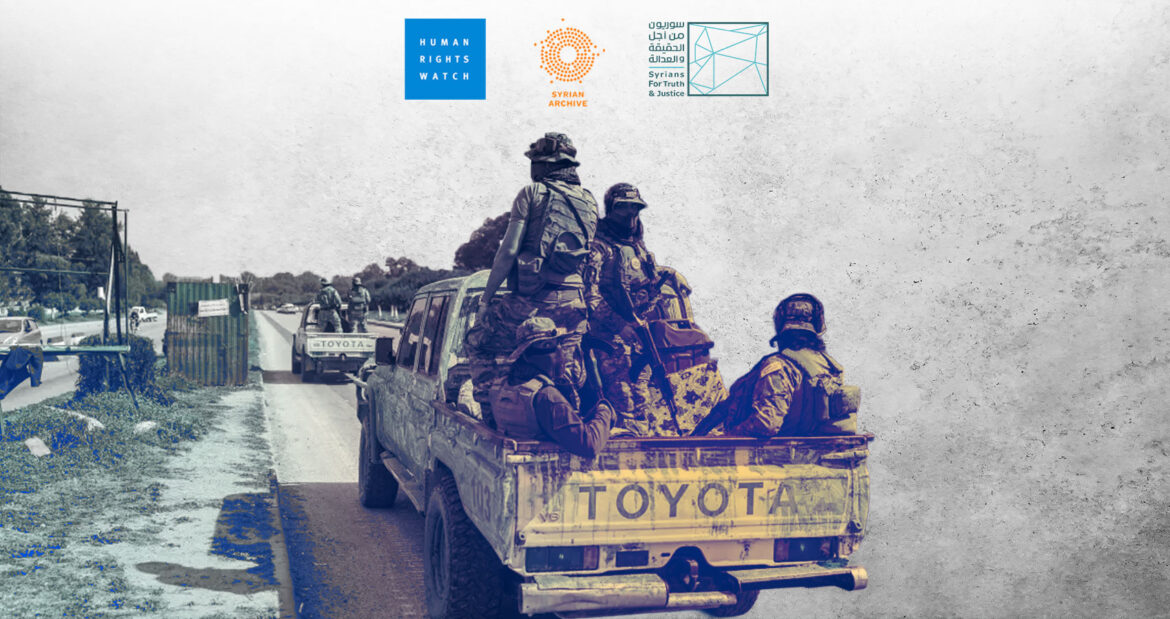
This report, researched and produced jointly by Human Rights Watch, Syrians for Truth and Justice, and Syrian Archive, documents widespread abuses carried out by government forces and government-aligned armed groups during so-called security “combing” operations. Though framed as efforts to root out “regime remnants” and confiscate stockpiled weaponry, these operations resulted in grave violations targeting civilians based on identity.
Drawing on more than 100 interviews, hundreds of verified videos and photographs, and satellite imagery, the report presents evidence that these forces committed widespread summary executions, deliberate destruction of property, and abuse of detainees.
Between March 7 and at least March 10, government forces and other armed groups stormed through more than 30 Alawi-majority towns, villages, and neighborhoods, with the professed aim of targeting former government affiliates and uncovering arms depots. In the process they killed at least 1,400 people. In many cases, they moved house-to-house, demanding to know residents’ sect, looting valuables, torching homes, and executing children, women, and men, including older people, often using overtly anti-Alawi slurs and rhetoric. In some places, fighters wiped out entire families.
Atrocities also included acts of humiliating abuse: men forced to crawl and bark like dogs before being shot and older detainees beaten on camera. Survivors described multiple waves of armed men, masked, in military fatigues or civilian clothes, repeatedly sweeping through their homes and communities. In Salhab in Hama Governorate, a video shows the Ministry of Interior’s General Security forces executing detainees at point blank range. In other areas, curfews imposed by authorities lulled families into staying home, only to be executed in their living rooms hours later. Fighters carried out many of the massacres under the pretext of “investigation,” but the patterns of abuse and identity-based targeting revealed a darker intent: to punish Alawi communities collectively, regardless of individual guilt or innocence.
While this investigation does not uncover direct evidence of orders to commit violations, the atrocities that engulfed Syria’s coastal region and Hama in March unfolded during a centrally coordinated military operation overseen by the Ministry of Defense, which mobilized tens of thousands of fighters, assigned operational zones to different factions, and facilitated joint deployments across Latakia, Tartous, and Hama. Fighters from at least a dozen factions, many formally or informally integrated into the Ministry of Defense, described receiving direct orders from the ministry, participating in shared operations rooms with other factions, and handing control over areas to General Security forces after sweeps.
Within this coordinated operation, the scale, duration, and consistency of the documented abuses make clear they were not isolated incidents. Although the majority of killings and mass abuses occurred during the first four days of the operation, violations persisted in multiple locations for several days thereafter, and according to fighters, senior officials and commanders continued coordinating with armed units long after grave abuses had become public.
Real-time videos shared online and verified by researchersas well as public statements issued by authorities on March 7 and 8 urging protection of civilians, acknowledging “infractions” and announcing the formation of an oversight committee, prove that the senior officials and military commanders were aware of ongoing violations. These measures proved insufficient to stem the violence. Some interim government forces reportedly acted to evacuate civilians or intervene against abuses by other fighters. Yet the overall lack of meaningful, timely action, despite these public acknowledgments, points to a failure by both civilian and military authorities to uphold their duties.
In its August report on the March events, the UN Commission of Inquiry found that interim government forces, and private individuals, as well as pro-former government fighters, committed serious violations—including murder, torture, abductions, pillage, and destruction of property—that likely amount to war crimes.
Senior civilian officials and military commanders can bear individual criminal responsibility for international crimes committed by their subordinates under the principle of command responsibility should they have failed to take all necessary and reasonable steps to prevent or punish these crimes.
Participation in the abuses by individuals who were not part of the security forces, officially portrayed as spontaneous and voluntary, further undermines the authorities’ narrative. Interviews with fighters and volunteers reveal that men unaffiliated with the security forces were actively recruited, armed, organized, and deployed alongside formal units by Defense Ministry representatives. Despite public statements instructing unaffiliated participants to withdraw, some remained involved in combat, checkpoints, and house raids well beyond March 8. Authorities sought to distance themselves from violations by attributing abuses to “unorganized elements,” but statements by interviewees and deployment patterns suggest otherwise: volunteers were embedded in official operations and, in some cases, directed by Ministry of Defense officials.
Moreover, the March atrocities did not erupt in a vacuum. They were the culmination of months of incitement, reprisals, and unchecked violence in post-Assad Syria, and decades of structural sectarianism, weakened rule of law, and impunity for systemic crimes perpetrated by the Assad government. After the former government’s collapse in December 2024, the interim government led by Ahmed al-Sharaa, previously known by his nom-de-guerre Abu Muhammad al-Jolani in his capacity as leader of the armed group Hay’et Tahrir al Sham (HTS), raced to assert control, merging dozens of armed factions into a fledgling Ministry of Defense. But integration was nominal. Many groups retained their structures and loyalties. While formal command structures were weak or still forming, the Defense Ministry actively coordinated deployments, issued mobilization orders, and integrated fighters into joint operations. In doing so, it assumed responsibility for forces it failed to meaningfully supervise. Efforts to vet fighters and commanders lagged, allowing previously unaccountable units to rebrand as state forces and act with impunity. Meanwhile, insurgent attacks against government forces often served as the trigger for retaliatory raids. What followed was a period marked by deepening mistrust and growing insecurity, especially in Alawi-majority areas perceived as former strongholds of the Assad government.
By February 2025, reports of summary killings, disappearances, and arbitrary detentions of Alawis had become frequent. Witnesses described house raids, arbitrary arrests, and checkpoint harassment, often justified as rooting out “regime remnants.” In several towns across Latakia, Tartous, Hama, and Homs, former government soldiers and security forces who had “settled their status” with interim authorities through official reconciliation procedures in hopes of protection were killed or subjected to violence and detention by government-affiliated forces nonetheless.
And identity-based abuses have persisted across Syria. In mid-July, formally deployed state units sent to Sweida to “restore order” were soon accused of field executions, looting, and arson in acts disturbingly reminiscent of the March massacres.[1]
Additionally, the absence of a functioning justice system has left a vacuum filled by revenge killings and growing public disillusionment. Violent actors ranging from the extremist armed group Islamic State (ISIS) to rogue local groups have exploited the government’s limited capacity to deliver justice, carrying out assassinations and stoking fear.
This report examines early efforts at accountability for the March atrocities by Syria’s transitional authorities. It describes the creation of two official bodies, the Fact-Finding Committee and the Civil Peace Committee, tasked with investigating the violence and easing communal tensions. It also notes arrests and other limited disciplinary measures announced by authorities, alongside the introduction of a Military Code of Conduct and a Transitional Justice Commission with a narrow mandate.
To curb renewed violence and build lasting stability, the transitional government should overhaul the security sector and launch a comprehensive justice process. That means bringing every integrated faction under a single, civilian‑supervised chain of command, vetting commanders and rank‑and‑file alike, dismantling abusive units, and strictly enforcing the new Military Code of Conduct. At the same time, authorities should publish the full fact‑finding report, prosecute those it implicates, and thoroughly examine the responsibility of senior officials and commanders who persisted in directing deployments and coordinating operations despite clear and mounting evidence of widespread abuses.
This should go hand-in-hand with advancing broader efforts towards comprehensive accountability for the crimes of the Assad era and those committed in the aftermath of his ouster, including ongoing cooperation with international efforts aimed at supporting justice, including the UN International Impartial and Independent Mechanism and Commission of Inquiry. Without a serious reckoning with the past, Syria risks entrenching a new cycle of impunity and sectarian violence. The choices made now, at this fragile juncture, will shape not only the legitimacy of the transitional government, but the future of Syria’s social fabric. Donors, in turn, should make security assistance conditional on measurable progress in reforms to guarantee that justice and human rights remain at the center of Syria’s transition.
Justice in Syria cannot be delayed. The scale and brutality of the March atrocities and ongoing identity-based abuses demand more than symbolic acts or piecemeal reforms. Justice must be inclusive, prompt, and unwavering in its commitment to all victims.
Click here to read the full report (51 pages) in English