
I lived in Syria for thirty years of my life, twenty-nine of them deprived of its nationality —moving between being “Unregistered” (Maktoum) at one time and a “Hasaka Foreigner” (Ajanib) at another— before spending a single year under a “deficient citizenship,” if this term can even be used, in a country whose successive governments seemed devoted to transferring it from one form of authoritarianism to another.
By simple arithmetic, my “citizenship age” in what is supposed to be my homeland and birthplace was only one year! And ironically, that very year included my arbitrary arrest and enforced disappearance for nearly three months in the cells of the Air Force Intelligence at Mazzeh Military Airport, then in the basements of the Fourth Division and the Military Police, and finally in Adra Central Prison in Damascus.
Confusion and bewilderment accompanied all my attempts to understand why I was born in my homeland, alongside my brothers and sisters, without rights or nationality —automatically stripped of any legal belonging to it, without fault or crime.
Later I realized that the birth of those feelings began during my preparatory education in one of the schools of Qamishli in the northeast of the country, where I was taught only in Arabic and not in my Kurdish language. I always asked myself: if I spoke Kurdish at home, in the neighborhood, with my friends, relatives, and neighbors, why was I learning in another, difficult language that was not my mother tongue?
I still vividly remember those years, and how another girl in that class endured years of relentless bullying simply because, when the teacher showed pictures of domestic animals and asked the pupils to name them, she gave their names in Kurdish instead of Arabic.
-
Denial of Basic Rights
I spent the first two decades of my life, and the following nine years, without an “identity card,” unlike my Syrian peers who obtained theirs at the age of fourteen.
At the time, I was unable to register for the free preparatory or secondary school exams “as a private candidate”, obtain a driver’s license, travel abroad or even domestically by plane, or purchase a SIM card. All of this was because I belonged to the Maktumeen (Unregistered) category who were even less fortunate than the Hasaka Foreigners. Yet both groups, as stateless, were denied legal recognition as Syrian citizens and deprived of many fundamental rights, such as the right to own property. Like many others, we were forced to register our homes, lands, and all possessions under the names of relatives who held Syrian nationality, which also created numerous legal disputes, even among members of the same family.
One of the harshest realities we experienced during the period of statelessness was witnessing many people born without nationality because of the 1962 census and because their parents themselves were deprived of nationality. Many of them died without ever experiencing the meaning of genuine citizenship in Syria.
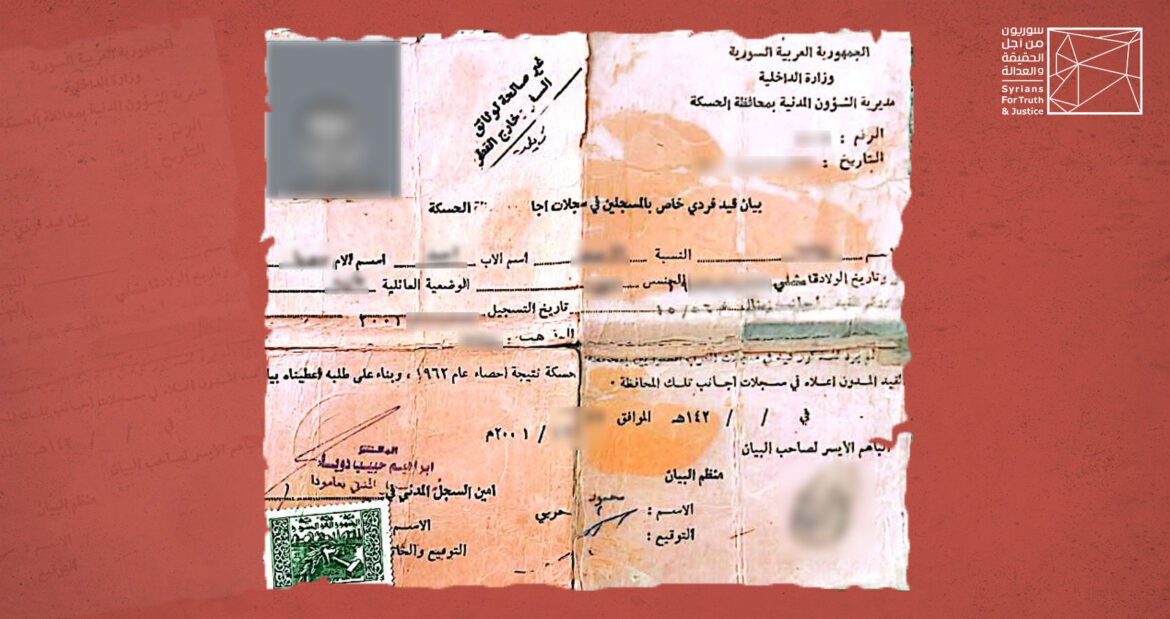
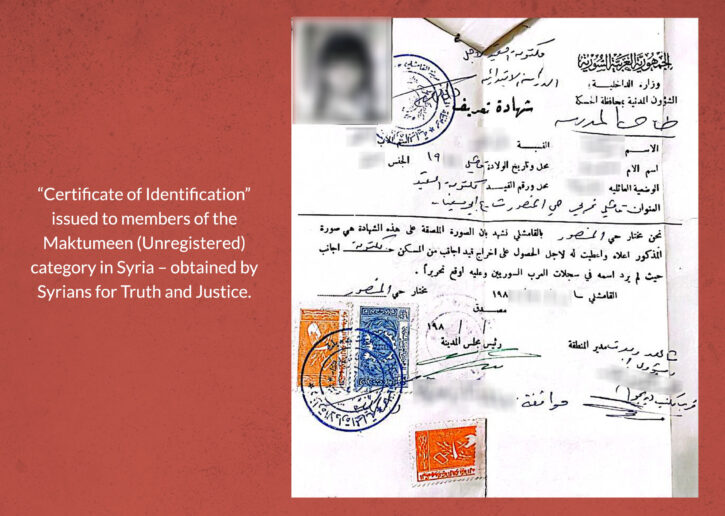
From the perspective of civil documentation, the distinction between Maktumeen and Hasaka Foreigners was made through documents: the former were given only a “Certificate of Identification” —a stamped piece of paper issued by the local mukhtar that conferred no rights whatsoever— while the latter were issued the so-called “red identity card,” which granted them a few limited rights, such as the ability to sit for free preparatory and secondary exams “as private candidates” and to obtain a driver’s license, but not other fundamental human rights, including registering a marriage.
In Syria, to live as a Kurd deprived of nationality in al-Hasaka province under the rule of the Arab Socialist Baath Party meant enduring layers of compounded injustice. On the one hand, you shared the oppression faced by all Syrians living under an authoritarian, repressive, and undemocratic regime. As a resident of al-Hasaka and the broader al-Jazira region, classified as a “developing” area, you also suffered from marginalization, poverty, exclusion, and unemployment compared to those from many “interior provinces.” On top of that, you were denied recognition of your mother tongue and the right to learn it, your annual Newroz celebration, even your legal personality, and the most basic cultural, linguistic, civil, and political rights —simply because you were born Kurdish and stateless, to Kurdish parents in al-Hasaka province.
-
“A Refugee in My Own Country”
The labels used to describe stateless people in Syria varied in both public discourse and everyday language. They ranged from “foreign infiltrators,” to “refugees” allegedly coming from Turkey in search of land after the Agrarian Reform Law, to Maktumeen (Unregistered), Hasaka Foreigners, “denationalized,” “deprived of nationality,” “stateless,” “those evading mandatory military service,” and many other terms. Yet the most striking paradox was the use of the term “refugees.” In the context of countries of asylum, “refugee” signifies legal recognition and the enjoyment of a set of rights. In Syria, however, it was sometimes applied to Kurds deprived of nationality, without conferring upon them any civil or political rights.
I argue —without minimizing the suffering of other Syrians or denying the existence of other forms of discrimination in Syria— that the deprivation of nationality under the exceptional 1962 census in al-Hasaka governorate is unlike any other injustice. You are not merely living in limbo, suspended in a legal void, but rather confined within a vast prison, while at the same time not existing at all—not recognized. You have no dreams resembling those of others regarding your future. You cannot travel to seek a new homeland.
Instead, you wage daily struggles at school, in university, and in everyday life with those different from you, trying to prove that you are like them and deserve the same rights —rights you cannot even express openly because of authoritarianism, in a country where human rights ranked at the very bottom of successive governments’ priorities since the founding of the Syrian state.
Tens —indeed hundreds— of racist incidents targeted stateless people in Syria, whether through derogatory labels, or through outright denial of the possibility of falling in love with a “citizen” girl and even falling in love with a girl from the Maktumeen or the Hasaka Foreigners. The documents they carried were often mocked as “cards for animals” or “for cattle.” They were spoken of with a mix of “contempt and pity.” One of the most common forms of mockery was the widespread saying: “Even cattle have IDs in Europe, while you do not even have anything resembling one.”
-
From Discrimination to False Privilege
Statelessness can shift your position from being a person subjected to discrimination for years to suddenly feeling that you “enjoy” a superficial privilege over other groups deprived of the very same rights!
After the year 2000, the Syrian authorities allowed some stateless persons to “regularize” their legal status, moving them from the category of Maktumeen (Unregistered) to the Hasaka Foreigners —holders of the red identity card— particularly in cases where the mother was a Syrian citizen, as in my own case.
This status allowed them to obtain a driver’s license and sit for the free preparatory and secondary school exams “as a private candidate,” without having to advance grade by grade like other Syrian citizens. Yet they remained deprived of fundamental rights such as property ownership, traveling abroad, or even spending a night in the hotels of the capital.
-
A Step Closer to the Dream and a Historic Opportunity
Obtaining the “red identity card” issued to the Hasaka Foreigners meant embarking on a “new stage” in the long journey of statelessness in Syria. After my family’s legal status was changed from Maktumeen (Unregistered) to the category of Hasaka Foreigners, I asked a friend traveling to al-Hasaka city to register me for the General Secondary Examination (literary branch), as I was residing in Qamishli, on the border with Turkey, at the time.
He had two names —one Kurdish used at home and another Arabic on official papers. The clerk, acting arbitrarily and claiming the documents were incomplete (though they were not), rejected the application. That news was one of my greatest disappointments at the time.
I tried again the following year (2002–2003). This time, my father went himself to the Directorate of Education, carrying stacks of documents, both required and unnecessary. To our amazement, it worked. I was finally allowed to sit for the secondary school exam as a private candidate that year, bringing me one step closer to the dream of pursuing university studies in Damascus. I placed my hopes in fate, believing that the future had to hold something better and that remaining in al-Hasaka forever was not destiny.
In haste, I abandoned my grueling daily work repairing and rewinding electric motors. I had barely four months left to prepare for my exam. I studied day and night, walking every day to a spot near the “Airport Quarter,” a district of luxury villas, adjacent to a small grove of trees called the “Assad Forest,” and close to wheat fields, vegetable gardens, and fig and mulberry trees, along with wells of fresh water and the railway connecting Qamishli to al-Hasaka.
That place had become a regular gathering spot for students engaged in self-study. It resembled an open-air school, bustling with dozens of young men and women, including those escaping the city’s noise and the strict confines of family life.
-
A Success in Limbo
My grades qualified me to enroll at Damascus University, Faculty of Arts and Humanities, Department of Arabic Language. Throughout those university years, one “joke” repeatedly circulated among dozens of non-Kurdish students: “You’re Kurdish, so why are you studying Arabic literature? Ha ha ha ha …” And once they learned that I did not hold Syrian nationality and was therefore deprived of rights, they would add sarcastically: “And on top of that, you’re not Syrian and will never get a job! Ha ha ha ha.” Truly, it was a kind of dark comedy.
In reality, pursuing a university education as someone from the Hasaka Foreigners (something completely off-limits to the Maktumeen until the year 2000) was a risky adventure with extremely high costs, especially for my family, that supported me as much as they could during the early years, before I began a long and exhausting journey of working alongside my studies in one of Damascus’s luxury hotels.
I remember those years (2002, 2003, 2004), when the entire Jazira region with its three governorates had no universities at all. Like thousands of other students, I had to travel on long-haul buses for more than nine hours from Qamishli to Damascus, or somewhat fewer hours from Jazira to Aleppo. Yet the real burden was not just the travel: it was the financial and personal risk of years of university study without any clear future. Stateless students were also denied the right to obtain a graduation certificate that could be used for employment.
Before enrolling at the university, I had joined an underground Kurdish party, one of the Kurdish political movements that, since their establishment in 1957, placed the plight of the Hasaka Foreigners at the core of their agenda, alongside the so-called “Arab Belt” issue. Their monthly publications rarely omitted references to these two causes. Likewise, many of their activities —and those of several Arab Syrian opposition members, especially those sympathetic to the Kurdish cause in particular and to the democratic cause in Syria more broadly— revolved around these issues. Many among them endured arrest, enforced disappearance, and torture.
Clinging to the hope of a miracle that might occur in the future —and to the conviction that statelessness was not destiny— was the only lifeline for the Hasaka Foreigners during their university years. Attending university, in addition to the heavy financial burden, also deprived students of the chance to learn a craft or trade, which naturally could have provided a better income. At that time, many people preferred to learn a craft or a trade rather than spend years at university —years that offered no hope of employment or a clear professional future.
-
Hasaka Foreigners and the Syrian Uprising
Following the nationwide protests that erupted after March 2011, in the context of what was then called the “Arab Spring,” former Syrian president Bashar al-Assad issued Legislative Decree No. 49 in April of the same year. The decree granted Syrian Arab nationality to those registered in the records of the Hasaka Foreigners. However, it excluded tens of thousands from the category of Maktumeen (Unregistered). Between 1962 and 2011, the combined number of Hasaka Foreigners and Maktumeen reached approximately 517,000, according to exclusive statistics obtained by STJ from a source within al-Hasaka’s Civil Registry.
Once again, the Maktumeen were subjected to compounded and inhumane injustice. In addition to being deprived of all rights since 1962, Decree No. 49 failed to address their plight as it did for the Hasaka Foreigners. While some Maktumeen succeeded in “regularizing” their status to become Hasaka Foreigners and eventually Syrian citizens, the stories of tens of thousands of others were effectively erased. By 2012, as the Syrian conflict escalated into a proxy war that claimed hundreds of thousands of lives and displaced or forced millions into exile, new categories of people deprived of documentation —and at risk of statelessness— emerged, most notably internally displaced persons and refugees.
It was evident that the decision to grant nationality to deprived Kurds in 2011 was a “political” maneuver by the former Syrian regime to win Kurdish support, rather than a genuine attempt at reform in a fractured country. At the very least, it was an effort to prevent their active participation in the protests against the regime. Yet the months and years that followed proved this strategy ineffective, as most Kurdish cities and areas with large Kurdish populations witnessed sustained demonstrations against the regime, in parallel with protests across the rest of Syria.
-
The Golden Question: Why Is Your ID New?
At the beginning of 2012, after I had completely withdrawn from political activism, I began working with the Violations Documentation Center in Syria (VDC), one of the projects of the Syrian Center for Media and Freedom of Expression (SCM). In mid-February 2012, a heavily armed force —later identified as belonging to Air Force Intelligence— raided the Center’s office near the Sabaa Bahrat Square (Seven Fountains) in the heart of Damascus and arrested all team members, male and female, taking us to the Mezzeh Military Airport.
Upon our arrival at the military base, they ordered us off the long-haul bus and began collecting our personal data and belongings. When my turn came, one of the security agents was taken aback when he saw that I carried a brand-new Syrian national ID card, which I had obtained from the Civil Registry in Amuda shortly before the arrest. Immediately, the young agent asked: “Why is your ID new?”
Normally, Syrian citizens receive their identity cards at the age of fourteen, which sparked the agent’s suspicion. He repeated the question several times. In those moments, I remembered the calls made by some religious clerics in 2011, urging Syrians to “break their identity cards” as an act of defiance against the regime’s control.
Trying to contain the situation, I explained that my ID was new because I belonged to the category of Hasaka Foreigners and had only recently acquired Syrian nationality. At that point, I realized that being accused of “breaking my ID card” might be safer than being branded a “foreigner” inside an Air Force Intelligence branch —especially given the authorities’ and state media’s insistence at the time on portraying events as a “foreign conspiracy against Syria.”
After a short exchange, and his blunt question, “What does Hasaka Foreigner mean?” —and with the intervention of another officer— I managed to explain: “There is a group of people living in the far northeast of the country who were granted Syrian nationality as a ‘benevolent gesture’ from the President.”
-
Freedom and Asylum
After nearly three months of detention in the Air Force Intelligence branch, the Fourth Division, the Military Police, and finally Adra Prison —followed by transfer to the Military Court near the Ministry of Higher Education— I was released on the condition that I attend the remaining court sessions. I only showed up once before fleeing to neighboring Turkey, where I began a new life, expecting that the problems surrounding legal documents and recognition of my existence had finally ended. That expectation, however, proved illusory. Although I had crossed an international border and nominally carried the status of “refugee,” the actual legal situation for many Syrians amounted only to holding a “touristic residence permit,” under which the individual remained fully responsible for all personal needs.
Later, the Turkish government —with support from the European Union— began offering certain services exclusively to holders of the kimlik (temporary protection card), which was first introduced in 2014.
Restrictions on Syrians increased after the attempted coup in Turkey in 2016, forcing tens of thousands to leave the country. The pressure later intensified against specific groups of activists and journalists, including Syrian Kurds, especially after Turkey’s “Operation Olive Branch,” through which it occupied the Kurdish region of Afrin in 2018. This compelled me to seek asylum in France, just a few months before the outbreak of the COVID-19 pandemic.
Living as an asylum seeker rekindled many of the same challenges I had endured as a stateless person. Although my time as an asylum seeker in France was short compared to the long years of statelessness in Syria, the parallels were striking, particularly the absence of any official documents beyond the “asylum seeker certificate,” which grants only the most minimal rights in a country where one cannot move at all without a valid residence permit and a court decision recognizing the right to asylum (protection).
-
A New Opportunity
Today, decades after tens of thousands of Kurds were deprived of their natural right to nationality, the impact of the exceptional 1962 census and Legislative Decree No. 49 of 2011 still lingers in the lives of entire generations. My personal experience embodies what it means to be born in your homeland without identity, rights, or recognition, and then to be granted nationality belatedly, as if it were a political concession, not an inherent right.
If the former Syrian authorities squandered a historic opportunity in 2011, the transitional authorities today face an equivalent one: to address this issue with seriousness, to grant nationality to all remaining cases, to acknowledge the injustice, to compensate victims, to preserve their memory, and to ensure that no Syrian is ever again deprived of the right to identity, belonging, and full citizenship.
Bassam Alahmad – Co-Founder and Executive Director of Syrians for Truth and Justice (STJ).