
1. Executive Summary
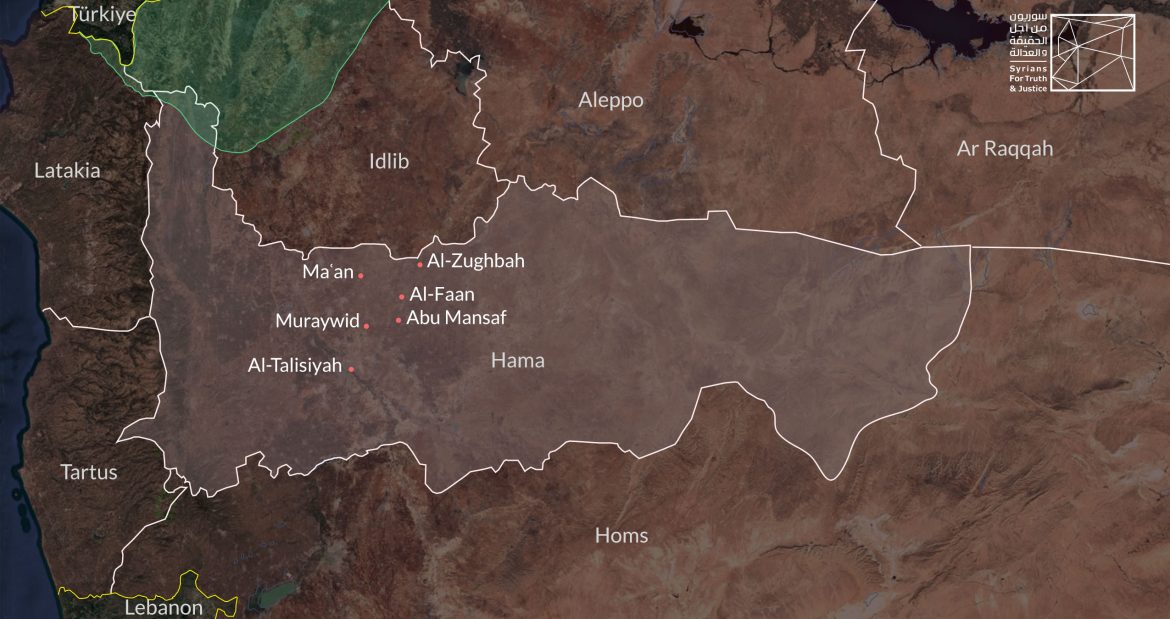
This report documents incidents of mass forced displacement affecting the residents of al-Zughbah village and other predominantly Alawite villages in northern rural Hama —including Muraywid, al-Talisiyah, Maʿan, al-Faan, and Abu Mansaf— following the collapse of the defensive structure of the former Syrian regime’s forces and the takeover of the area by factions participating in the “Deterrence of Aggression” operation on 8 December 2024.
Drawing on field evidence and first-hand testimonies, the report establishes that the displacement did not constitute a voluntary withdrawal; rather, it was a coerced flight under the pressure of a sudden military attack in which “Shahin”-type explosive drones were used, generating intense fear among civilians and compelling them to abandon their homes and property and flee with nothing but their lives.
The violations did not stop at the moment of displacement. The report records a post-displacement pattern of abuses, including the prevention of residents from returning through direct security threats and the absence of protection measures. In parallel, the property of those forcibly displaced was subjected to widespread looting, which evolved from individual acts of pillage into organized appropriation carried out through newly established entities –most notably “Iktifaa Company,” an agricultural investment body based in Idlib engaged in agricultural production projects– which took control of agricultural lands (including pistachio and olive groves) under the guise of “investment,” thereby depriving the original owners of their sole source of livelihood.
The report concludes that these practices constitute serious violations of both international and domestic law, including forced displacement, collective punishment, and infringement of property rights, and that they risk entrenching permanent demographic change. The report further presents a set of recommendations aimed at safeguarding the rights of the displaced to return and to recover their property.
2. Methodology
The preparation of this report relied on a methodology that combined qualitative field research with secondary sources to ensure the accuracy and objectivity of the information presented:
- Primary, first-hand testimonies: The report draws on 19 testimonies collected from victims of displacement from the village of al-Zughbah, who are currently residing in areas of displacement (such as the city of Salhab). These testimonies covered the details of the day of displacement, the conditions of flight, and unsuccessful attempts to return, while ensuring the protection of witnesses’ privacy in the overall narrative of the report. Informed consent was obtained from all participants after the voluntary nature of their participation and the purposes for which the information they provided would be used, including the inclusion of excerpts from their testimonies in this report, had been clearly explained to them. All witnesses confirmed their wish to have their identities, or any identifying details, withheld for fear of retaliatory acts that could target them or their families. Accordingly, the legal paper refers to individuals whose testimonies are cited using initials only.
- Secondary sources and human rights reports: The testimonies were corroborated with information drawn from credible secondary sources, including reports issued by international and local organizations. These sources helped confirm the broad scope of the displacement, which affected approximately 12 villages and 2,000 families in the area.
- Information triangulation: A process of information triangulation was adopted to verify the facts; witness accounts concerning the timing of the attack and the type of weapon used (Shahin drones) were cross-checked against military data and analyses published in open-source materials relating to the course of hostilities in northern rural Hama.
- Case-study approach: The report employs a case-study approach focused on the village of al-Zughbah as a micro-model reflecting developments in nearby villages (such as al-Talisiyah and al-Faan), in order to shed light on the deliberate nature of the violations and their humanitarian and legal implications.
3. Background and Context: Rural Hama as a Violent Frontline
To understand the magnitude of the humanitarian catastrophe that befell the village of al-Zughbah and other villages in northern rural Hama, it is necessary to consider the geopolitical position of this area and the role it has played throughout the years of the Syrian conflict, while underscoring that understanding the historical context does not, under any circumstances, confer legitimacy upon subsequent policies of collective retaliation or forced displacement.
3.1. Demographic and Military Geography
The villages of northern rural Hama (al-Zughbah, al-Talisiyah, al-Faan, and others) formed a geographical buffer separating Sunni-majority areas in southern Idlib countryside from those in northern rural Hama. Given their demographic composition —predominantly Alawite within a largely Sunni surrounding— the former Syrian regime sought to exploit this demographic configuration and instrumentalize it within the Syrian conflict in pursuit of its military objectives against opposition armed groups.
3.2. The Legacy of Conflict: Memory and Military Instrumentalization
By virtue of their location along frontline zones during the conflict, these villages witnessed recurring military deployments and, at various stages, became sites of concentrated government troop presence. In previous reports, STJ documented incidents of displacement affecting residents of neighboring Sunni villages at the time, events that left profound social impacts on the area. The policies pursued by the former regime, whereby civilian areas were incorporated into its military apparatus, sowed seeds of sectarian division.
Nevertheless, it remains essential —both legally and ethically— to distinguish between the political and military responsibility of the regime and the rights of civilian populations. The fact that the regime exploited these villages militarily, or that some of their residents may have participated in combat, does not strip civilians living there of their legal protections, nor does it justify, under any circumstances, subjecting them to forced displacement or collective punishment as a form of retaliation. A violation cannot justify a counter-violation; international humanitarian law clearly prohibits reprisals against civilian populations for acts committed by their governments or armed forces.
4. Facts of the Displacement: Mass Flight (8 December 2024)
4.1. “The sky was raining shrapnel”: The shock of the initial attack
Consistent, corroborated witness testimonies indicate that the residents of al-Zughbah initially remained in their homes following the withdrawal of the former regime’s army in early December 2024, and that they had no prior intention to leave, refuting any claims of a pre-planned voluntary evacuation. The situation changed abruptly when the attacking factions, led by Hay’at Tahrir al-Sham (HTS), launched an intense assault using Shahin-type drones. According to the testimonies, the strikes were not limited to strictly defined military targets within the built-up area of the village, but instead generated an atmosphere of indiscriminate terror.
In this regard, witness “S.M.” —a 74-year-old farmer— described the scene as follows:
“The sky began raining shrapnel and fire… the first projectile fell near my neighbor’s house and killed an elderly civilian man and injured several women.”
The use of drones —accompanied by a continuous buzzing sound followed by explosions— created a state of psychological terror that led residents to believe that remaining in the village meant certain death, particularly after civilian casualties were documented during the first moments of the attack. Witness “R.H.,” a widow and mother of six, confirmed the panic, stating:
“Staying became impossible. We rushed out without taking anything with us.”
4.2. Fleeing in nightclothes: A journey of fear
Under the pressure of indiscriminate shelling and the spread of panic, an unorganized wave of mass displacement began. The testimonies clearly indicate that people fled without any preparation: witnesses “A.M.,” “S.S.,” and others reported that they escaped “only to save their lives,” unable to take luggage, documents, or personal belongings.
The accounts depict a bleak and perilous flight. Witness “H.M.” reported that his brother was wounded by shrapnel in the leg, forcing the family to provide improvised first aid while running through fields and farmland to escape the attack. Another witness, “H.S.,” recounted harrowing details of fleeing under fire:
“While we were escaping, a shell fell very close to us… my wife was injured in her hand, and my young daughter almost suffocated from the dust and smoke.”
Witnesses further described families being scattered in different directions: some headed toward western rural Hama, others toward the coast, while the largest group of al-Zughbah residents fled to the nearby city of Salhab, where they were confronted with an uncertain future, without shelter or means of livelihood.
5. Post-Displacement Realities: Denial of Return and Policies of Intimidation
The suffering of al-Zughbah’s residents did not end with their departure from the village; what began as temporary displacement has evolved into a sustained condition of deprivation, in which residents face security and material obstacles that render return impossible in the foreseeable future, entrenching a reality of forced demographic change.
5.1. Life in dispersion: Waiting without horizon
The majority of the village’s residents are currently living in the city of Salhab and in areas along the Syrian coast, where they have taken refuge in schools or in the homes of relatives and acquaintances. According to documentation by STJ, they are living in extremely difficult humanitarian conditions after losing their primary sources of livelihood and their homes, and now depend on assistance or borrowing to secure their daily needs, amid constant anxiety regarding the fate of their property. Witness “A.M.” expressed this reality, stating:
“Today, we no longer have shelter in our village. We have lost our homes and our land.”
5.2. Security barriers to return: “We cannot guarantee your safety”
When residents sought to explore the possibility of return through peaceful and administrative channels, they were met with an official response disclaiming any responsibility by the new authorities for their protection. Consistent testimonies indicate that a delegation of village notables met with the Governor of Hama, ʿAbd al-Rahman al-Sahyan, to obtain guarantees for return, but the governor’s response was: “I cannot guarantee your safety if you return,” urging them to wait, indefinitely.
Matters went beyond this to reach the level of direct threats. STJ documented the case of a prominent notable from al-Zughbah (whose position is withheld for security reasons) who received an explicit death threat against himself, and his children should he attempt to return to the village:
“I received a direct threat from some of the local residents now controlling the village, stating that if I returned with my family, they would kill me and my children.”
Many residents likewise received warnings from acquaintances in the area that approaching the village could expose them to assault or arrest, creating a wall of fear that prevents any individual attempts at return.
5.3. The violation of property: From looting to residential occupation
In parallel with security-based prohibitions on return, the village has undergone systematic destruction and pillage. Testimonies confirm that a number of homes were subjected to comprehensive looting “Taʿfīsh”,[1] affecting furniture, windows, and even electrical installations, before some of them were burned entirely to ensure they were rendered uninhabitable.
Even more serious than looting is the settlement-like occupation of property. Testimonies collected by STJ indicate that groups from nearby Bedouin villages, as well as some members of the “al-Muwali tribe” who had returned to the area, took possession of several homes belonging to the displaced and began residing in them. This demographic substitution not only constitutes an encroachment upon property rights, but also signals an intention to alter the area’s demographic identity and to prevent rightful owners from reclaiming their homes.
6. The Political Economy of Displacement: “Iktifaa Company” and the Institutionalization of Looting
One of the most alarming findings emerging from the testimonies is the shift from individual, disorderly acts of appropriation (taʿfīsh) to a form of organized institutionalization carried out under an alleged legal and investment-oriented framework.
6.1. “Iktifaa Company”: The façade of coerced investment
In northern and northeastern rural Hama, a company known as Iktifaa for Agricultural Development and Investment has emerged as a key factor in the management of properties belonging to the displaced. On its official website, the company presents itself as operating in the agricultural production sector and headquartered in Idlib, with activities focused on increasing local agricultural output and enhancing food security through production plans based on modern technologies and agro-industrial methods, as well as the cultivation of crops and fruit-bearing trees in line with quality and food-safety standards.
Official media reports portray the company as an agricultural investment initiative in rural Hama. However, field evidence and local testimonies indicate its involvement in the seizure of land belonging to Alawite residents of the area, in coordination with arrangements reportedly managed alongside the Economic Office in Hama Governorate.[2] The company operates as an economic front, taking control of fertile agricultural land abandoned under coercion by its owners, in particular pistachio and olive groves for which the villages of al-Zughbah and al-Talisiyah are renowned.[3]
6.2. Expropriation mechanisms: Auctions as a legal façade
With facilitation from the Syrian government, Iktifaa Company has employed administrative mechanisms to confer a veneer of legality on acts of confiscation:[4]
- Classification of owners: Original landowners are designated as “absent” or “wanted for security reasons,” thereby providing justification for placing their lands under control.
- Sham public auctions: The lands are offered for “investment” through public auctions that require obtaining a security clearance, a prohibitive condition for the displaced, effectively restricting investment to individuals aligned with the controlling factions.[5]
- Adhesion contracts: The company contacted some displaced people to propose nominal lease contracts for their lands, in an attempt to legitimize the de facto situation and consolidate dispossession through documents that appear legally valid on their face.
6.3. Economic impact: Strangling the means of survival
These lands constitute the sole lifeline for the residents of al-Zughbah. The area is known for its “green gold” —pistachio— as well as olives, both of which are strategic crops requiring many years of care. The confiscation of these resources, whether through harvesting them directly for the benefit of the governing authority or through leasing them to new investors, deprives thousands of families of their primary source of livelihood and pushes them into destitution.
In addition to confiscation, the agricultural wealth is being subjected to degradation at the hands of “new settlers.” Witness “S.D.,” a former employee of the Agriculture Directorate, described this destructive encroachment as follows:
“They have no hesitation in demolishing any historic structure or cutting down a fruit-bearing tree for heating… I have lost my land, which contained fruit trees nearly 40 years old.”
7. Conclusion and Recommendations
The documented events in the village of al-Zughbah, in northern rural Hama, indicate the commission of serious violations affecting both international humanitarian law and international human rights law, as well as the provisions of the Constitutional Declaration and applicable Syrian legislation. The coercive environment created through direct and indiscriminate attacks against civilians, followed by threats and the prevention of return, constitutes prohibited forced displacement under Article 17 of Additional Protocol II. At the same time, it represents an assault on the constitutional rights to personal liberty and inviolability of the home, and may, under domestic law, fall within crimes affecting individual freedom and the unlawful use of force and threats.
Moreover, the widespread looting of private property, followed by its appropriation through merely formal, pseudo-legal mechanisms, amounts to a violation of the prohibition of pillage under international law and an arbitrary deprivation of property. At the national level, these practices contravene the principle of protection of private ownership and may constitute crimes of unlawful property seizure or usurpation of real estate, which cannot be legitimized by any administrative cover.
Furthermore, the linkage of the fate of civilian populations in Alawite villages to the crimes of the former regime reflects an intention to engage in collective punishment, prohibited under Article 33 of the Fourth Geneva Convention. Such conduct is also incompatible with the principles of equality and non-discrimination enshrined in the Constitutional Declaration and poses a threat to social cohesion and civil peace.
The denial of safe return for residents to their homes and lands —contrary to the obligations of the authorities under Principle 28 of the Guiding Principles on Internal Displacement to create conditions and provide the means enabling internally displaced persons to return voluntarily, in safety and dignity— constitutes, in the national framework, an infringement of the rights to residence, movement, and vested rights, falling outside the bounds of lawful administrative authority and subject to judicial challenge.
Taken together, these events reflect an interlinked system of international and domestic violations and underscore the need for effective legal accountability, reparation, and protection of the rights of affected people.
Accordingly, Syrians for Truth and Justice recommends the following:
7.1. To the Transitional Government
- Suspend all ongoing investment and appropriation contracts involving the property of persons forcibly displaced, deem them void of legal effect pending adjudication through an independent judicial mechanism, and halt the activities of “Iktifaa Company” and all entities involved in property seizure.
- Adopt an official plan to ensure safe and dignified return for residents, including the establishment of effective protection measures, designation of a responsible governmental body for follow-up and complaints, and accountability for individuals or groups engaged in intimidation or threats.
- Initiate criminal proceedings against those implicated in looting and unlawful appropriation, recover stolen property, and enforce immediate eviction orders from occupied homes and unlawfully seized real estate.
- Establish an independent mechanism to safeguard land and property records, prevent tampering, and document the property rights of the displaced, as a preparatory step for restitution and compensation within the broader transitional justice process.
7.2. To Human Rights and Civil Society Organizations
- Support community-based reconciliation initiatives led by notables from neighboring Sunni villages and tribes —some of whom, as reflected in testimonies, support the right of return— to serve as local guarantors for the return of their displaced Alawite neighbors, while emphasizing that such efforts do not replace the State’s duty to ensure protection and accountability.
- Prepare well-documented legal case files and refer them to the competent judicial bodies; support accountability efforts relating to displacement and property appropriation; and empower victims to reclaim their property and seek compensation for the harm suffered.
7.3. To the International Community and Donor Entities
- Link financial support to the authorities’ compliance with protecting property rights for all Syrians, preventing forced confiscation, and supporting independent monitoring mechanisms for return and property-related cases.
- Direct urgent humanitarian assistance to displaced persons currently residing in shelter areas (including Salhab and the coastal region), who have lost their agricultural seasons and sources of livelihood, in order to sustain their basic living conditions.
[1] Taʿfīsh: A colloquial term used to describe systematic looting or the appropriation of civilians’ movable property following military operations or during the deployment of controlling forces. It encompasses the taking of furniture, household appliances, tools, and even crops or livestock, and is often carried out in an organized manner attributable to armed actors or military/security entities, rather than being treated as isolated, opportunistic acts of theft.
[2] Syrian Observatory for Human Rights, Land Grabbing under the Cover of Agricultural Investment in Rural Hama: Alawite Villages as Victims of “Iktifaa”’s Suspicious Contracts, (Arabic) 30 June 2025.
[3] Syrian Center against Violence and Hatred, Severe Violations of Property Rights in Syria During the Transitional Phase, 1 December 2025.
[4] See the two previous references.
[5] The mechanisms employed by “Iktifaa Company” intersect with a pattern previously documented in Hama Governorate in recent years, whereby governmental bodies there (under the Assad regime) used public auctions to “invest” the lands of the absent and the displaced, while requiring participants to obtain a “security clearance.” Reports issued by Syrians for Truth and Justice demonstrated that these auctions were merely formal in nature, as the aforementioned condition constituted a systematic barrier preventing original owners from participating, while enabling the transfer of land use to actors close to the authorities or supported by security bodies. Those incidents further showed that the auctions did not constitute a neutral economic measure, but rather served as a tool to confer a superficial legal character upon the removal of control from rights holders and to impose a long-term de facto reality over their agricultural properties. See: Syrians for Truth and Justice, The Syrian Government is Seizing Large Swathes of IDPs Lands in Hama and Idlib Suburbs, 10 June 2021; Syrians for Truth and Justice, Hama: Syrian Government Auctions New Swathes of IDP’s Lands, 27 September 2021; Syrians for Truth and Justice, Syria: Regime Auctions Off Privately-Owned Pistachio Lands in Hama and Idlib, 12 November 2022.