
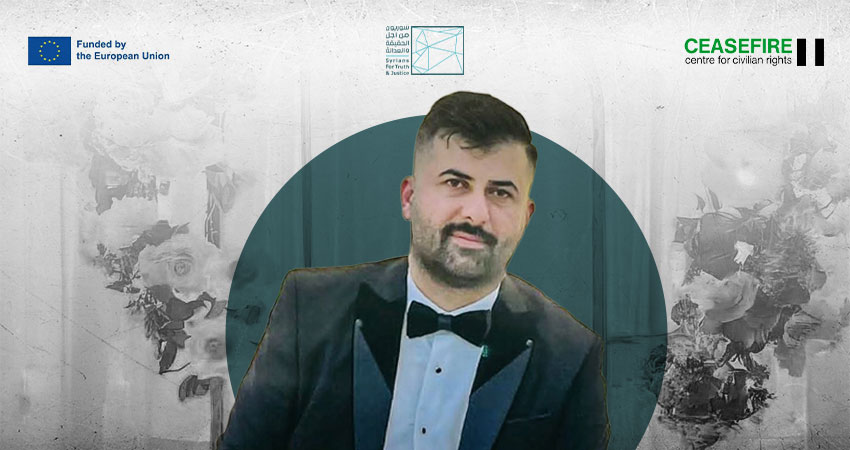
This publication was funded by the European Union, and in partnership with the Ceasefire Centre for Civilian Rights. The contents of this publication are the sole responsibility of Syrians for Truth and Justice – STJ/ the publisher and do not necessarily reflect the views of the European Union or the Ceasefire Centre for Civilian Rights.
1. Introduction
This report examines the case of the death of Alaa al-Din Adnan al-Amin, a 35-year-old Kurdish man and Syrian national holding Swedish citizenship, who died while in the custody of a security entity affiliated with the Autonomous Administration of North and East Syria (AANES), as acknowledged by the Commander-in-Chief of the Syrian Democratic Forces, Mazloum Abdi, and the Internal Security Forces (Asayish).
This brief investigation is based on a set of direct testimonies collected from members of his family and close circle, following their informed consent, in addition to open-source information, visual materials, official documents, and medical evidence. The aim is to reconstruct the sequence of events and identify the key elements that may constitute legal and human rights violations in this case.
In addition to testimonies, the report relies on supporting evidence reviewed by STJ, including photographs of the body, video footage from the moment of arrest, medical and radiological reports, as well as official documents related to the victim’s entry into the country.
Available information indicates that Alaa was arrested from his family home in the city of Qamishli during a nighttime raid carried out by an armed group that did not identify itself. Security authorities subsequently denied any knowledge of his whereabouts, while the family continued searching for him through various official institutions and informal channels, without success.
After approximately four months of disappearance, the family received a phone call instructing them to travel to the city of al-Hasakah to retrieve him, only to discover that they were being asked to receive his body rather than secure his release. This development was accompanied by an initial official account stating that the death resulted from a “heart attack.” However, available medical findings reveal the presence of severe blunt-force trauma to the head, raising serious questions regarding the official narrative about the circumstances and cause of death in detention.
The gravity of this case does not lie solely in the death itself, but extends to the broader context surrounding it, including the initial denial of detention, the lack of transparency regarding the victim’s fate, the discrepancy between the official account and certain medical indicators, as well as the family’s statements indicating visible signs of violence and injuries on the victim’s body upon its return.
These concerns were further exacerbated by an attack on the mourning tent erected to commemorate the victim, which was set on fire in what appears to be a continuation of the violations and an attempt to intimidate the family.
This case acquires particular significance in light of official statements issued by the Asayish (Internal Security Forces), which acknowledged that the death occurred during detention and announced the formation of an investigation committee. This places a clear obligation on the relevant authorities to establish the truth and determine responsibility. However, the absence of publicly available information regarding the outcomes of previous investigations into similar cases —such as that of Amin Issa, who was killed in a detention facility run by the Autonomous Administration in al-Hasakah in 2021— raises serious concerns that this case may likewise conclude without genuine or transparent accountability, thereby reinforcing a troubling pattern of impunity.
These concerns are not limited to individual cases. International human rights reports indicate the continued occurrence of deaths in detention across Northeast Syria, including cases linked to torture, ill-treatment, and inhumane detention conditions. In its 2024 report, Amnesty International documented deaths in detention facilities operated by entities affiliated with the AANES, within a broader pattern of violations that included torture, arbitrary detention, and the absence of legal safeguards. Other human rights organizations have similarly called for independent investigations into detainee deaths in these facilities.
At the same time, such violations have not been confined to a single actor, but have also persisted within the context of political transformations following the fall of the regime. A journalistic investigation published by Reuters documented cases of deaths occurring under or following torture in detention centers run by the Syrian Transitional Government, in the absence of effective oversight or clear accountability. This convergence of patterns across different actors reflects a broader structural problem related to the absence of fundamental safeguards for detainees’ safety and the continued impunity for deaths in custody in Syria.
Within this context, this report seeks to present the facts as documented through available testimonies and supporting evidence, and to analyze them in light of applicable legal standards. It further aims to highlight existing contradictions and identify issues requiring an independent and transparent investigation, in order to ensure the right to truth, hold those responsible accountable, and prevent the recurrence of such violations.
2. Unjustified Raid and Arrest without Legal Basis
According to family testimonies, the events of the case began after Alaa al-Amin returned to the city of Qamishli on 7 September 2025, arriving from Europe to complete civil procedures related to family reunification and his wife’s travel with him to Sweden. Testimonies indicate that, a few days after arriving in Syria, he traveled to Damascus to follow up on certain official procedures, before returning again to Qamishli.
The family reports that the situation was normal during the first days, until their home was subjected to an initial raid late at night. An armed group arrived in the neighborhood and positioned itself around the house, then violently knocked on the door before entering without presenting any legal warrant or official identification.
On that night, Alaa was not at home. According to testimonies, the individuals conducted a thorough search of the premises, opened cabinets, and examined personal belongings. They also asked general questions without clarifying the reason for the raid, before leaving the premises without carrying out any arrest or clear seizure, and without providing any official explanation for what had occurred.
Alaa himself attempted to inquire about the reasons behind the raid, going to court and asking about its background. A staff member reportedly responded:
“There is no reason to ask… go home and do not worry. As long as they did not take anything and did not arrest anyone, there is nothing to fear.”
The family also learned at the time, through informal attempts to verify his legal status, that he was not wanted by the security authorities, which reinforced their belief that there was no justification for any action against him.
However, these indications changed abruptly days later. On 20 October 2025, an armed group carried out a second raid on the house during late-night hours. The victim’s mother described the moment of arrest, stating:
“Suddenly they stormed our home… they entered my son’s apartment through the window… they immediately seized Alaa; he was wearing his sleep clothes and was barefoot when they took him.”
She added that the individuals were “masked and wearing military uniforms”, and that they did not identify themselves or the entity they belonged to. She noted that the raiding force consisted of four vehicles, including a van with tinted windows positioned at the head of the street, a pickup, a white jeep, and another van parked on the opposite side. She explained that the number of individuals directly involved in the arrest ranged between five and six men, in addition to two women, while the remaining personnel stayed inside the vehicles. She further stated that Alaa was placed into the jeep despite the gathering of several neighborhood residents at the scene, and that the individuals fired shots into the air and used a stun grenade during the operation, causing panic among family members and residents.
The testimony confirms that the arrest was carried out without providing any explanation or presenting charges, despite the family’s attempts to inquire. The mother stated that she shouted at them “What do you want from him? We have done nothing… we are not terrorists,” but the individuals “did not mention any reason… they simply seized Alaa and took him.”
Family testimonies also indicate that the individuals confiscated mobile phones during the raid to prevent the family from documenting what was happening, before returning the devices when leaving. Subsequently, other security patrols affiliated with the Internal Security Forces (Asayish) arrived at the scene and forced family members to delete the footage they had recorded during the arrest. This resulted in the loss of several recordings documenting the moment of the raid and limited the ability to retain full visual evidence of the arrest, except for one short video consisting of a few seconds reviewed by STJ, showing masked individuals and their vehicles.
These facts, as reflected in the testimonies, indicate a pattern of arrest carried out without the presentation of official authority or a clear legal basis, and under conditions lacking minimum procedural guarantees, marking the beginning of a prolonged period during which no information was available regarding the fate of Alaa al-Amin.
3. The Search for His Fate: Official Denial and Financial Extortion
Following the arrest, the family began an intensive search for Alaa’s fate, moving between various security and judicial bodies without obtaining any clear or confirmed information. According to family testimonies, Alaa’s father went the following day to Asayish centers, where his presence was categorically denied. He then approached the “Terrorism” Court and other security entities, only to receive the same response: no information regarding his detention.
Testimonies indicate that the family presented the video footage showing masked armed forces during the arrest to certain official bodies and directly asked whether the individuals appearing in it belonged to them. According to one relative, the response was: “Yes, these are our vehicles,” yet this was not followed by any acknowledgment of Alaa’s detention or clarification of his fate, deepening the family’s uncertainty and concern.
In light of these repeated denials, the family turned to informal channels, including what is locally referred to as ‘wasta’ (the use of personal connections and influence) in the hope of obtaining information or securing his release. According to a relative of the victim, individuals believed to be connected or influential within security institutions were contacted, where “one of them confirmed that he would get Alaa released,” in exchange for a large sum of money, which the family indeed paid, without any result. The testimony adds that the family initially paid USD 7,500 to a person who promised to reveal his fate, only to later discover that he did not fulfill his promise. They also agreed with another individual to pay an additional USD 2,500, deposited with a third party, in exchange for information, but to no avail. This reflects a pattern of extortion commonly faced by families of detainees or disappeared persons in the absence of effective official channels.
In parallel, the family continued approaching official bodies, including courts and security authorities, without receiving any confirmation of Alaa’s presence or any charges brought against him. The victim’s mother described the level of despair the family reached, stating that she went to the court and threatened escalation, saying: “If you do not tell me now where my son is, I will set my body on fire here in front of the court,” in an attempt to pressure the authorities to disclose his fate, but this did not yield any tangible outcome.
Testimonies also indicate that throughout his disappearance, the family refrained from publicizing his case in the media, fearing that doing so might harm him. They believed he was being held by a security authority and that raising the case publicly could negatively affect his safety. This belief remained until the family received the call that would completely alter the course of the case.
4. From Promise of Release to Announcement of Death
After months of fruitless searching, Alaa’s family received a phone call on 8 March 2026 that marked a decisive turning point in the case. According to his mother’s testimony, the call initially came through an intermediary who requested Alaa’s father’s number. Shortly thereafter, the father received a direct call from an Arabic-speaking individual who told him: “You have a detainee named Alaa al-Din Adnan al-Amin… go to al-Hasakah and get your son,” without providing any further details regarding the place of detention or his health condition.
The testimony indicates that this call generated a mixture of hope and concern within the family. At first, it appeared to signal an imminent release; however, certain indicators raised suspicions. The victim’s mother stated: “I felt a pang in my heart… because they do not usually say ‘come and get your detainee,’” pointing to the unusual nature of this procedure compared to standard release practices.
Shortly thereafter, while the family was on their way to al-Hasakah, a second call was received from a different number. This time, the caller spoke Kurdish, and the profile picture associated with the number displayed the flag of the Kurdistan Workers’ Party (PKK). He informed Alaa’s father directly: “Go to the National Hospital and collect your son’s body.” This call came as a shock to the family, as it revealed for the first time that Alaa had died, after months of complete denial by all official entities of his detention.
Upon arriving at the National Hospital in al-Hasakah, the family was initially unable to locate the body. They were then told: “Go and look for it yourselves in the refrigerators,” prompting them to search until they found him. The victim’s mother described the condition in which the body was found, stating that it had not been preserved appropriately, but was “placed in a room resembling a garbage area,” next to the bathrooms, covered with a torn bag, and left on a table outside the refrigeration unit for the family to collect, in conditions that do not comply with recognized medical or humanitarian standards for handling bodies.
The testimony further indicates that Alaa was “handcuffed” when received, and that his body bore clear signs of injury, including bleeding from the head, a broken nose, and signs of blunt force trauma in various areas, reinforcing the likelihood that he had been subjected to severe violence prior to his death.
Family testimonies also indicate that they were provided with a preliminary medical report –reviewed by STJ– stating that the cause of death was a heart attack, dated 16 January 2026, approximately two months before the family was informed of his death. This raises further questions regarding the delay in notifying the family and the continued denial of his detention during that period.
Taken together, these facts reflect a fundamental discrepancy between what the family experienced during the period of disappearance and the initial official account later presented regarding the death. After months of complete denial of Alaa’s presence in custody, it became evident that he had been detained and had died during that time, without any prior notification to his family. Moreover, the condition of the body, combined with family testimonies indicating injuries and signs of violence, raises serious concerns regarding the circumstances of his detention and the treatment he was subjected to prior to his death, particularly given that the cause of death was attributed to a heart attack without addressing these indicators. These contradictions constitute a pivotal element of the case and place a clear burden on the relevant authorities to provide a transparent and coherent explanation of what occurred inside the place of detention during the period in which Alaa’s fate remained unknown.
5. Medical Evidence and Contradictions in the Cause of Death
In an effort to understand the circumstances of the death, STJ reviewed medical and radiological reports related to the victim’s body, including CT scans of the brain and chest conducted by the family on 9 March 2026, in addition to a preliminary forensic medical report issued by al-Hasakah Hospital on 16 January 2026.
According to a radiology specialist consulted by STJ, a significant portion of the findings visible in the imaging —such as the presence of fluids or gases, or changes in brain tissue appearance— can be explained by post-mortem changes over time and do not, in themselves, constitute evidence of a specific cause of death.
However, the images clearly showed a fracture in the left parietal bone of the skull, a medical finding that is not typically attributable to post-mortem changes and indicates that the head was subjected to blunt force trauma.
The significance of this finding lies in the fact that it was not clearly reflected in the preliminary forensic medical report, which attributed the cause of death to a heart attack without referring to the presence of a traumatic head injury or providing any explanation for it. This discrepancy raises serious concerns regarding the accuracy, credibility, and independence of forensic medical assessment.
6. Attack on the Mourning Tent: Continuation of Violations and Intimidation Attempt
Following the receipt of Alaa’s body and his burial on 9 March 2026, his family set up a mourning tent in the al-Siyahi neighborhood in the city of Qamishli, where they continued to receive condolences for several days amid a climate of tension and public anger surrounding the case. However, this period was not without further incidents, most notably the attack on and burning of the mourning tent during nighttime hours.
According to a relative of the victim, the incident occurred at approximately 2:30 a.m., when two family members noticed individuals pouring a flammable substance on the tent before setting it on fire. The witness stated: “They were two masked individuals… They poured diesel on the tent, and when we rushed toward them, they fired at us and insulted the martyr and his family,” before fleeing the scene using a vehicle that had been waiting for them.
The testimony further indicates that the attackers also removed Alaa’s photograph from the front of the tent before burning it, in conduct that reflects a targeted act going beyond mere material vandalism. Residents of the neighborhood were able to intervene and extinguish the fire before firefighting teams and Asayish forces arrived at the scene, where an initial investigation was launched and surveillance cameras in the area were reviewed.
In parallel, corroborating testimonies obtained by STJ indicated suspicions of the involvement of individuals believed to be affiliated with the “Revolutionary Youth” movement, known as “Ciwanên Şoreşger,” in carrying out the attack. Some testimonies also referred to the presence of a headquarters used by this group in the Mashtal area of the Qaddour Bek neighborhood in Qamishli. However, STJ was unable to independently verify or conclusively confirm this information.
In an official statement issued by the Asayish regarding the incident, condemning the targeting of the mourning tent, it stated:
“Our specialized forces, in coordination with the formed committee, have launched intensive and immediate investigations, which have resulted in the arrest of three individuals directly involved in this incident. The detainees are currently undergoing thorough interrogation to uncover all motives and those behind them. We will share the results of the investigation with the public upon completion and ensure that the detainees are referred to the judiciary to receive their punishment.”
For his part, the Commander-in-Chief of the Syrian Democratic Forces, Mazloum Abdi, condemned the attack on the mourning tent, describing it as a “sabotage act,” and affirmed that the relevant authorities would continue the investigation and work to hold those responsible accountable.
As of the time of writing this report, no additional information is available regarding the results of this investigation or any measures taken on its basis.
In this context, the attack on the mourning tent cannot be viewed in isolation from the broader circumstances surrounding the case. Rather, it constitutes an additional indicator of the pressured and tense environment faced by the family and raises concerns about possible intimidation or harassment, particularly given the sensitivity of the case and the absence of comprehensive official clarifications regarding the circumstances of the death.
This incident further reinforces existing concerns regarding the safety guarantees available to families seeking to know the fate of their relatives and to pursue justice. It also raises questions about the capacity of the relevant authorities to provide protection, prevent the recurrence of such acts, and ensure that those responsible are held accountable in a transparent and effective manner.
7. Patterns of Violations and the Broader Context: Investigations without Accountability
The facts presented in this case reveal an intersection of multiple patterns of violations that cannot be examined in isolation. The sequence begins with an arrest carried out at night without the presentation of legal authority or clarification of reasons, followed by repeated denial of the victim’s presence by security entities affiliated with AANES, then a complete absence of information regarding his fate for several months, before the family was informally notified of his death. This sequence points to a pattern that goes beyond the arrest itself, encompassing incommunicado detention and the deprivation of the family’s right to know the fate of one of its members, in the absence of any effective official channel to obtain information or challenge the legality of the detention.
Furthermore, the information related to the circumstances of death, the contradictions surrounding its cause, and the family’s indications of signs of torture on the body raise serious concerns regarding the safety of detainees during detention, interrogation practices, and the handling of deaths in custody. These concerns are exacerbated by the absence of detailed official explanations or publicly available final reports clarifying what occurred, despite the announcement of the formation of an investigation committee and commitments to hold those responsible accountable. This situation once again raises the issue of the lack of transparency regarding the outcomes of such committees.
This case does not appear to be isolated from a broader context. Similar concerns have been raised in previous cases, including that of Amin Issa, who died in detention in 2021 in a facility affiliated with AANES in al-Hasakah. His family received his body bearing severe injuries. At the time, the Syrian Democratic Forces denied responsibility for the incident and attributed the death to health-related causes, while the victim’s family expressed readiness to conduct a public re-autopsy in the presence of specialists and independent entities. Despite the widespread controversy surrounding the case, no clear or final investigation results were published to determine responsibility. This reinforces concerns that the case of Alaa al-Amin may similarly conclude without genuine or transparent accountability, thereby entrenching a troubling pattern of impunity.
In this context, a broader issue emerges concerning the repeated announcement of investigation committees in such cases without the publication of clear results or the adoption of traceable accountability measures. The lack of transparency regarding the outcomes of these investigations, and the failure to make their findings available to the public or to victims’ families, undermines their effectiveness, keeps such cases within a sphere of ambiguity, and reinforces a climate of impunity. This, in turn, erodes trust in justice mechanisms and increases the likelihood of repeated violations without deterrence.
8. Recommendations
In light of the facts presented in this report, and within the context of ongoing transformations in northeast Syria and the reconfiguration of roles among security and administrative actors, STJ emphasizes that ensuring transparency and accountability in such cases constitutes a fundamental condition for preventing the recurrence of violations and restoring trust in any existing or emerging security and administrative arrangements in the region. Accordingly, STJ recommends the following:
- The authorities in northeast Syria, including AANES and its affiliated security and military bodies, should immediately disclose all circumstances surrounding the detention and death of Alaa al-Amin, and publish the results of any investigation without delay, in a manner that ensures the identification of both individual and institutional responsibility and the accountability of those involved. They should also disclose the locations of all detention facilities, ensure that families and lawyers are able to know the fate of detainees and communicate with them on a regular basis, and put an end to all forms of unacknowledged detention.
- The Syrian government, within the framework of ongoing agreements with the authorities controlling northeast Syria, should ensure that such cases are incorporated into a national accountability process and take concrete steps to prevent the recurrence of arbitrary detention, enforced disappearance, and torture. This includes establishing clear mechanisms for registering and overseeing all places of detention, and ensuring that families and lawyers have access to accurate information regarding the fate of detainees and are able to communicate with them regularly.