
1. Introduction:
As the families of the victims of the Syrian Coastal massacres (March 2025) began receiving the remains of the deceased, completing their registration procedures, and obtaining official documents related to their loss, Syrians for Truth and Justice (STJ) documented patterns of violations targeting the victims and their families.
These violations included difficulties in accessing or burying the remains, depriving some families of the right to bury their relatives in a safe and dignified manner, in addition to instances of mutilation of bodies and degrading the human dignity of the victims. Furthermore, numerous testimonies indicated that families faced pressure while obtaining death certificates or registering the causes of death. This included attempts to link some victims to hostilities or characterize them as “regime remnants,” despite the fact that numerous testimonies and the circumstances surrounding their killings indicate they were civilians or persons not taking part in hostilities.
This report addresses the violations related to the handling of the remains, the burial of victims, and the procedures for registering deaths and obtaining death certificates. It also highlights how these practices reflect violations of human dignity, the right to truth, and access to justice.
For the purpose of drafting this report, STJ interviewed seven sources, including witnesses and relatives of the victims. The informed consent of the participants was obtained after explaining the voluntary nature of their participation and the use of the information—including the publication of this report—and informing them of their right to withdraw their consent at any time. At their request, pseudonyms were used to refer to the witnesses, and any details that could lead to the disclosure of their identities or expose them or their families to the risk of reprisal were withheld.
2. Background:
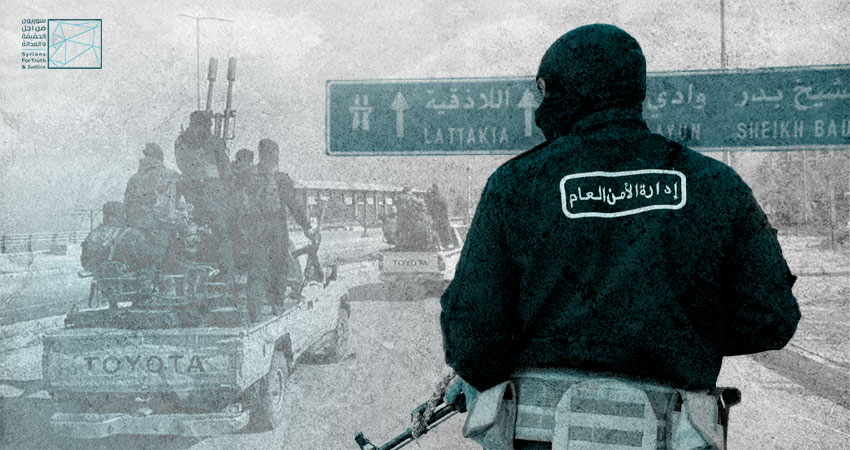
Between 6 and 10 March 2025, the Syrian coast, particularly the governorates of Latakia, Tartous, Hama, and Homs, witnessed a wave of violence following the launch of large-scale “security operations” by Syrian authorities under the pretext of pursuing loyalists to the former regime and confiscating their weapons.
During these operations, numerous human rights reports, including those by Syrians for Truth and Justice (STJ), documented the commission of a series of gross violations. Government forces and allied armed groups, alongside armed volunteers who joined the operations, launched coordinated attacks targeting more than 30 towns, villages, and neighborhoods predominantly inhabited by Alawites, under the pretext of pursuing “regime remnants.” These operations resulted in the identity-based killing of at least 1,400 individuals, and were accompanied by widespread raids, looting, and arson of homes, within a context marked by sectarian hate speech and incitement. Furthermore, some areas witnessed the extermination of entire families. Numerous witnesses also reported that the attackers identified themselves as affiliated with the Ministries of Defense or Interior, or with factions operating alongside the transitional authorities.
The violations also included systematic patterns of humiliation and cruel treatment; men were forced to crawl and bark like dogs before being summarily executed by gunfire, while detainees, including the elderly, were subjected to severe beatings on camera. Survivors confirmed facing successive waves of masked armed men, some wearing military uniforms and others in civilian clothing, who repeatedly stormed homes and neighborhoods.
Although many of these violations were committed under pretexts related to “investigation” or “pursuing remnants,” the pattern of repeated targeting based on identity and sectarian affiliation, coupled with the vast scale of the violations, indicates a collective punishment approach that broadly targeted Alawite communities, regardless of individual responsibility. Notably, these violations did not cease with the end of the main wave of massacres on 10 March 2025, but continued in various forms during the subsequent period, especially in Homs.
The Syrian Transitional Government had announced on 9 March 2026 the formation of a national commission for inquiry and fact-finding. However, the commission’s formation and working mechanisms, in addition to its report which was not published in full, raised criticisms and concerns regarding its independence, transparency, lack of inclusivity, and lack of impartiality.
In the aftermath of these events, the UN Commission of Inquiry on Syria concluded in its August 2025 report on the events in the Syrian coast that the attacks were systematic and widespread, and that members of forces affiliated with the transitional authorities, alongside independent actors and fighters loyal to the former regime, committed gross violations that may amount to war crimes, including murder, torture, abduction, looting, and destruction of property.
3. Obstacles to Recovering and Burying Victims’ Bodies:
The suffering of the victims’ families did not end with the loss of their relatives during the massacres, but extended to the subsequent stages related to receiving and burying the remains. In many cases, remains were left for long hours, and sometimes for days, inside homes or on the streets, amidst ongoing gunfire, the deployment of armed groups, and the residents’ fear of moving or approaching the locations of the remains.
In his testimony to STJ, “Khaled,” a witness and brother of one of the victims in the city of Baniyas, recounted that his brother’s family was unable to receive the remains after his killing due to the continued presence of armed men and heavy gunfire in the neighborhood. “Khaled” added that his father attempted to make arrangements to retrieve and bury the remains immediately upon learning of his son’s killing. However, a neighbor who remained in the neighborhood warned him, saying: “Do not come; they are killing anyone who approaches,” in reference to the ongoing presence of armed men and gunfire in the area.
“Khaled” explained that it took the neighbor many hours to be able to pull the remains and bring them inside the building, before the victim’s mother, an elderly woman suffering from osteoporosis, was forced to transport her son’s remains herself after the presence of armed men had relatively subsided. The witness said: “She carried her son’s remains alone, wrapped in a blanket, and brought them back home.”
“Khaled” added that the family refrained from transferring the remains to the hospital due to the fear of losing them or having them buried in mass graves, stating that residents were circulating information about “taking the bodies and burying them en masse using bulldozers and trucks.” Meanwhile, other testimonies spoke of the piling up of remains inside hospitals and the difficulty of identifying some of them. He also reported that Red Crescent and “White Helmets/Civil Defense” teams later began collecting the remains and cleaning the streets “out of fear of United Nations vehicles passing by,” as he expressed it.
In another testimony, “Mai,” a witness from the city of Baniyas who lost two of her relatives, stated that numerous families refused to transfer the remains of their relatives to the hospital due to the absence of any clear mechanism for receiving or documenting them, in addition to the fear of the remains being lost or buried without the knowledge of their families. She added that her relatives who assisted the Red Crescent in transporting the bodies told her that the teams’ role was limited to “writing the victims’ names on body bags,” amidst the presence of “massive numbers piled on top of each other” inside the hospital, as she described.
These testimonies indicate that the suffering of the victims’ families did not end with the loss of their relatives; rather, it extended to the phase of handling and burying the remains, under circumstances characterized by fear, lack of protection, chaos, and the continued control of armed groups over the affected areas.
4. Mutilation of Bodies and Degrading the Dignity of Victims:
STJ documented cases where families were forced to experience agonizing moments related to the desecration or degrading treatment of bodies. In her testimony to STJ, “Dalal,” a survivor who lost three of her family members during the massacres, stated that armed men returned to the family home after killing the three victims and “began mutilating and desecrating the bodies in an indescribable manner,” as she expressed it. She added that the remains stayed inside the house for nearly two days before Red Crescent teams were able to transfer them to the National Hospital in Baniyas.
In another testimony, “Razan,” a survivor from the village of Al-Snoubar in the Jableh area, described what the village residents endured after the killings, noting that residents were forced to watch the remains of their relatives in the streets without being able to reach or bury them. She stated: “Residents were watching the bodies of their relatives being eaten by dogs.” She also reported that armed men “desecrated the bodies of the martyrs using firecrackers at night,” and “dragged the bodies through the village streets with their cars,” adding that the village residents were prevented from burying their victims, and that “humiliation afflicted both the living and the dead alike.”
These testimonies reflect how the handling of the victims’ remains turned into an extension of the violence itself, where the suffering extended from the loss of relatives to depriving families of bidding them farewell or burying them in a dignified manner, and forcing them to face degrading and harsh scenes that left deep psychological impacts on the survivors and the relatives of the victims.
5. Death Certificates and the Imposition of an Official Security Narrative:
The suffering of the families extended to the phase of registering deaths and obtaining official documents. Testimonies obtained by STJ reported that families faced direct and indirect pressures to characterize the victims as “regime remnants” or casualties of clashes with government forces, in exchange for completing the official procedures related to issuing death certificates. In many cases, these pressures drove families to refrain from obtaining death certificates for months, or to resort to lawyers and “confirmation of death” lawsuits to avoid adopting the narrative that some official bodies attempted to impose.
In his testimony to STJ, “Khaled,” the brother of one of the massacre victims in the city of Baniyas, stated that months after his brother’s killing, his sister-in-law attempted to initiate the procedures for confirming the death, but was surprised by a change in the procedures followed at the Civil Registry Office. He explained that the employees told her she had to sign a pre-prepared document stating that the deceased was “from the regime remnants,” and that he “participated in the coup attempt and was fighting in the ranks of the remnants.” He added: “She was told: If you do not sign this paper, you will not get a death certificate.” According to “Khaled,” his sister-in-law refused to sign this narrative, prompting the official to tell her: “Go out, think, and then come back with an answer,” before she left the premises without completing the procedures.
In another testimony, “Samar,” an employee at a hospital in Tartous and the sister of a victim, stated that she and her sister-in-law went almost two months after his killing to complete the legal procedures related to confirming the death. However, the Directorate of Civil Registry asked them to bring a police report because a “gunshot wound” was mentioned in the doctor’s report. She added that they were sent to the Southern Police Station in the city of Tartous, where the officers refused to write the report and asked them to sign a paper stating that her brother “was from the remnants of the former regime and was fighting the state.” “Samar” confirmed that they refused to sign “this false claim,” explaining that her brother “was heading from his home in Tartous to the village, had no connection to the regime remnants, and possessed no weapons or any illicit items.” She added: “To this day, we have not issued the death certificate and have not carried out the legal procedures; we will not wrong my brother a second time after he was wronged and killed for no reason.” She also stressed that her brother had previously been detained by the former regime’s apparatuses and remained on trial for years, adding: “My brother suffered injustice during the rule of the former regime, and suffered injustice again after the de facto authority came to power.”
“Mai,” an agricultural engineer from the city of Baniyas who lost two of her relatives during the massacres, also reported that the family was forced to hire a lawyer to follow up on the procedures for the death certificate and the determination of heirship, before the death was officially registered under the phrase “natural death.” “Mai” also pointed out her knowledge of other cases where “they were forced to sign a paper claiming that their deceased was killed because he was from the remnants of the defunct regime and was in an armed clash with the security forces.”
In another testimony, “Hiba,” a survivor from the city of Jableh who lost her husband, his two brothers, and his father in the massacres, said that the family faced direct pressures related to the issuance of death certificates, explaining: “We were pressured to sign a paper stating that the one who was martyred was affiliated with the remnants of the former regime or was killed by the remnants of the former regime.” She added that because of this, the family refrained from obtaining death certificates for the victims for a long period, before the official bodies retracted that formulation and began registering the death as resulting from “sustaining a gunshot wound.” She said: “When the government realized that we would not sign these false claims, they started writing in the death certificate that the death resulted from sustaining a gunshot wound, and at that point we issued the death certificates.”
Similarly, “Dalal,” a survivor who lost three of her family members, said that her daughter and her mother-in-law initially refrained from obtaining death certificates for the victims, explaining that “government departments were pressuring them to claim that regime remnants were the ones who killed them.” She added that the family was only able to obtain the death certificates nearly two months after the massacres, and that the cause of death recorded in the official documents was limited to the phrase: “Death as a result of a gunshot wound.” She also noted that families of other victims, including the family of her close friend, faced similar pressures to claim that “regime remnants were the ones who committed the massacre.”
As for “Razan,” a survivor from the village of Al-Snoubar in the Jableh area who lost her father and three of her brothers during the massacres, she said that the family was asked to bring a police report showing the cause of death when attempting to obtain the death certificates, adding that “it was being written: regime remnants, or during a clash between security forces and regime remnants.” She added that the family rejected this formulation as they saw it as an attempt “to evade responsibility for the massacres,” which drove them to refrain from issuing the death certificates for a long time. She explained that during February 2026, the family was forced to hire a lawyer and file a “confirmation of death” lawsuit, which included describing the perpetrator as an “unknown masked armed group,” despite the family knowing the identity of those responsible for the killing, adding: “The killers and criminals are known and are still free and present in our village.”
These testimonies indicate that the procedures for registering deaths and obtaining death certificates were not merely a neutral administrative or legal track, but transformed into an additional space to pressure families and reshape the narrative related to the killing of the victims, by linking them to hostilities or characterizing them as “regime remnants.” This comes despite the fact that many of the testimonies documented by STJ relate to civilians killed inside their homes, on the rooftops of buildings after being forced up there, or in the vicinity of their homes and neighborhoods, without any indications of their participation in hostilities or their possession of weapons. The testimonies also showed that a number of the victims were civilian employees, students, or people who had previously been subjected to arrest or trial under the former regime, which reinforced their families’ refusal to adopt the narratives that official bodies attempted to impose regarding the circumstances of their killings. In several cases, witnesses reported that they knew the identity of the attackers, or that the armed groups identified themselves as affiliated with the Ministries of Defense or Interior, or with factions operating alongside the transitional authorities, which deepened the families’ refusal to characterize the victims as casualties of clashes with “regime remnants.”
6. Legal Characterization of Documented Violations:
This report does not address in detail all the violations that accompanied the Syrian Coastal massacres in March 2025, many of which have been previously documented in other human rights reports. Rather, it focuses primarily on the violations related to the handling of remains, the obstruction of victim burials, the mutilation of bodies, and the pressures related to the procedures for registering deaths and obtaining death certificates, and the resulting violation of human dignity, the right to truth, and access to justice.
The facts and testimonies documented by STJ indicate that a number of these acts constitute a gross violation of International Humanitarian Law, Customary International Humanitarian Law, as well as the Syrian Penal Code. The four Geneva Conventions and their Additional Protocols stipulate the obligation of warring parties to respect the rules regarding the burial of the dead during military operations, and that burials be carried out according to the rites of the deceased’s religion if possible, along with the necessity of respecting their graves. They also oblige parties to the conflict to search for the dead of the opposing party, prevent their despoliation, and record as soon as possible all particulars which may assist in the identification of the dead.[1]
The aforementioned conventions also permit parties to the conflict to appeal to civilians and relief societies to search for the dead and report their locations. Parties to the conflict must agree on arrangements to allow teams to search for the dead, identify them, and recover their bodies from combat zones, with the necessity that the members of these teams enjoy respect and protection while exclusively engaged in these duties. The dead must be searched for, protected from desecration, and given their last rites in a dignified manner.[2] Customary International Humanitarian Law also obliges parties to the conflict to respect the bodies of the dead, to respect and adequately maintain their graves, and necessitates taking the required measures to prevent the despoliation of the dead or the mutilation of their bodies.[3]
These texts prove that human dignity in international humanitarian law is an absolute value that does not diminish with death or military hostility. Obliging adversaries to search for the remains of their enemies, protect them from mutilation or despoliation, and ensure their proper burial reflects a strict legal protection for the sanctity of the dead, regardless of their stance or identity. These binding rules gain special importance in the face of the heinous violations documented by the testimonies, ranging from the mutilation and dragging of bodies, leaving them in the streets or preventing their burial, up to deliberately forcing families to watch these atrocities, and coercing them to provide statements contrary to the truth to obtain death certificates. This constitutes a flagrant assault on human dignity, whose degrading psychological impact extends to the living relatives of the victims.
In this context, it must be noted that the Syrian Penal Code has accorded special sanctity to bodies and burial ceremonies, imposing a penalty of imprisonment from one month to one year on anyone who violates the sanctity of the dead or steals or destroys a body, in whole or in part (Articles 463 and 465).
Furthermore, depriving families of safe access to the remains of their relatives or burying them in a proper manner, and obstructing or delaying burial operations, contradicts the principles that mandate respect for the bodies of the dead and ensure they are handled in a manner that preserves their dignity and the rights of their relatives. The gravity of these violations increases when coupled with incendiary discourse or targeting based on identity and sectarian affiliation, as reported in a number of testimonies documented by STJ.
Regarding the procedures for registering deaths and obtaining death certificates, the testimonies presented in this report raise serious legal issues concerning the right to truth, and the duty of authorities to document facts accurately and impartially, ensuring that administrative or legal procedures are not used to impose narratives that contradict the facts or the statements of victims and witnesses. The UN “Updated Set of principles for the protection and promotion of human rights through action to combat impunity” has affirmed that every victim and every society has an inalienable right to know the truth about gross violations and the circumstances of their occurrence.
The testimonies documented by STJ show that some families faced direct or indirect pressures to sign narratives linking the victims to hostilities or characterizing them as “regime remnants,” in exchange for completing death registration procedures or obtaining official documents. These practices not only prejudice the rights of the victims and their families, but also undermine the integrity of official records and the possibility of access to truth and accountability in the future, especially in the contexts of mass violations that require independent and effective investigations to preserve facts and evidence accurately and impartially.
Moreover, the residents’ refraining from completing official procedures for long periods reflects the persistence of an environment of fear and a lack of trust in the existence of safe and effective pathways for redress and accountability, in addition to the families’ fear of facing reprisal or harassment due to their adherence to their narrative regarding the circumstances of their relatives’ killings.
7. Recommendations:
In light of the testimonies and facts documented by Syrians for Truth and Justice (STJ), and the violations they reveal regarding the handling of remains, the burial of victims, and the procedures for registering deaths and obtaining death certificates, STJ presents the following recommendations to the Syrian Transitional Authorities and the international community. These recommendations aim to ensure respect for the rights of victims and their families, prevent the recurrence of these violations, and promote the pathways to truth, accountability, and justice.
7.1. To the Syrian Transitional Government:
- Ensure independent, effective, and transparent investigations are conducted into the violations related to the handling of remains, the prevention of burial, the mutilation of bodies, and the pressures associated with death registration procedures and the issuance of death certificates in the context of the Syrian Coastal massacres. Take clear steps to hold perpetrators accountable, including those who issued orders, participated in, or facilitated their commission, regardless of their positions or affiliations.
- Ensure that state institutions are not used to impose narratives relating to the circumstances of the victims’ deaths or their political or military affiliations, and cease any practices that coerce families into signing statements or narratives that contradict the facts regarding the killing of their relatives.
- Ensure the causes of death are registered accurately, professionally, and impartially; provide the opportunity to review or correct official documents in cases where inaccurate or misleading information is suspected to have been recorded; and guarantee the right of families to obtain death certificates and official documents without discrimination.
- Respect the dignity of victims post-mortem, and ensure the handling of remains complies with legal and humanitarian standards, including handing them over to their families without unjustified delay, allowing their burial in a safe and dignified manner, and preventing any practices that involve the mutilation of bodies or degrading the dignity of the dead.
- Adopt effective measures to protect victims, survivors, their families, and witnesses from any acts of reprisal, intimidation, or harassment due to their testimonies or stances related to the events.
- Implement its legal obligations under the Geneva Conventions and their Additional Protocols, the rules of Customary International Humanitarian Law, and the Syrian Penal Code.
7.2. To the International Community and UN Mechanisms:
- Support independent documentation efforts, including those regarding violations related to remains and the right to truth.
- Continue monitoring the situation of victims and their families, and press for independent and transparent investigations leading to actual accountability for the perpetrators of violations.
- Support initiatives aimed at preserving evidence and records related to the violations, and ensure they are not tampered with or used to impose inaccurate narratives regarding the victims and the circumstances of their killings.
- Emphasize, in all forms of engagement with the Syrian Transitional Authorities, the necessity of respecting human rights, particularly the rights of victims and their families, and ensuring their right to truth, justice, and redress.
- Pressure the Syrian government to fulfill its legal obligations in accordance with the standards of International Humanitarian Law and Customary International Humanitarian Law.
[1] Articles 15, 16, and 17 of the First Geneva Convention for the Amelioration of the Condition of the Wounded and Sick in Armed Forces in the Field, and Article 20 of the Second Geneva Convention for the Amelioration of the Condition of Wounded, Sick and Shipwrecked Members of Armed Forces at Sea.
[2] Articles 17, 33, and 34 of Additional Protocol I and Article 8 of Additional Protocol II to the four Geneva Conventions.
[3] Rules 112, 113, and 115 of Customary International Humanitarian Law.