
1. Background
The project, commonly known as the “Arab Belt,” is one of the most prominent examples of “demographic engineering” carried out in Syria before 2011. Although the project’s practical implementation began in the 1970s, its roots and early indicators trace back to a series of policies and veiled legal measures introduced years earlier.
The project was officially implemented following Resolution No. 521, issued by the Regional Command of the Arab Socialist Ba’ath Party on 24 June 1974. Under this directive, thousands of Arab families displaced by the construction of the Tabqa Dam were resettled along a border strip along the Syrian-Turkish frontier. These communities became widely known as the “Arab al-Ghamr” (the Inundated Arabs), a designation derived from the flooding (al-ghamr) of their ancestral lands by the rising waters of the Euphrates Dam.
The project involved the expropriation of vast tracts of agricultural land across predominantly Kurdish areas within the al-Hasakah Governorate, as well as in parts of the rural Raqqa countryside and northern Aleppo, with a particular focus on land directly adjacent to the Syrian-Turkish border.
2. Chronological Development of the Project
The project’s history can be divided into four main phases:
1. Preparatory Phase (1931–1962):
This period saw the emergence of official proposals and policies advocating the redistribution of populations in Kurdish border regions and the restriction of the Kurdish presence there. Among the earliest examples was the memorandum submitted by Muhammad Kurd Ali, Minister of Education in the government of Taj al-Din al-Hasani, to the Prime Ministers on 18 November 1931.
2. Land Expropriation Phase (1958–1973):
With the implementation of Agrarian Reform Law No. 161, agricultural lands and properties deemed to exceed the legally prescribed ownership ceiling were confiscated from Kurdish landowners and villagers, as well as from some Assyrian and Arab owners. This phase also saw the first settlement initiatives, bringing Arab families into villages in the countryside of Ras al-Ayn/Serê Kaniyê.
3. Settlement Phase (1974–1980s)
This period marked the effective implementation of the “Arab Belt” Project, during which families displaced from inundated areas affected by the construction of the Euphrates Dam were resettled in model villages established for this purpose.
4. Entrenchment Phase (From the Era of Hafez al-Assad to the Post-Regime Period)
The consequences of the project and its associated policies persisted throughout the rule of Hafez al-Assad and beyond the fall of the regime. To date, the legal and social repercussions resulting from these measures remain largely unaddressed.
3. Key Facts About the “Arab Belt” Project
3.1. The Official and Systematic Implementation of the Project Began in 1974
Although ideas and proposals to reshape the demographic composition of Kurdish border regions date back several decades, the systematic implementation of the “Arab Belt” Project began after the Regional Leadership of the Arab Socialist Ba’ath Party issued Resolution No. 521 on 24 June 1974.
The resolution provided the political and administrative framework needed to move the project from conceptualization and security-oriented planning to practical implementation. This was achieved by establishing model villages and resettling Arab families within the border strip, particularly in the northern parts of al-Hasakah Governorate.
3.2. The Project Was Preceded by the Expropriation of Land Through Legal and AdministrativeMeasures
The “Arab Belt” Project did not begin with the resettlement of populations. Rather, it was preceded by a prolonged process of restructuring land ownership across Syria, particularly in the Jazira region. With the implementation of Agrarian Reform Law No. 161 of 1958, extensive tracts of agricultural land were expropriated. While the law was officially intended to curb large-scale landholding and promote social justice, available documents and studies indicate that its implementation in Kurdish-majority areas took a distinct form. Expropriation and land seizure disproportionately affected Kurdish landowners compared with other communities. Portions of the confiscated land were later redistributed to local Arab tribes or to settlers who were brought into the region as part of the “Arab Belt” Project. Many Kurdish scholars and researchers have argued that these practices linked agrarian reform to broader political and demographic objectives that extended beyond the law’s stated economic goals.
3.3. The Project Extended Along the Entire Syrian-Turkish Border Strip
The project spanned a vast area stretching from al-Malikiyah/Derik in the east, through Qamishli and Ras al-Ayn/Serê Kaniyê, to areas west of Tell Abyad/Girê Spî, and at one stage as far as Afrin, covering more than 300 kilometers. This extensive scope demonstrates that the project was not a limited local initiative but rather a state policy targeting the entire border region, where the historical Kurdish presence has been concentrated in northeastern Syria.
3.4. The Project Sought to Create a Demographic Buffer Along the Border
In some areas, the belt reached a width of approximately 10 to 15 kilometers. Its stated objective was security-related, namely, the creation of an Arab-populated strip directly along the Turkish border. However, numerous historical and human rights studies view the project as a deliberate attempt to sever Kurdish communities in Syria from their demographic and cultural extensions on the other side of the border, thereby disrupting geographic continuity and isolating Kurdish populations on both sides.
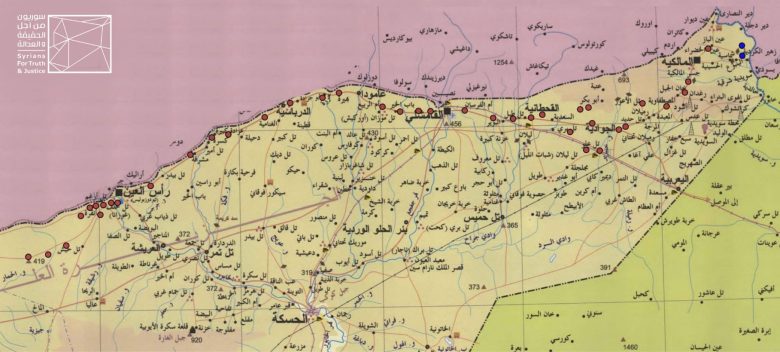
A map designed by Syrians for Truth and Justice (STJ) showing the newly established model villages in red, as part of the project commonly referred to as the ‘Arab Belt’.
3.5. The Project Relied on the Resettlement of “al-Ghamr” Families
The Syrian authorities relocated thousands of Arab families whose lands were submerged by the reservoir after the construction of the Euphrates Dam. These families were resettled in newly constructed villages on previously expropriated lands that were, for a time, designated as “State Farms.” Consequently, these communities became widely known as the “al-Ghamr Families.”
Although compensating communities displaced by national infrastructure is a standard state obligation, the manner of implementation here was inherently unlawful. By expropriating land already owned or contested by local inhabitants, the authorities weaponized resettlement as a tool of demographic engineering. This created a structural conflict between the ‘acquired rights’ of the settlers and the ‘inalienable rights’ of the displaced native landowners.
3.6. The Project Was Closely Linked to the 1962 Exceptional Census
The “Arab Belt” project cannot be understood in isolation from the 1962 Exceptional Census in al-Hasakah Governorate, which stripped tens of thousands of Syrian Kurds of their nationality. This systematic deprivation of citizenship effectively paralyzed the affected population’s legal capacity: it blocked them from registering property ownership, proving land titles, or invoking the legal protections guaranteed to Syrian citizens. Consequently, rendered legally defenseless, these communities became uniquely vulnerable to the loss of their ancestral lands and faced insurmountable hurdles in contesting state expropriation and confiscation orders.
3.7. Not All Beneficiaries of the Project Supported It
Testimonies documented by STJ in an earlier report, together with numerous published documents, indicate that not all Arab families resettled under the project viewed it as entirely legitimate or equitable. Some newcomers expressed ethical and social reservations about living on lands they knew had previously belonged to other inhabitants. These accounts suggest that the project’s consequences were not confined to the Kurdish communities directly affected by land expropriation and displacement. Rather, they also placed a segment of the Arab beneficiaries in a socially complex and often uncomfortable position.
3.8. The Project Raised Fundamental Constitutional and Legal Concerns
Numerous legal studies indicate that the land expropriation measures associated with the project did not fully satisfy the constitutional requirements governing the deprivation of private property. These requirements generally require that expropriation serve a genuine public interest and be accompanied by fair and prior compensation for affected owners. Furthermore, linking expropriation and land acquisition policies to ethnic or demographic considerations runs counter to the principles of equality before the law and non-discrimination, both of which have been enshrined in successive Syrian constitutions. Nevertheless, the practical implementation of these constitutional guarantees has been marked by widespread violations and significant inconsistencies over time.
3.9. The Project Left Lasting Social Consequences and Protracted Property Disputes
Land expropriation and population resettlement policies created a complex legacy of property and social disputes that persisted for decades. Many parcels of land remained the subject of competing claims between original owners and subsequent beneficiaries, while the demographic engineering policies underpinning the project profoundly affected social relations and mutual trust among local communities.
The repercussions of these policies persist today, fueling ongoing legal claims, unresolved property disputes, and deep-seated social tensions rooted in historical grievances and the region’s collective memory.
4. The “Arab Belt” Project and Transitional Justice in Syria
Following the fall of Bashar al-Assad’s regime, addressing the legacy of discriminatory policies affecting property, housing, and citizenship rights became an urgent national priority. STJ views the “Arab Belt” issue as an indispensable component of transitional justice. The policy directly affects individual and collective property rights, as well as victims’ rights to effective remedies and reparations. Resolving this issue requires equitable legal solutions that restore the original owners’ rights while deliberately preventing new injustices against subsequent generations.
Therefore, addressing this file, alongside the exceptional census and the stripping of citizenship from many Syrian Kurds, which Decree No. 13 later dealt with, is a pivotal issue in any national reconciliation process and in rebuilding a state based on the rule of law, institutions, and equal citizenship.
5. Conclusion and Recommendations
The facts surrounding the “Arab Belt” project demonstrate that it was not merely a land redistribution program or an initiative to resettle those affected by the construction of the Euphrates Dam. Rather, it was part of a broader set of exceptional policies and measures that affected property rights and altered the demographic structure of vast areas in northern and northeastern Syria. These policies have left enduring legal, social, and economic consequences that have persisted for decades and continue to shape ongoing disputes over land, property ownership, and local identity.
In light of the above, there is a pressing need to incorporate the “Arab Belt” file into Syria’s transitional justice process through an independent, comprehensive review of the land confiscations and resettlement operations associated with the project. This should include ensuring that affected individuals have the right to reclaim their property or receive fair compensation, as well as documenting violations of property, housing, and land rights and preserving relevant evidence.
This process should be carried out by establishing an independent legal commission composed of legal experts, researchers, and representatives of local communities. The commission’s mandate would be to examine claims of such violations and issue determinations, with its decisions subject to appeal before the competent property and land courts.
Furthermore, it is essential to adopt an approach grounded in equality and non-discrimination, ensuring that the consequences of past exceptional policies are addressed and that they do not recur. Such an approach should help strengthen social peace and coexistence among Syria’s diverse communities, grounded in the principles of equal citizenship and the rule of law.
This approach should also include developing alternative, sustainable solutions, such as alternative resettlement arrangements or adequate financial compensation, for those who were used as instruments in this project, namely, those displaced or affected by flooding caused by the Euphrates Dam. This is necessary to ensure that the restoration of rights does not displace other families or create new grievances and injustices.