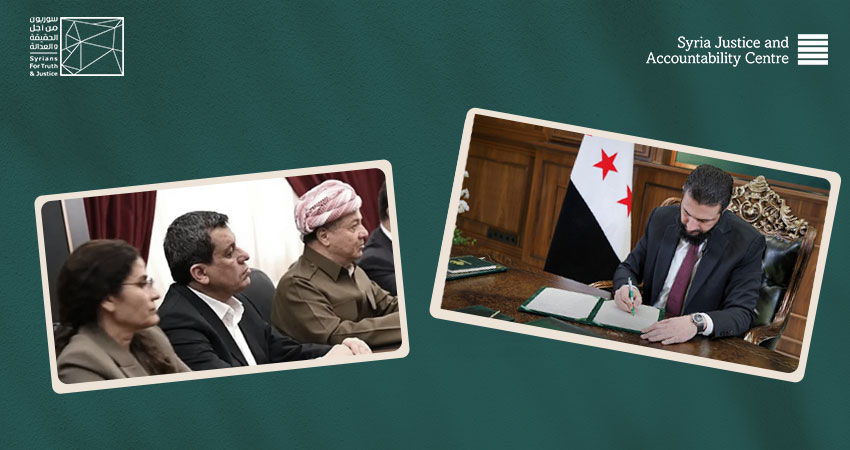
As part of its efforts to monitor the implementation of Decree No. 13 on Kurdish rights in Syria, issued in January 2026 by Syria’s Transitional President, Ahmed al-Sharaa, Syrians for Truth and Justice (STJ), in partnership with the “Syria Justice & Accountability Centre – SJAC”, convened the inaugural meeting of its working group to track the decree’s implementation and assess its practical impact on the ground.
This activity is part of an independent project implemented by STJ to monitor the implementation of all provisions of the decree in a technical and objective manner. The initiative is carried out through a working group comprising experts, local and international organizations, and individuals with expertise and interest in human rights and legal issues. Comprising more than 40 members, the group seeks to assess the extent to which relevant authorities are complying with the decree and to promote its implementation in line with Syria’s legal obligations under both national and international law.
The session, held on 1 June, brought together a broad range of activists, civil society actors, political figures, and legal experts, who discussed progress in implementing the decree, the challenges surrounding its enforcement, and the gaps that remain to be addressed.
During the session, Faisal Youssef, a representative of the Kurdish Reform Movement and a spokesperson for the Kurdish National Council (KNC), welcomed the decree, calling it “a positive step, though only a partial entry point toward addressing the Kurdish issue in Syria.” He stressed the need to submit the decree to a future parliament so that Kurdish rights can be incorporated into national legislation and the country’s permanent constitution.
For his part, Riyad Ali, Senior Legal Adviser at STJ, described the decree as “a step forward,” while noting that it does not address several key issues related to Kurdish rights. He underscored the importance of incorporating the decree’s provisions, as well as the issues left unaddressed, into Syria’s future constitution to ensure the long-term protection and sustainability of these rights. He also highlighted the need to clarify certain terms in the decree, including the phrase “significant proportion,” and to formulate the state’s obligations regarding the rights enshrined therein in a clearer and more binding manner.
Thomas McGee, a researcher specializing in nationality and statelessness and co-coordinator of the MENA Statelessness Network (Hawiati), highlighted the ongoing lack of clarity about the decree’s implementation mechanisms and timeline. He noted that individuals deprived of nationality and living outside Syria still lack a clear avenue to apply for the restoration of their rights. He also questioned the extent of the government’s commitment to advancing the linguistic rights set out in the decree, including access to Kurdish-language education.
Background
As part of its monitoring and follow-up efforts, STJ announced in January 2026 the creation of an independent monitoring group to oversee the implementation of Decree No. 13. The group is tasked with tracking implementation, coordinating with Syrian and international partners, and advocating for the effective enforcement of the decree’s provisions. It will also hold regular sessions to discuss various aspects of the decree and produce policy papers and recommendations for relevant stakeholders and decision-makers.
In addition to monitoring implementation, the group will address a number of historical grievances and unresolved issues not covered by the decree, most notably the legacy of the Arab Belt project and pathways toward sustainable solutions during the transitional period, including efforts to ensure that the rights enshrined in the decree are incorporated into Syria’s permanent constitution.
Interested individuals are encouraged to participate in upcoming discussions and sessions and to contribute to efforts to advance Kurdish rights and promote the full and effective implementation of the decree.
To participate or for further inquiries, please contact us at: decree13@stj-sy.org