
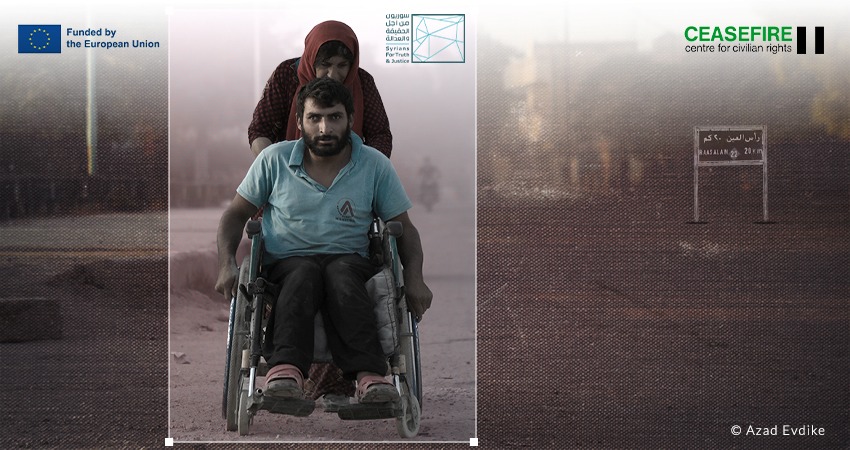
This publication was funded by the European Union, and in partnership with the Ceasefire Centre for Civilian Rights. The contents of this publication are the sole responsibility of Syrians for Truth and Justice – STJ/ the publisher and do not necessarily reflect the views of the European Union or the Ceasefire Centre for Civilian Rights.
1. Introduction
The fall of the Syrian regime in late 2024 marked a historic turning point, raising hopes among millions of refugees and internally displaced persons (IDPs) that they could finally return to the homes and properties they had been deprived of for years.
One year after this change, despite presidential pledges from Damascus advocating a policy of Zero Camps and Zero Displacement and reaffirming the right of return, the issue of forcibly displaced people from the Peace Spring areas; Ras al-Ayn/Serê Kaniyê and Tell Abyad/Girê Spî, remains at a standstill. In fact, compared with other regions, progress in these areas appears effectively blocked, owing to the stark gap between political rhetoric and the actual security conditions on the ground.
The displaced population was scattered across multiple locations in North and East Syria and beyond, including cities in al-Hasakah Governorate and the Kurdistan Region of Iraq. Washokani/Twaina and Serê Kaniyê camps became the primary reception centers for those fleeing Ras al-Ayn/Serê Kaniyê, jointly accommodating more than 32,000 people in the years that followed. Meanwhile, those displaced from Tell Abyad/Girê Spî primarily relocated to Raqqa city, Ain Issa town, and the Tel Samen Camp, which alone hosted approximately 7,000 individuals, according to data from local non-governmental organizations.
As of June 2026, no reliable official statistics are available on the number of returnees to the two areas following the collapse of the former regime in Syria. Nevertheless, available indicators suggest that returns remain extremely limited. Reports have noted the gradual return of some families, while thousands of Kurdish families continue to await adequate security guarantees before deciding to return.
The Syrian transitional government has yet to present a clear plan for the return of displaced persons from these two areas or for the restitution of property to its rightful owners. The only official indication came from Dr. Mustafa Abdi, a member of the Syrian Presidential Team responsible for implementing the agreement with the Syrian Democratic Forces (SDF). In an exclusive interview with Rudaw Media Network, Abdi said,
“Preparations are underway to return approximately 12,000 families from Serê Kaniyê to their homes and properties in safety and dignity.”
Despite the apparent goodwill in the Presidential Team’s statement, it directly clashes with realities on the ground. The announcement lacks any concrete implementation mechanism or independent judicial framework to address property grievances and enforce restitution. Moreover, the statement underscores a stark contradiction between the political messaging directed at the media and the internal dynamics of the transitional government. Internal reports and verbal communications indicate that displaced Kurds have been advised to “exercise patience and refrain from returning for the time being.” This hesitation stems from the central security apparatus (General Security)’s inability to establish effective control over local councils and armed factions, which continue to resist oversight and profit from unlawfully seized properties and agricultural lands.
Reports also emerged about a meeting held in Serê Kaniyê/Ras al-Ayn on 6 June 2026. According to information published by Welat TV, the meeting was attended by Brigadier General Marwan al-Ali, Commander of Internal Security in al-Hasakah; Brigadier General Mahmoud Khalil; District Director Abdullah al-Jasham; and Security Director Mahmoud Saleh.
The report noted that the participants affirmed that “the current priority is to accelerate mine-clearance operations and the removal of war remnants in order to secure residential and agricultural areas and create suitable conditions for the return of residents, in accordance with the January 29 Agreement.” It also stated that discussions addressed ways to strengthen the role of the Internal Security Forces and to reactivate their institutions in a manner that supports stability and security in the region.
These statements come amid genuine local concerns that the meeting’s outcomes, along with the accompanying discourse on creating conditions for return, may amount to little more than an attempt to legitimize the status quo and project a superficial administrative facade. The prevailing official narrative places considerable emphasis on technical and material obstacles, such as landmines and explosive remnants of war, while completely overlooking deep-seated structural and security impediments. These include entrenched factional patronage networks, “property ransom” extortion schemes, and systemic ethnic discrimination allegedly practiced by armed groups against returning residents.
This updated report examines the structural, security, and legal factors that continue to impede the return of the original inhabitants, particularly displaced Kurdish and Arab residents, to the Ras al-Ayn/Serê Kaniyê and Tell Abyad/Girê Spî axis. It highlights ongoing violations of housing, land, and property (HLP) rights, the institutionalization of financial extortion, and the lack of security guarantees to protect returnees from retaliation. Furthermore, the report assesses the nature and implications of the publicly announced integration of local factional structures with the transitional government.
2. Background and Political-Security Context (2025-2026)
The Turkish military operation, conducted alongside factions of the Syrian National Army (SNA) in October 2019, displaced more than 176,000 people by the end of the month, according to estimates from the United Nations Office for the Coordination of Humanitarian Affairs (OCHA). The United Nations Under-Secretary-General for Humanitarian Affairs also informed the Security Council that the offensive had displaced approximately 180,000 people from the border areas, including tens of thousands of children from the two cities and their surrounding countryside.
Following the collapse of the Assad regime, Transitional President Ahmed al-Sharaa announced that every displaced person could return home without conditions. Subsequently, signs emerged of Türkiye’s gradual withdrawal from direct involvement, including the cessation of salary payments to military personnel after their integration into the Syrian Ministry of Defense, the removal of certain visible symbols of Turkish administrative presence, such as Turkish Post Office (PTT) branches, and the return of members of the Turkish Coordination Office in Ras al-Ayn/Serê Kaniyê to Türkiye. However, according to documented testimony, Türkiye maintained its influence behind the scenes while allowing the Syrian state to maintain the appearance of control.
Factional designations were formally replaced by the Syrian Army, and the civil and military police forces were rebranded as the General Security Service. The shift was marked by the adoption of standardized military uniforms bearing the state’s new visual identity and the official announcement of integration. However, witness testimony suggests that this transformation is largely cosmetic, as factions retain their organizational structures, leadership hierarchies, and control over strategic positions. Sources further report that these factions continue to receive directives from Turkish authorities, reinforcing the persistence of Turkish influence in the region. This is underscored by the continued presence of Turkish military bases, including the upgraded installation in Koberlik village, alongside bases in Arisha, Bab al-Faraj, al-Dawoudiyah, Allouk Station, and Tal Akhdar.
3. Methodology
This report is based on seven in-depth interviews and testimonies conducted in April and May 2026 with displaced individuals from diverse backgrounds, including lawyers and merchants from the cities of Ras al-Ayn/Serê Kaniyê and Tell Abyad/Girê Spî. These participants are located across Qamishli, al-Malikiyah/Derik, the countryside of Tell Abyad/Girê Spî, and Raqqa. The testimonies were documented following exploratory field visits by some witnesses to inspect their properties after the recent political change. To ensure their personal safety, the full identities of certain participants have been withheld, and their accounts were cross-checked against on-the-ground conditions.
The researchers also obtained informed consent from all participants after explaining the voluntary nature of their participation and the intended use of the information, including its publication in this report. At the participants’ request, pseudonyms have been used and identifying details omitted, given the potential security risks involved.
4. Structural and Security Obstacles Preventing Return
Based on oral testimonies and direct witness observations, a range of substantive, non-formal obstacles make the return of displaced persons exceedingly difficult.
First: Geographic Restrictions and the Closure of Main Transportation Routes
Despite the official announcement last March that the M4 international highway between the al-Hasakah and Aleppo governorates, specifically the Ras al-Ayn/Serê Kaniyê-Tell Tamer and Ras al-Ayn/Serê Kaniyê- Ad Darbasiyah sections, which had been closed following the Turkish Operation Peace Spring, would reopen, these two vital routes were not operational by the time this report was drafted in early June 2026. Their use remains severely hindered, and military checkpoints remain heavily deployed along them.
Individuals seeking to inspect their homes in Ras al-Ayn/Serê Kaniyê are forced to take long, secondary detours, starting in Tell Tamer and heading to the Aliya Silos checkpoint on the M4 international highway, the sole available access point. At these checkpoints, families are subjected to degrading security procedures, including being forced to hold their identification documents against their chests while being photographed alongside their vehicles for circulation. These practices effectively strip Damascus’s promises of “facilitating return” and its “Zero Camps” policy of any substantive meaning, a reality confirmed by corroborating testimonies documented by STJ.
Describing his experience trying to reach Ras al-Ayn/Serê Kaniyê over the past few months, Dilyar Miran, a displaced resident of the city, stated,
“If you want to go to Ras al-Ayn, you are forced to enter exclusively through the Aliya Silos route on the M4 international highway. The other two main roads remain closed to people seeking to return. This is why we say that the government is not sincere when it speaks of ‘zero displacement,’ ‘zero camps,’ and similar slogans.”
Miran noted multiple checkpoints along the route, adding,
“Near the al-Duwaira village, there is a checkpoint where travelers are forced to hold their identification cards against their chests. Photographs are then taken of them, and the vehicle they are traveling in is also photographed.”
This account was corroborated by another witness, Jwan Khoshnav, who visited the city approximately one month ago. Having taken the exact same route to the al-Duwaira checkpoint, he testified,
“We were stopped at the checkpoint. It was flying the Turkish flag, but the personnel manning it were local residents. However, Turkish soldiers were present inside the checkpoint rooms, I saw them with my own eyes. They searched the vehicle, asked about our destination, and then took a photograph of us inside the car, as well as another photo of our identities and the license plate, to be circulated to all checkpoints in the area.”
Second: Violations of Property Rights
Field inspections by witnesses indicate that theft and property-related violations were carried out in a systematic manner. Homes were reportedly resold, altered, or modified without the lawful owners’ knowledge or consent.
In this regard, Khoshnav stated,
“All houses had their doors and windows stolen. One of my uncles’ homes was completely leveled to the ground by a tracked bulldozer. I do not know why, perhaps to steal the concrete blocks and timber. The same happened to another uncle’s house. You could say that more than 95 percent of the houses had their doors, windows, stones, electrical cables, and electrical boxes removed. Even linen, washbasins, water taps, hoses, and all household contents were taken.”
In Tell Abyad/Girê Spî, witnesses observed that entire neighborhoods, such as al-Layl/al-Akrad and al-Jisr, had effectively been transformed into closed compounds, inhabited by commanders and members of Turkish-backed factions who had consolidated control over local properties.
Anwar Bozo, a forcibly displaced resident of Tell Abyad/Girê Spî, stated,
“The al-Akrad Quarter is inhabited by faction leaders, faction members, and personnel affiliated with the military and civil police forces who entered during Operation Peace Spring and who are from Deir ez-Zor, Eastern Ghouta, and other areas. After the fall of the Assad regime, nothing changed regarding the factions. They declared formal allegiance to the new government in Damascus but remained in their positions. Those who left, and they were very few, were civilian displaced persons. Anyone connected to a job within the factions or the police neither vacated nor relinquished any house.”
Additionally, an exclusive footage obtained by STJ, recorded by a displaced person who returned to the village of al-Qasimiyah in the countryside of Serê Kaniyê/Ras al-Ayn, revealed the extent of the destruction inflicted on the village’s homes. In the footage, a returning displaced resident identifies the owners of numerous demolished houses and notes that even the village cemetery was vandalized and destroyed. Evidence of similar systematic devastation was also apparent in video footage obtained by STJ from the village of al-Salihiyah, located between al-Arisha and al-Manajir, where widespread damage to civilian property was documented.
Third: The Spread of “Property Ransom” Practices
When original property owners attempt to reclaim their homes, they often face financial demands imposed by military or civilian occupants. Occupants frequently justify these demands by claiming they purchased the properties from departing faction members or incurred expenses for renovations and the installation of solar power systems. Such financial extortion reportedly ranges from $500 to $3,000 in exchange for vacating a house or commercial property.
Khoshnav recounted his experience as follows,
“I had to pay money to recover my house. At first, we negotiated the amount. He demanded $1,500 and swore to me that he had paid the same amount to the military official responsible for the sector. The house had been completely stripped of its contents, though the doors and windows had not been removed. In the end, we agreed that I would pay him $500 on the condition that he leave me the electricity meter and the water tank. Approximately ten days later, I regained possession of my house from him.”
Khoshnaw further noted that the occupant of his house told him he was the fifth purchaser of the property, adding that the previous occupant had stolen all of its contents and even intended to take the doors and windows with him, including the main garage door.
In the countryside of Tell Abyad/Girê Spî, particularly in villages such as Bir al-Arab and Tal Ahmar, returnees found homes completely demolished and leveled by bulldozers. As a result, displaced residents are forced to clear the rubble themselves, without the financial means to rebuild.
Meanwhile, the regularization of agricultural land owned by Kurdish residents is expected to begin after the current harvest season ends. However, the squatters occupying these properties refuse to vacate them, using bribes or regular financial kickbacks to local councils. This practice gives them quasi-official cover to solidify their presence and prevent the original landowners from reclaiming their property.
In the same context, witness Majo Khalil stated,
“Several acquaintances and friends visited their properties in the villages of Tal Ahmar and Bagha Jagh, but the occupants refused to vacate the land before the end of the current harvest season, even after the owners identified themselves as the rightful proprietors. The occupants told them: ‘If you wish to file a legal complaint against us, go ahead. We give the local council in Tell Abyad a 12% share of the harvest, so any complaint will be futile.’”
Fourth: Unchecked Violence, Physical Assault, and Direct Death Threats
The obstacles facing returnees extend far beyond financial extortion, at times escalating into direct existential threats. STJ documented a violent mob assault in downtown Tell Abyad/Girê Spî during the past month of Ramadan (March 2026) that targeted two returnees. Video footage of the incident was later circulated online (Video 1/ Video 2/ Video 3/ Video 4/ Video 5). The two displaced individuals, Sharfan al-Ramo and Khalil Ismail (widely known as Khalil Mirzo), were on a routine visit to the city when they were violently attacked by local mobs numbering in the hundreds while dining at a restaurant. One of the men was brutally beaten and dragged through the streets; his eyeglasses were smashed, his clothes torn, his shoulder fractured, and his money stolen. Furthermore, the vehicle shared by the two men was vandalized, dragged through the marketplace, and completely incinerated.
The attack was carried out under the pretext of malicious, fabricated allegations, such as affiliation with the SDF and planting car bombs. Hamad al-Barhou, a witness near the scene, told STJ that the incident began as Khalil was asking the tenant of one of his shops about the general situation, subtly implying it might be time to either start paying rent or return the shop to its owners. Suddenly, another individual wielding a cleaver grabbed Khalil and shouted in a Bedouin dialect,
“SDF?! What are you doing here? You are a Kurd, what are you doing here?!”
Al-Barhou added,
“Before long, I saw nearly 200 people trying to storm the restaurant Khalil had entered, launching a violent assault against him. With the help of a well-meaning bystander, he managed to escape the mob and sought refuge in the home of a local family of notables who stepped forward to protect him. Meanwhile, he contacted a friend in the military police, who arrived immediately, used armed force to extract Khalil from the house, and transferred him to a safe location.”
In another incident, a returning Kurdish civilian was physically assaulted and verbally abused by the unlawful occupiers of his home and their relatives in the Tell Abyad/Girê Spî military police when he asked them to vacate the property. The occupier claimed he had spent a significant amount of money on the house, installed solar panels, and carried out renovations, and demanded that the owner pay him $500. When the owner refused, they attacked him and hurled ethnic slurs, explicitly stating their “rejection of the return of Kurds to the city,” according to the account provided by witness Anwar Bozo.
Fifth: Systemic Discrimination and the Imposition of Tribal Dominance
The areas encompassed by Operation Peace Spring are marked by a discriminatory environment fueled by a deeply entrenched factional ethos that has hardened in recent years. Jwan Khoshnav stated that returnees are routinely compelled to conceal their ethnic identity, even afraid to speak the Kurdish language in public markets.
He also highlighted the persistence of this “factional mentality,” noting that armed groups are largely composed of individuals from the same geographic region or belonging to a single tribe. He added,
“Neighborhoods have effectively been segregated along familial and tribal lines to favor displaced newcomers. For instance, the al-Mashhour tribe has seized control of the outskirts of Tell Abyad, while factional fighters have saturated the Kharaba neighborhood. They have established dedicated checkpoints at the entrance of the district to inspect the identities of passersby and interrogate them regarding their reasons for entry. Meanwhile, the city’s original inhabitants can now be counted on the fingers of one hand.”
Anwar Bozo also highlighted the case of a displaced person who returned to his village near al-Sukariyah. The area had previously seen Arab-Kurdish communal tensions after a local resident was killed during the battles to liberate Tell Abyad/Girê Spî from ISIS. These hostilities resurfaced during subsequent military operations when transitional government forces seized control of the northern Raqqa countryside, leading to fierce clashes between the SDF and local armed groups in the village.
According to Bozo, although the Kurdish returnee reached his village and ancestral properties, his presence was met with deep resentment from neighbors. They reportedly targeted him with whispers and suspicious glares, muttering: “What are you doing here? Why are you Kurds coming back?”
Bozo noted that this hostile rhetoric mirrors the assault on another returnee, Zakaria al-Samman. Al-Samman was attacked and subjected to anti-Kurdish slurs by the squatter occupying his home, alongside relatives serving in the Tell Abyad/Girê Spî military police, who openly declared their “rejection of the return of Kurds to the city.”
Sixth: Concerns Regarding the “Symbolic” Nature of Syrian Sovereignty
Since their administrative formation, the areas of Tell Abyad/Girê Spî, first and foremost, and Serê Kaniyê/Ras al-Ayn to a lesser extent have experienced an ongoing struggle over identity and belonging amid the absence of a genuinely shared national identity. The years of the Syrian uprising did not alleviate these divisions; rather, they widened the gap between the region’s different communities. This dynamic peaked with Operation Peace Spring, which effectively placed political, military, and administrative decision-making in both cities under Turkish control.
After the transitional government announced the integration of military, police, and security forces into the Ministries of Defense and Interior, it began assuming control over economic, administrative, and service institutions across most areas of the country. It appointed governors and assigned representatives to manage each region, with both areas receiving their share of such appointments.
However, witnesses interviewed by STJ presented a different picture of the reality on the ground. They pointed to the “symbolic” nature of these relationships and the roles played by the appointed officials, stating that “the actual decision-making authority remains Turkish,” according to their accounts.
Witness accounts corroborate open-source information indicating that Damascus appointed new district directors in both cities, even as the pre-existing local councils remained intact. This shift was accompanied by a reshuffling of roles among other officials. For instance, Lieutenant Colonel Mahmoud al-Saleh, widely known as Abu Saddam al-Khabouri, was appointed Director of the Internal Security Directorate in Ras al-Ayn/Serê Kaniyê, having previously served as the chief of the city’s military police under the former operational framework of Operation Peace Spring.
Similarly, Abdullah al-Jasham was appointed district director. Al-Jasham had previously served on the local council in 2020, where he headed its media office. Notably, he holds Turkish citizenship and had been selected to serve on the subcommittee overseeing the People’s Assembly elections in the city.
In this context, witness Anwar Bozo stated,
“Damascus attempted to enforce the use of the Syrian Pound in the local market of Tell Abyad, instructing bread distributors to make payments to the automated bakery in it. However, the very next day, the bakery refused to implement the decision and insisted on the Turkish Lira, which remains the primary currency in the area, rather than the Syrian currency.”
Bozo added,
“The main reason we cannot return is that the military forces there do not take their orders from Damascus but from Ankara. This creates deep-seated fear among the Kurds. No one can guarantee your safety if the person occupying your property is a fighter or a commander in a faction. To whom will you complain, and which judiciary will grant you justice or restore your property?”
Nominally, the highest administrative authority in the region is the Governor of Raqqa. According to corroborating testimony, the governor met with a civilian delegation of residents from Tell Abyad/Girê Spî (the city and its countryside) to discuss the return of displaced persons. However, during the meeting, he told his guests, “As of now, we do not have actual control over Tell Abyad; therefore, it is preferable that no Kurdish displaced persons return at this time.”
Bozo also noted,
“Another security source, whom we contacted through the Kurdish National Council (KNC) in Syria to discuss our return, similarly urged us to wait.”
5. Legal Commentary and Analysis
The practices documented in this report, ranging from the confiscation of property belonging to forcibly displaced persons to the imposition of financial levies and “property ransoms” as a condition for evacuation, constitute a flagrant and direct violation of the 2025 Constitutional Declaration governing Syria’s transitional phase. Article 16.1 of the Declaration explicitly provides,
“The right to private property is protected and may not be expropriated except for public benefit and in return for fair compensation.”
Furthermore, these acts, predicated on ethnic and linguistic discrimination and aimed at preventing Kurdish citizens from returning to their homes, violate Article 10 of the Declaration. This article strictly prohibits discrimination among citizens on the basis of race, gender, religion, or lineage and affirms their absolute equality in rights and duties.
This constitutional breach is further compounded by Article 12 of the Declaration, which establishes that all rights and freedoms enshrined in the international treaties and conventions ratified by Syria form an integral part of the constitutional order governing the current transitional period.
On the other hand, these practices constitute an explicit breach of the agreement between the Democratic Autonomous Administration of North and East Syria (DAANES) and the transitional government in Damascus (the Integration Agreement), particularly Clause 14, which expressly provides,
“Ensuring the return of all displaced persons to their cities and villages (Afrin, Sheikh Maqsoud, and Ras al-Ayn/Serê Kaniyê), and appointing local officials within the civil administrations in those areas.”
Accordingly, the transitional government bears a direct legal obligation to implement this agreement by ensuring the safe and dignified return of displaced persons and the restitution of properties unlawfully seized from them. This requires issuing clear and binding directives to the factions and to military formations formally integrated into the Ministry of Defense, as well as investigating and prosecuting all individuals responsible for, complicit in, or facilitating such violations. These measures are mandated by the Syrian Penal Code, which, pursuant to Article 723, criminalizes the unlawful appropriation of another person’s real property.
At the international level, the right to housing and property is a fundamental right protected under international law. Article 17 of the Universal Declaration of Human Rights (UDHR) prohibits the arbitrary deprivation of property. Similarly, Article 5 of the International Convention on the Elimination of All Forms of Racial Discrimination (ICERD) of 1965, which Syria ratified in 1969, obliges States Parties to guarantee the right to property and housing without distinction of race, nationality, or ethnic origin.
These obligations align with the Guiding Principles on Internal Displacement (GPID), which strictly prohibit the arbitrary deprivation of property and possessions. The GPID place primary responsibility on governing authorities to establish the necessary security and legal conditions to facilitate the voluntary, safe, and dignified return of IDPs. They also mandate that the State assist them in the restitution of assets and property left behind or seized upon their displacement.
6. Recommendations
Based on the findings documented in this report, and given that these ongoing practices constitute flagrant violations of both Syrian and international law, this report urges the current transitional government to fulfill its legal and ethical obligations by taking the following measures:
- Translate the theoretical framework outlined in the Integration Agreement with the SDF on the return of IDPs and refugees into concrete implementation mechanisms with a clear timeline.
- Enact strict, binding military orders instructing all factions to immediately dismantle field-level obstacles to return, and refer all personnel implicated in HLP rights violations and extortion to independent judiciaries that strictly uphold fair-trial principles.
- Form specialized judicial committees and tribunals in the target regions examined by this report to systematically verify the deeds of original property owners and facilitate legal claims to nullify all unlawful sale, lease, or allocation contracts imposed as a fait accompli since 2019.
- Enact robust legislation criminalizing hate speech and nationalist or ethnic incitement, fully aligned with international human rights standards, to safeguard social cohesion and civil peace.
- Initiate diplomatic coordination to end Turkish military and administrative intervention in the region and transfer comprehensive authority to national state institutions, fostering a secure, neutral environment that guarantees the voluntary, safe, and dignified return of displaced populations.