
This publication was funded by the European Union, and in partnership with the Ceasefire Centre for Civilian Rights. The contents of this publication are the sole responsibility of Syrians for Truth and Justice – STJ/ the publisher and do not necessarily reflect the views of the European Union or the Ceasefire Centre for Civilian Rights.
1. Background
On 30 May 2026, the Syrian Ministry of Interior announced that its preliminary investigation had found that Amjad Youssef, one of the perpetrators of the 2013 Tadamon Massacre, was involved in the killing and enforced disappearance of the six children of Dr. Rania al-Abbasi. The announcement triggered a widespread wave of grief and public outrage across Syrian society.
The following day, an account operating under the name “Lasta Shajara Campaign” (You Are Not a Tree) appeared on the social media platform X (formerly Twitter), calling for a comprehensive social and economic boycott of Alawite communities in Syria. The campaign subsequently expanded its activities to five additional platforms: Facebook, YouTube, TikTok, Instagram, and Telegram.
The campaign positioned itself as a “grassroots extension” of ongoing accountability efforts and as a complementary initiative that would operate “in integration rather than in opposition” to official state institutions. Within weeks, calls for a boycott had expanded to encompass virtually every aspect of daily life and social coexistence, including social interactions and greetings, marriage, healthcare, education, and even burial practices. The campaign peaked with the dissemination of maps identifying specific neighborhoods and population centers by name and explicitly calling for their “social and economic dismantlement.”
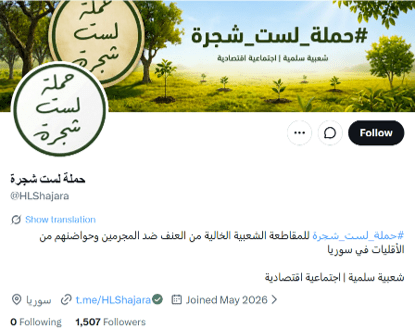
Figure 1. Screenshot of the “Lasta Shajara Campaign” account on X.
The discourse advanced by the campaign cannot be understood in isolation from the historical and on-the-ground context that enabled and shaped its emergence. Since late 2024, Syrians for Truth and Justice (STJ) has documented a series of identity-based violations targeting Alawite civilians. These included summary executions preceding the March 2025 coastal massacres, followed by grave violations in their aftermath across Latakia, Homs, Hama, Tartous, and the Damascus countryside.
The documented patterns of abuse also included identity-based targeting, a persistent pattern of motorcycle assassinations in predominantly Alawite areas, kidnappings targeting Alawite women, and forced displacement affecting Alawite families in the al-Sumaria neighborhood and other predominantly Alawite localities.
STJ has previously documented how hate speech and sectarian incitement have facilitated, exacerbated, and legitimized the violence witnessed in Syria’s coastal regions. This underscores that the risk of inflammatory rhetoric escalating into physical violence is not merely a theoretical possibility in the current Syrian context; rather, it is substantiated by recent, well-documented events.
The “Lasta Shajara” Campaign is particularly alarming because it explicitly targets members of the Alawite community based on their sectarian affiliation.
2. Methodology
This report is based on monitoring, documentation, and comprehensive analysis of all content published by the “Lasta Shajara” Campaign account (@HLShajara) on platform X, from its earliest documented post on 31 May 2026 through 2 July 2026. The analysis also included direct monitoring of the campaign’s officially affiliated accounts on Facebook and YouTube during the same reporting period.
For analytical purposes, each post was treated as the primary unit of analysis and examined through its two textual layers: (i) the text contained within the accompanying visual design or graphic, and (ii) the accompanying caption or post text. Each post was subsequently subjected to a multi-label classification framework across several analytical dimensions.
In addition, posts were categorized into several documentary classifications, including procedural and organizational content, calls for a general economic boycott, and content specifically targeting named individuals.
STJ team also monitored the Syrian Transitional Government’s response by systematically tracking official government websites and social media accounts affiliated with relevant state institutions. In documenting open-source information, the team used a corroborative methodology, cross-checking information across multiple independent sources to verify its accuracy before including it in this report.
For this report, eight direct testimonies were collected in June 2026 from Alawite men and women residing in the governorates of Tartous, Latakia, and Homs. The informed consent of all participants was obtained before their testimonies were used, following a clear explanation of the voluntary nature of participation, the intended use of the information provided, and their right to withdraw consent at any stage.
At the participants’ request, all real names have been replaced with pseudonyms, and any identifying details that could reveal their identities or expose them or their family members to retaliation risks have been withheld or anonymized.
3. Analysis of the Campaign’s Discourse
The X account for the “Lasta Shajara” Campaign published 25 posts on the day of its launch alone. Between 4 and 10 June 2026, the campaign entered what may be characterized as a phase of geographical escalation, during which it disseminated maps and locality-specific statements identifying particular areas and communities. Posting activity then gradually declined.
Across its social media platforms, the campaign consistently describes itself as a “popular non-violent boycott campaign against criminals and their incubating environments among Syria’s minorities.” Despite its relatively small number of direct followers,[1] media monitoring documented that the campaign’s visual materials and hashtags circulated far more widely than through its official accounts alone, with its messaging achieving broader dissemination.
The account also dedicated 15 posts to public mobilization efforts, announcements, and attacks on its critics. At a minimum, it publicly targeted two critics, a writer and an actor, through derogatory labeling and condemnatory statements, one of which explicitly urged the Ministry of Information to restrict the writer’s speech.
The campaign’s content was organized into the following thematic categories:
| # | Thematic Category | Number of Posts | Percentage of Total Activity |
| 1 | Incitement against specifically named localities and regions | 11 | 11.8% |
| 2 | Demographic engineering narratives (“land reclamation” discourse) | 14 | 15.1% |
| 3 | Visual materials containing dehumanizing content | 7 | 7.5% |
| 4 | Textual materials containing dehumanizing content | 11 | 11.8% |
| 5 | Calls for social and everyday-life segregation | 22 | 23.7% |
| 6 | Economic boycott measures | 16 | 17.2% |
| 7 | Religious and historical justifications for the campaign | 4 | 4.3% |
| 8 | Internal contradictions, including assertions of non-sectarianism | 18 | 19.4% |
| 9 | Procedural and organizational content | 9 | 9.7% |
| 10 | Other content (mobilization efforts, announcements, and attacks on critics) | 15 | 16.1% |
| 11 | Targeting of specifically named individuals | 15 | 16.1% |
Table 1. Distribution of Themes Across the Campaign’s Posts.[2]
3.1 Targeting of Specific Localities and the Discourse of “Settlements”
The campaign account dedicated 11 posts to incitement against specific localities and residential areas explicitly named, while an additional 14 posts promoted what may be characterized as a “land reclamation” discourse.
This discourse seeks to deny current residents recognition as legitimate inhabitants of these areas and portrays their communities as occupying “usurped lands” that ought to be restored to their purportedly “original” demographic composition.
This discourse evolved over time. It began on the first day with a form of geographically based “touristic guidance,” categorizing destinations along the Syrian coast as permissible or prohibited based on the identity of their inhabitants. It then escalated to explicitly naming and stigmatizing neighborhoods in Homs ; al-Nozha, Wadi al-Dhahab, and Akrama, through imagery of their street signs, accompanied by calls to refrain from renting or selling property to Alawites.
The discourse peaked with the publication of two maps of Damascus that identified eight neighborhoods by name, depicted them as a “cordon” and as “settlements,” and included the explicit appeal: “O Sunni Damascene: do not allow this cordon to be repeated, and work continuously towards its social and economic dismantlement.” Another post targeted the Majd Suburb Housing Complex on the main Homs-Damascus highway, using two aerial photographs and the slogan: “Boycott the settlements and work towards their social and economic dismantlement.”
This discourse extends beyond calls for a boycott, advancing claims such as: “These are not originally their areas… we will reclaim them and restore them to their former Sunni character,” culminating in demands for the “dismantlement of these settlements and the restoration of usurped rights, properties, and lands to their rightful owners.”
The report identified 20 locations explicitly named in contexts of incitement or stigmatization across five governorates. These ranged from specific housing complexes and neighborhoods to entire cities and governorates, including several neighborhoods that were directly identified and labeled in the campaign’s published visual materials.
3.2 Dehumanization and Its Justification
Across 18 textual and visual posts, the targeted group was described using derogatory and degrading language, and imagery depicting monsters, “zombies,” animal heads, and distorted faces was used to represent members of the community (see Table 1).
Conversely, a small number of posts served a pivotal justificatory function. One invoked religious and historical narratives to underscore an alleged historical antagonism between sectarian communities, while another explicitly drew parallels between the campaign and the processes of denazification in Germany and the dismantling of apartheid in South Africa. Through such justificatory framing, exclusion and segregation are recast within the campaign’s discourse as a matter of choice into a purported moral and historical imperative.
3.3 Social Exclusion in the Details of Everyday Life
The largest share of content falls within this category, with 38 posts (40.9%) addressing various aspects of everyday life. The campaign’s messaging ranges from marriage and family formation; “Avoid Alawite women; choose your children’s maternal relatives carefully”, to basic social interaction, including calls such as: “Do not greet Alawites, nor return their greetings.”
These prescriptions also extend to food practices and religious slaughter, including statements such as: “Do not consume meat slaughtered by an esoteric Nusayri or Druze,” as well as to the fields of medicine, nursing, dentistry, and education, culminating in calls for the segregation of burial practices, including the statement: “Do not bury Nusayri dead in your cemeteries.”
The campaign’s gendered rhetoric is similarly explicit. Several posts warn women against visiting “Alawite” beauty salons, alleging that they could be photographed and subsequently blackmailed, accompanied by phrases such as: “Protect your women.” Other posts encourage the transmission of this narrative to children and cast doubt on the educational qualifications, testimonies, and professional credentials of members of the targeted group.
Economic boycott measures were likewise extended to construction workers, water and vegetable vendors, and taxi drivers. The campaign further called for coordinated efforts to inundate any Alawite-owned establishment with negative reviews and promoted the broad dissemination of the contact details of taxi drivers belonging to the Alawite community. Such practices may amount to organized campaigns of public shaming and stigmatization directed against individuals on the basis of their sectarian identity.
3.4. Denial as a Discursive Structure
The account devoted 18 posts (%19.4) to denying the campaign’s sectarian nature and emphasizing its purportedly peaceful character. In many instances, however, denial and acknowledgment coexist within the same post. The account’s pinned post, for example, rejects allegations of “incendiary hate” while affirming that the campaign constitutes a form of “social and economic targeting of their incubating environments, particularly among minorities.” Likewise, the campaign’s founding statement explicitly declared its objective to be the establishment of a “Sunni social isolation” framework.
Although the campaign repeatedly targeted the Sunni businessman Mohammad Hamsho, widely known for his close ties to the former Assad regime, and cited this as evidence of its non-sectarian character, another post later attributed the “reasons for Mohammad Hamsho’s influence” to the fact that “his mother is Alawite.”
In total, 43 posts (%46.2) contained explicit sectarian targeting,[3] indicating that denial is not an incidental contradiction in the campaign’s messaging but rather a structural feature of its discourse.
4. From the Virtual Sphere to the Street
The previous section of this report examined the content and scope of the campaign’s discourse through quantitative analysis and thematic classification. This section, by contrast, presents excerpts from testimonies collected by STJ that document how far the campaign’s slogans and narratives have moved beyond the digital sphere and into public spaces, as well as their tangible and immediate impact on the lived experiences of specific individuals.
As Rima, a physician from Homs, stated,
“At first, I did not pay much attention to the campaign when I saw its posts circulating on social media… However, I was shocked the following day to witness sit-ins in the city of Homs. These demonstrations called for a complete boycott of Alawites: prohibiting marriage to Alawite women, preventing Alawites from passing through certain streets, and isolating Alawites from the rest of Syria’s social components.”
This account is corroborated by the testimony of Salma, a psychotherapist from Homs, who likewise described the campaign’s shift from the digital sphere into public spaces,
“We witnessed demonstrations in which participants carried banners reading: ‘Boycott, you are not a tree.’”
She also noted that several Alawite families known to her left their homes in Homs and moved to rural areas out of fear during the campaign’s heightened activity.
By contrast, the testimony of Nada, a teacher from Latakia, documented an economic impact that coincided with the campaign’s activities. She stated that some parents of her Sunni students stopped sending their children to the private tutoring sessions she provided and failed to pay the outstanding fees for the previous month (May).
Similarly, Ammar, a shop owner from Tartous (born in 1970), reported that the campaign compelled him to close his business earlier than usual, remain at home, and exercise extreme caution in his movements after sunset, all of which adversely affected his livelihood and economic circumstances.
Ziyad, a university student from Homs, described the sense of insecurity he experienced during the campaign as follows,
“The feelings were a mixture of fear and anxiety. The sense that you have suddenly become the subject of public attention, that you are targeted and exposed, makes you experience profound fear and despair at the same time. Especially today, when there is neither a deterrent for the perpetrator nor legal protection [for the victim].”
Walid, a master’s student from Tartous, described the counterproductive effect the campaign had on his behavior, stating,
“I have never been a racist person, but it seems that those behind these campaigns seek to drag all segments of Syrian society into the mire of racism and sectarianism. My personal experience demonstrates that they are succeeding, as I have in fact begun deliberately limiting my interactions to Alawite vendors and shop owners.”
Walid’s testimony illustrates both the limits and the dangers of such discourse. While these testimonies alone may not suffice to measure the extent of public responsiveness to the campaign, they nonetheless reveal its capacity to deepen fear and insecurity among those targeted and to encourage some individuals to retreat into sectarian social circles, thereby further exacerbating societal fragmentation and communal divisions.
5. Uneven Official Response: Rapid Arrests Amid the Absence of a Public Response to the Campaign
In June 2026, STJ documented three arrests by security authorities in response to the dissemination of what was characterized as “offensive content” on social media platforms. Collectively, these cases demonstrate the capacity of security institutions to act swiftly and enforce the law across at least three Syrian governorates, Tartous, Latakia, and al-Hasakah.
- On 3 June 2026, the official Facebook page of Tartous Governorate announced that Internal Security Forces had apprehended an individual “for his involvement in insulting religious symbols.” The authorities described his online posts as a “flagrant violation of religious values and sanctities, and a deliberate attempt to incite discord and threaten social peace.”
- On 14 June 2026, businessman Habib George Haddad was arrested at a café in Latakia in connection with a Facebook comment in which he praised Hafez al-Assad.
- On 30 June 2026, General Security Forces in the town of Amuda, in the countryside of al-Hasakah, arrested an individual alleged to be affiliated with the Revolutionary Youth Movement after a video circulated on social media showing him stepping on the Arab agal and shemagh.
Notably, the first of these arrests occurred on the fourth day of the campaign’s existence, indicating that monitoring and enforcement mechanisms were already active during the same period when the campaign was disseminating its content.
This report does not assess the legality, necessity, or proportionality of the three aforementioned arrests, nor does it present them as models to be replicated. Rather, they are cited solely to demonstrate the competent authorities’ capacity to monitor online content, identify those responsible for its dissemination, and take responsive measures within a relatively short timeframe.
By contrast, as of the date of this report’s preparation, no official measure, investigation, prosecution, or public statement concerning the “Lasta Shajara” Campaign had been identified, even though the campaign’s accounts remained active and their content fully accessible at the time of documentation.[4]
The decline in the campaign’s posting activity after mid-June 2026 does not negate the harm already caused. The inciting content remains available, continues to be recirculated, and has been disseminated across multiple platforms. Moreover, the documented testimonies indicate that the campaign’s discourse had already moved beyond the digital sphere and into everyday behavior and public spaces before the decline in online activity.
It is also noteworthy that the campaign itself did not refrain from directly engaging with state authorities. Rather, it submitted what it described as “public complaints,” including complaints directed to the Ministry of Information against specific individuals and to the Ministry of Interior regarding certain social media pages. The campaign further expressed its “highest appreciation and respect” for the Ministry of Interior following the Ministry’s announcement of the arrest of one of the individuals accused of involvement in the al-Bayda massacre.
The campaign has not disclosed the identities of those responsible for its creation or management. STJ identified a video published on YouTube and Facebook under accounts bearing the name “Abu Dujana bin Ghiyath,” in which the speaker stated that “the originator of the idea and the creator of the first design is a friend of his, a Sunni activist from Latakia known through accounts under the name ‘Muraqib al-Sham (Monitor of al-Sham),’” and that “the campaign is entirely grassroots and has no connection to the Syrian government.”
STJ was unable to independently verify these claims. While it confirmed the existence of two Facebook accounts bearing this name (Link 1 and Link 2), created in 2010 and 2015, respectively, it was unable to access their content. Access to a similar account on X was also unavailable. The investigation further found that multiple accounts using the same name had been created and deleted on several occasions (see image below).
According to Facebook’s transparency information, the page “Abu Dujana bin Ghiyath” is managed from Germany and has more than 52,000 followers.
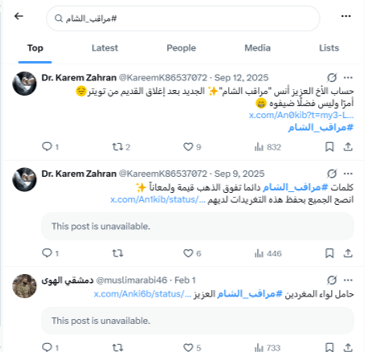
Figure 2. Screenshot of multiple posts referring to deleted X accounts operating under the name “Muraqib al-Sham.”
Nevertheless, STJ considers that the lack of publicly available information about the identities of those operating the campaign is insufficient to justify the absence of an official response. Measures that do not require prior identification of the individuals behind the campaign were likewise not undertaken: no public official condemnation was issued, no announcement of an investigation was made, and no request was submitted to the relevant platform seeking the removal of the content.
The phenomenon generated extensive public debate within Syrian society and received notable media coverage, making it highly likely that it came to the attention of official authorities and making it difficult to characterize it as unknown or marginally circulated.[5]
The documented facts reveal a clear disparity in the official response to content disseminated on social media platforms. While the competent authorities acted swiftly in three separate incidents, this report identified no public condemnation, investigation, or officially announced measure addressing an organized campaign that repeatedly promoted exclusionary and discriminatory calls based on sectarian identity.
6. Legal Characterization
Freedom of expression retains its legal protection even when an expression is shocking, offensive, or controversial. However, that protection does not extend equally to advocacy of religious or sectarian hatred when it reaches the threshold of incitement to discrimination, hostility, or violence.
The Syrian Constitutional Declaration guarantees freedom of opinion and expression under Article 13 and, pursuant to Article 12, recognizes the rights enshrined in international conventions ratified by Syria as an integral part of the constitutional framework. Furthermore, Articles 7 and 10 impose obligations on the state to preserve civil peace, prevent the incitement of sectarian tensions and violence, and ensure equality of citizens before the law without discrimination on the basis of religion, ethnicity, gender, or lineage.
In addition, Article 307 of the Syrian Penal Code criminalizes any act, written material, or speech that is “intended to, or results in, provoking sectarian or racial tensions, or inciting conflict between sects and the various components of the nation.”
This framework is consistent with the International Covenant on Civil and Political Rights (ICCPR), as Article 20.2 requires the prohibition of any advocacy of national, racial, or religious hatred that constitutes incitement to discrimination, hostility, or violence.
To determine whether a particular form of expression has reached the threshold of prohibited incitement, the Rabat Plan of Action proposes a six-part threshold test for forms of speech that are prohibited under criminal law. The test takes into consideration: the context of incitement to hatred, the speaker, intent, content, extent of the speech, and likelihood of causing harm.
The presence of any single element in isolation is insufficient to establish prohibited incitement. Rather, the expression must be assessed as a whole and within its specific context, while maintaining a high threshold before resorting to criminal sanctions.
Applying these elements to the “Lasta Shajara” Campaign first shows that the discourse was disseminated in an exceptionally sensitive context, one that followed recent acts of violence and violations based on sectarian identity, and that was preceded and accompanied by the spread of hate speech and incitement.
In such a context, calls to isolate an entire sectarian community or to dismantle its neighborhoods cannot be treated as abstract expressions detached from the real-world risks of identity-based discrimination and violence. Rather, they must be assessed in light of the broader circumstances in which they were produced, circulated, and received.
With regard to intent, the systematic repetition of posts, the use of standardized visual designs, the explicit identification of targeted groups and locations by name, and the publication of detailed guidelines for boycott and segregation collectively indicate that the content was not merely a transient comment or an isolated emotional expression. Rather, it constituted a form of incitement aimed at influencing public behavior toward specific individuals and communities based on their sectarian identity.
This conclusion is further reinforced by the campaign’s persistent calls to avoid interacting with Alawites across multiple spheres, including marriage, commerce, healthcare, education, transportation, housing, and burial practices, as well as by its collective questioning of their professional and educational qualifications and its use of dehumanizing narratives against them.
The content of the discourse is one of the most significant elements of assessment. The campaign did not merely express hostility or employ derogatory language; rather, it called upon the public to adopt specific discriminatory measures against individuals based on their sectarian affiliation.
The campaign also disseminated maps and identified neighborhoods and population centers by name, describing some of them as “settlements” and calling for their “social and economic dismantlement.” This transforms the discourse from mere sectarian stigmatization into a practical call to deprive a segment of the population of equal treatment and of their ordinary participation in social and economic life.
Regarding the extent of dissemination and the status of the speakers, the campaign did not disclose the identities of those responsible for its operation. The number of direct followers on some of its accounts remained relatively small, preventing a comprehensive assessment of the influence of its organizers.
Nevertheless, the campaign’s activities spanned multiple platforms. Its visual materials and hashtags were widely recirculated, and it received significant media coverage and visibility in the public sphere. These factors substantially broadened the reach of the discourse beyond the number of followers recorded on the original accounts.
Regarding the likelihood of causing harm, the documentation indicates that discourse similar to the campaign’s calls appeared in everyday interactions and that the campaign contributed to generating fear among members of the targeted group, prompting some individuals to retreat into sectarian social circles.
In light of the current Syrian context, this renders the risk of discrimination and hostility arising from such discourse a foreseeable consequence rather than a remote or speculative possibility.
Accordingly, STJ considers that many of the campaign’s posts, particularly those that explicitly called for boycotting individuals, denying them access to services and ordinary social and economic transactions, and dismantling their communities based on sectarian identity, go beyond offensive expression and cross the threshold into advocacy of hatred that constitutes incitement to discrimination and hostility, as understood under Article 20.2 of the ICCPR.
The use of terms such as “settlements” and calls for the “social and economic dismantlement of neighborhoods” constitute incitement that goes beyond ordinary hate speech and indicate advocacy for forced displacement. This concern is further supported by the testimony of one witness, who reported that families had already left their homes out of fear of potential consequences.
Furthermore, calls for “social and economic isolation” and for preventing individuals from accessing rental and property transactions, healthcare, and education constitute direct infringements on constitutionally protected economic and social rights, including the right to work, the right to property, freedom of movement, and participation in economic activity.
7. Recommendations to the Syrian Transitional Government and Competent Authorities
Addressing the campaign requires a comprehensive institutional response that protects targeted groups, prevents incitement from translating into discriminatory practices or acts of violence, and ensures that efforts to combat hate speech do not become a pretext for restricting freedom of expression.
Such a response should combine investigation and accountability measures, when the applicable legal threshold is met, with preventive and protective measures, engagement with affected communities, and the development of long-term policies to address hate speech and ensure the equal application of the law without discrimination.
- Issue a clear, public, and official condemnation of calls for segregation and discrimination based on sectarian identity, while affirming that responsibility for crimes is individual and cannot be attributed collectively to entire communities, neighborhoods, or families.
- Open a professional, impartial investigation under independent judicial oversight into the identities of those responsible for the “Lasta Shajara” Campaign and into posts that may constitute incitement to discrimination, hostility, or violence. This should include preserving digital evidence and publicly disclosing the investigation’s findings.
- Establish a precise legal framework that prohibits advocacy of national, racial, or religious hatred that constitutes incitement to discrimination, hostility, or violence, in accordance with Article 20.2 of the ICCPR and the Rabat Plan of Action threshold test. Such a framework must include safeguards to prevent its use against criticism, controversial expression, or speech that is merely offensive or unpopular. (This recommendation was previously issued by STJ in its report on the role of hate speech in the coastal massacres and has yet to be implemented. It should also be noted that the three documented arrests in this report demonstrate that the absence of specific legislation has not prevented action where the necessary political will exists.)
- Adopt a comprehensive national strategy to address hate speech that is not limited to punitive measures but also incorporates public awareness initiatives, civic education promoting equality and citizenship, support for counter-speech initiatives, and engagement with media outlets, religious and community leaders, and civil society organizations. The strategy should include monitoring indicators of incitement and mechanisms for early intervention.
- Engage social media platform administrators through official and transparent channels to seek the removal of inciting content after preserving copies of such material as evidence, and to request the restriction or removal of posts that violate human rights standards.
- Ensure the equal and non-discriminatory application of the law by publishing clear standards governing the handling of online content by security agencies and public prosecution authorities, alongside periodic public reports on investigations and measures undertaken. Such transparency would enable public oversight and reduce the risk of selective enforcement.
- Assess the risks faced by individuals, neighborhoods, and communities identified by the campaign, establish safe reporting mechanisms for threats, defamation, and the dissemination of personal data, and ensure that local authorities maintain communication with affected residents to strengthen their sense of protection and prevent hostile discourse from transitioning into discriminatory or violent acts.
[1] The campaign’s X account had 1,508 followers, along with affiliated accounts documented by STJ in June 2026: a Telegram channel (492 subscribers), a YouTube channel (42 subscribers and five videos), a TikTok account (16 followers), and Instagram and Facebook accounts.
[2] Note: A single post may fall under more than one thematic category. Accordingly, the total number of posts in the table exceeds the actual number of posts analyzed, which is 93.
[3] A post was classified as containing explicit sectarian targeting if it named the targeted sect (e.g., Alawites, Nusayris, or Druze) or called for its isolation, boycott, or stigmatization, whether in the text of the accompanying graphic or in the post itself. This indicator was recorded independently of the analytical categories presented in Table 1, because a post containing explicit sectarian targeting could simultaneously fall within one or more of those thematic categories.
[4] With the exception of its Facebook account, which was removed during the preparation of this report in mid-June 2026, STJ found no evidence that the account was removed in response to an official request from the Syrian government. Rather, STJ considers it more likely that the removal resulted from user reports and a subsequent enforcement decision by Facebook.
[5] See for example :
“In the wake of the Rania al-Abbasi Case, a Campaign Urging a Boycott of Alawites Draws Widespread Criticism from Human Rights Groups” [in Arabic], Ultra Syria, 1 June 2026 ;
“‘You Are Not a Tree’: Anonymous Campaign in Syria Calls for a Boycott of Alawites“, DW Arabic, 6 June 2026;
“‘You Are Not a Tree’: Anonymous Campaign Exploits Rania al-Abbasi Tragedy to Stoke Division in Syria” [in Arabic], Syria TV., 1 June 2026;
“From ‘You Are Not a Tree’ to the Logic of Revenge: How Are We Recreating the Catastrophe with Our Own Hands?” [in Arabic], Enab Baladi, 4 June 2026;
“‘You Are Not a Tree’: A Sectarian Boycott Campaign Rejected in Syria” [in Arabic], Alaraby Aljadeed, 3 June 2026;
“‘You Are Not a Tree’ Urges Syrians to Engage in a Sectarian Boycott!” [in Arabic], Al-Modon, 3 June 2026;
“‘You Are Not a Tree’: A Sectarian Campaign That Caps a Pattern of Impunity for Incitement” [in Arabic], Snack Syrian, 1 June 2026;
“The ‘You Are Not a Tree’ Campaign”, Syria Now, 3 June 2026.