
To the Attention of:
- The Special Rapporteur on the Right to Adequate Housing;
- The Special Rapporteur on Truth, Justice and Reparation;
- The Special Rapporteur on Minority Issues;
- The Special Rapporteur on Internally Displaced Persons;
- The Special Rapporteur on the Rights of Indigenous Peoples;
- The Special Rapporteur on Contemporary Forms of Slavery.
This submission is respectfully presented by Syrians for Truth and Justice (STJ) to Your Excellencies, in your official capacities, to bring to your distinguished attention the consistent and systematic pattern of economic and social violations endured by the indigenous population of the Kurdish-majority Afrin/Efrîn region in northwestern Syria since its takeover by factions of the Syrian National Army (SNA) as part of Operation Olive Branch in early 2018.
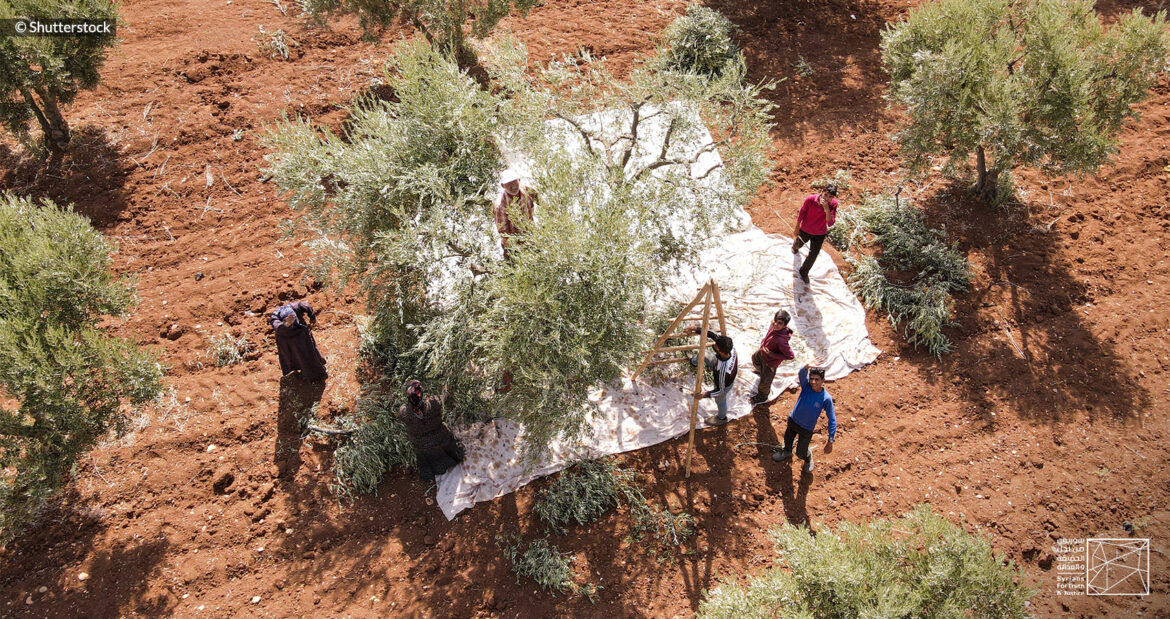
This takeover has resulted in a de facto hybrid military-civilian governance structure, which has enabled the spread of systematic practices, including financial extortion and illegal taxes. These practices include imposing so-called “levies” on the local population, particularly olive farmers who form the backbone of the economy. Violations have ranged from confiscating parts of harvests and charging arbitrary fees for harvesting and pressing, to threats, arbitrary detention, and property destruction, such as the deliberate uprooting and cutting of olive trees[1].
Despite significant political changes in Syria during 2024 and 2025, including the fall of the Assad regime and the formation of a new transitional government, the situation in the Afrin region has remained largely unchanged. Conversely, this pattern of violations has continued in a coordinated and systematic way, with local entities involved that are supposed to be under the authority of interim governing bodies.[2] This reality directly holds the official authorities, including the Syrian Interim Government, responsible for these violations, whether by their direct actions or their failure to prevent them and hold those responsible accountable.
Background
On 20 January 2018, the Turkish Armed Forces and the SNA, operating under the umbrella of Ankara-backed opposition groups, launched a large-scale military operation, dubbed Operation Olive Branch, with the declared objective of taking control of the Afrin region, a predominantly Kurdish area in northwestern Syria.[3] By 18 March 2018, Afrin and its surrounding areas had been seized, with the operation resulting in more than 400 civilian casualties.[4]
Alongside the military takeover, new administrative structures were established in Afrin, including local councils, military police, civilian police, and criminal courts. However, these institutions lack judicial independence and integrity, mainly serving as administrative tools to enforce a de facto authority aligned with armed groups. Within this framework, a dual power model has developed: a nominal civil-political authority managed through the councils, and a real military-security authority exercised by the SNA factions, which dominate every aspect of life, including judicial and social systems, without legal restraint or accountability.[5]
This structural flaw created a loophole that allowed the exploitation of civilians through levies and fees on almost every aspect of daily life, from crossing checkpoints to property, agriculture, and even the right to liberty and procedural guarantees in cases of detention. These levies amount to systematic and organized looting, as they are imposed by local administrative bodies and municipal councils but are exploited by factions as tools for financial control. This essentially turns the collection into a coercive economic policy, enforced through intimidation, extortion, and arbitrary imprisonment.[6]
The levies are mostly by specific factional leaders, such as the al-Hamza/al-Hamzat Division, the Sultan Murad Division, and the Military Police, who exercise control arbitrarily without external oversight. These practices have become part of a “shadow economy,” where military power, rather than law or an unbiased judiciary, determines the rules.
This recurring and escalating pattern constitutes a systematic policy that violates the fundamental rights of the people, including their economic livelihood, personal freedoms, and social security. Without oversight or accountability, economic and social oppression has become a daily reality imposed on civilians, which could culminate in detention and torture.
Facts
Between December 2023 and June 2025, STJ conducted 39 interviews with farmers, olive mill owners, civil activists, mukhtars, and former employees of local councils in the Afrin region. The interviews focused on the systematic economic violations carried out by factions of the SNA controlling the area since Operation Olive Branch in 2018. All interviewees are indigenous Kurdish residents of the seven subdistricts of Afrin, and their testimonies revealed recurring patterns of financial extortion and illegal levies systematically imposed on the olive industry, which is the main source of income in the region.
Testimonies indicate that taxes have affected every stage of olive farming, from protecting the trees and harvesting the olives to pressing and selling them. These taxes were levied by various armed groups controlling the area, primarily the Sultan Suleiman Shah Division (also known as al-Amshat), led by Mohammed al-Jassem (better known as Abu Amsha), which is considered one of the main groups involved in tax collection in the regions it controls.
The al-Hamzat Division, led by Sayf Abu Bakr, also took part in forced levy operations and has been repeatedly linked to violations against civilians. The Sultan Murad Division, led by Fahim Issa, also played a major role in collecting fees from farmers, alongside the Muntasir Billah Brigade, led by Fawaz al-Khalil, which also pressured residents in the agricultural areas it controls.
Testimonies indicated that levies have permeated every stage of olive farming, from protecting the trees and harvesting the olives to pressing and selling them. These levies were imposed by various armed groups controlling the area, most notably the Sultan Suleiman Shah Division (known as al-Amshat), led by Mohammed al-Jassem (Abu Amsha), which is regarded as one of the leading actors in tax collection within its areas of control. Other factions have also engaged in forced levy operations, including the al-Hamzat Division, led by Sayf Abu Bakr, which has repeatedly been implicated in violations against civilians; the Sultan Murad Division, under the command of Fahim Issa, which played a central role in collecting fees from farmers; and the Muntasir Billah Brigade, led by Fawaz al-Khalil, which likewise exerted pressure on residents in the agricultural regions under its control.
Additional parties involved in these practices include the Mu’tasim Division, led by Ma’n al-Nasser; the Ninth Division, led by Abu Bakr al-Saleh; and the Sham Legion/Faylaq al-Sham, a key faction within the National Front for the Liberation of Syria. The Levant Front/al-Jabha al-Shamiya also participated, as its 51st Battalion, led by Abu Hatem al-Shami, was involved in demanding cash fees and confiscating parts of agricultural produce.
The collection methods varied from taking a share of the harvest or olive oil to demanding direct cash payments. Sometimes, farmers were threatened or physically assaulted to force their compliance, turning these levies into a systematic extortion scheme carried out by factions under the cover of armed force and lawlessness.
Among the interviewees, three lived outside Syria (in Türkiye and Germany), and three were outside the Afrin region (in Qamishli and Tall Rifat). The rest were spread across the subdistricts of Afrin, most of whom were forcibly displaced from their original villages. Thirty interviews were conducted online using encrypted communication apps, while nine were held face-to-face in locations deemed safe and appropriate to maintain privacy. The research team made sure participants received a comprehensive explanation of the interview’s purpose and how the information would be used, including the possibility of publication in this report. As a result, all participants chose not to reveal their names or any details that could identify them, out of fear of retaliation from armed groups or entities supporting them.
Testimonies show that the factions controlling the area did not limit themselves to institutionalized levies through their economic and security offices; in many cases, they also permitted individual members to impose personal levies. Village mukhtars were involved in pre-assessment of production levels, helping to facilitate the collection process. Farmers who refused to pay faced collective punishments, including beatings, arbitrary detention, confiscation of agricultural tools, and even the uprooting of their olive trees.
Although more than six years have passed since these factions seized control of the region, and despite sweeping political changes in late 2024, these violations continue amid a lack of neutral civil authority and independent judicial oversight. In fact, Türkiye, as the de facto controlling entity, continues to support these factions in various ways, including through funding, arming, and administrative and security oversight. Instead of holding these actors accountable for their violations, they are effectively given de facto legitimacy due to the lack of any neutral civil authority or independent judicial oversight.
This ongoing support clearly violates Türkiye’s obligations under international humanitarian law (IHL), especially the principle of protecting civilians in conflict zones, as well as the duties of an occupying power under the Geneva Conventions. These obligations require Türkiye to preserve public order and ensure the safety of civilians in the areas under its control, rather than empowering armed groups to undermine them.
Levies and Systematic Exploitation of Afrin’s Farmers by Türkiye-Backed Armed Factions
- Levies on Farmers in Afrin: A Systematic Policy of Extortion and Impoverishment Amid the Absence of Rule of Law
Since factions of the SNA took control of the Afrin region in the spring of 2018, local farmers, especially those from the Kurdish community, have faced a growing pattern of systematic extortion disguised as “levies.” These practices have affected both farmers who stayed in their villages and those who were forcibly displaced. For residents who remained, however, the extortion has taken a different form, focusing on the ongoing exploitation of vital resources through taxes on olive trees, harvests, picking operations, and olive transportation, all done without any legal basis.[7]
Testimonies from over twenty farmers interviewed by STJ in the second half of 2024 revealed that these levies were directly imposed on them by armed factions that effectively control both the land and the economy, such as the Hamzat Division, the Sultan Murad Division, the Mu’tasim Division, and Faylaq al-Sham. Enforcement occurred through economic and security offices, often run by local commanders or individuals closely tied to Turkish authorities. According to corroborating testimonies, these factions regularly used several local mukhtars as intermediaries to collect levies, relying on lists that detailed the number of olive trees each farmer owned in the village. This practice indicates a well-organized structure for controlling agricultural resources.
In several villages, such as Khilnaira/Xelnêrê, Kafrshil/Keferşîl, and M’arata/Ma‘arrātā in the Afrin region, farmers were forced to pay what they call a “protection tax.” The armed factions use this term to describe sums of money collected from residents under the guise of securing the fields. However, in reality, these payments are forced, do not provide any actual services, and are a form of organized extortion. The value of this so-called tax ranged from $1 to $2 per olive tree, even for trees that produced no olives.[8] Witnesses reported that these levies were paid under the threat of being stopped from harvesting or having their crops seized[9].
In the village of al-Taqiyah/Taqîyê in the Afrin region, a farmer with 290 olive trees testified that an armed member of the al-Hamzat Division accompanied him to his grove and counted the trees to determine the levy amount. He recalled, “The fighter told me: ‘You will pay, or be banned from approaching your trees for a hundred years.’”[10]
In the village of Jouqa/Al-Khadra, residents were required to attend a meeting convened by the mukhtar in mid-October 2024, where they were informed that the levy was due immediately. Collections were made either in cash or in kind, without receipts,[11] highlighting the informal and exploitative nature of the practice. In Qatmah/Qitmê, Faction 51 of al-Jabha al-Shamiya imposed a fee of 5 Turkish liras (TL) per olive tree.[12] One witness noted that any delay in payment could lead to harassment and threats, “If a farmer refuses or delays payment, the security office takes over, often subjecting him to psychological pressure. These acts of harassment, intimidation, and threats are usually enough to force the farmer to pay the imposed share.”[13]
In other villages like Kakhra/Kaxrê, Qermitliq/Qermîtliq, and Kerzayhel/Kurzêlê, the al-Amshat Division charged a fee of $8 per olive tree.[14] Surprisingly, this fee was applied even to small trees or those that had not borne fruit for years. A farmer from Qermitliq recounted, “In 2020, we were charged $8 per tree, regardless of whether it was productive. As a result, I had to pay $2,400. My harvest that year was 120 tins of olive oil, worth about $2,100, so I had to send an extra $300 just to cover the payment.”[15]
These policies went beyond just imposing monetary levies and included directly taking part of the harvest. In Kharbat Sharran/Xirabî Şera, factions demanded a 13% share of the olive oil produced by each farmer, to be delivered at the end of the harvest season.[16] In some villages within the Jindires/Cindirês subdistrict, oil was collected directly from the mills after harvest, with representatives appointed by the faction overseeing the pressing process and recording production. Farmers who refused to cooperate or give the required share risked being questioned by security forces, which could lead to detention or even expulsion from the village[17].
In other instances, factions imposed double levies, requiring farmers to pay a “security tax” to one faction’s office and an “economic tax” to another. This duplication caused confusion and fear, leaving farmers uncertain about whom to pay.[18] Significantly, these practices happen in a legal vacuum with no oversight or grievance mechanisms. Local councils managing the villages, many linked to Türkiye, either participate in or ignore these operations,[19][20] showing institutional complicity that worsens policies of impoverishment and economic coercion. Under these conditions, residents cannot protect their livelihoods or challenge the legitimacy of these practices, leading to ongoing economic vulnerability and indirect displacement. This situation pushes local communities toward financial collapse, benefiting military-economic networks that depend on organized looting for funding and survival.[21]
- Levies on Olive Groves Under Power of Attorney: Economic Engineering of Expropriation and Legalization of Forced Exclusion
In the Afrin region, the displacement of the native population was not the end of their targeting but rather the start of a more complex strategy aimed at severing their connection to the land and cutting off their sources of livelihood. One of the most significant actions of this policy has been the widespread implementation of economic levies on olive groves owned by individuals who were forcibly displaced, whether inside Syria or abroad, having been driven from their lands due to conflict, security threats, or social and ethnic pressures.[22]
Although these owners authorized their relatives or local acquaintances to manage their olive groves through formal or customary power-of-attorney arrangements, the factions refused to recognize such authorizations as legal rights. Instead, they treated the properties as ‘abandoned land,’ subject to seizure and appropriation. Those acting under authorization faced complex extortion, including demands for high percentages of the harvest, sometimes up to 60% of total production, and, in some cases, the entire crop was confiscated. All of this occurred within a legal vacuum defined by arbitrariness and militarization.[23]
Testimonies from at least ten witnesses indicate that the al-Amshat Division was among the factions most involved in this practice. In some villages in the Jindires subdistrict, they imposed a levy of $20 per olive tree in lowland areas and $3.5 in mountainous areas, regardless of the tree’s productivity or the grove’s condition.[24]
In the village of Sharran/Şera, one witness reported that his family was forced to pay 3,500 TL as a levy on 700 trees, under the explicit threat that the harvest would be forcibly collected if payment was not made. He explained,
“The olive season has turned into a nightmare. The faction collects money through its security office and affiliated agriculture office. The agriculture officer receives funds from the farmers, and if a farmer refuses or delays payment, the security office steps in to harass him, often psychologically. These acts of harassment, pressure, and threats aimed at the farmer are usually enough to force him to pay the demanded share.”[25]
In the village of Terindi/Tirindî, within the Afrin district, a report was made about an entire olive harvest being confiscated despite the presence of a legitimate agent. The affected witness said that the faction sent 40 workers to harvest his grove, even though he lived nearby and had trusted a relative to manage the orchard. He was expelled from the property, threatened, and received only seven sacks of the olive harvest out of 30.[26]
Regarding heirs, an unlawful classification practice was established, where land ownership is considered “partially sovereign” based on the location of the heirs. If one heir lives outside Afrin, the factions treat the entire grove as subject to the power-of-attorney levy. In the villages of Kerzayhel and Terindi, the al-Amshat Division imposed a 60% levy on production from groves owned by heirs with family members living abroad, compared to only 10% when all heirs were in Afrin.[27]
The al-Hamzat Division enforced the same policies in the villages of Kurkan, Fiqiran/Feqîran, and Julaqan/Cûlaqan, where agents managing properties of owners residing in Europe were subjected to a 30% levy. If the landowner lived in areas the factions deemed “hostile”, such as territories controlled by the Syrian Democratic Forces (SDF), regime-held areas, or Lebanon, the entire harvest was confiscated without compensation. The faction would then hire harvesters to collect the crop on its behalf, while providing no reimbursement to the agents who had invested time, money, and effort in maintaining the groves.[28]
In a troubling case reported in the village of al-Taqiyah, a testimony stated that the faction seized 160 olive trees owned by a widow, preventing her from harvesting any part of her crop. As a result, she suffered a severe health crisis and was hospitalized. One of her neighbors commented, “The Division took the harvest of 160 olive trees belonging to a village woman, even though they knew her husband had recently died and she had no support, which caused her to be rushed to the hospital after having a stroke.”[29]
In Darker/Dargirê, Maabatli/Mabeta subdistrict, the al-Hamzat Division imposed a 50% levy on groves managed under power of attorney, accompanied by threats against women holding official authorizations from their displaced husbands.[30]
The Mu’tasim Division went even further by abolishing the power of attorney system entirely in the villages of Sari Ushaghi/Sariya Uşaxi, Hamalork/Ĥemlorik, and al-Rahmaniyah/Şêtana. It seized the olive groves and redistributed them to fighters or loyalists in exchange for minimal financial compensation. This action amounts to a form of ‘forced resettlement’ through economic means. One witness said, “There is no law protecting farmers; what prevails is jungle law, the strong devour the weak. These factions have weapons, and they use them to seize people’s property and rob them by force.”[31]
In the villages of Baflun/Baflûnê, Qatmah, and Naz Ushaghi/Naza Uşaxi, Faylaq al-Sham imposed levies of 40% to 50%, even on farmers residing in Afrin but outside their home villages. This reflects a policy of “geographical exclusion” driven by factional loyalty. In Maydanki/Meydankê and Dourakli/Duraqlîya, other groves were seized under the pretext of missing ownership documents, despite the absence of an official land registry in Afrin, which makes it impossible for residents to prove ownership and leaves them vulnerable to de facto confiscation.[32]
The Sultan Murad Division linked levy rates to ownership status and residence: 50% when landowners lacked documents and lived abroad, but only 13% when documentation was available and the owner resided locally. The Sultan Melikshah Division, meanwhile, seized lands in Jama/Çema, Kharbat Sharran, and Kobelik/Gobeleke, accusing their owners of supporting the Kurdistan Workers’ Party (PKK), and redistributed them in return for just 12% of the produce.[33]
These incidents reveal a systematic pattern of looting and appropriation through “fabricated legal instruments,” where powers of attorney were twisted into tools to legitimize seizures. Arbitrary policies were cloaked in the rhetoric of “national security” and “counter-terrorism.” Still, their true aim was to enable factions to seize land and resources, stripping indigenous residents of their livelihoods as part of a long-term strategy to reshape the region’s demographic and economic fabric.
These practices expose a systematic and institutionalized pattern of land expropriation disguised as “powers of attorney,” where the legal document is used as a tool to justify taxes and seizures. This policy goes beyond simple economic extortion, promoting exclusion and displacement under the pretense of economic reasoning. Meanwhile, those responsible, from de facto authorities to protectors, remain unaccountable and beyond scrutiny.
- Armed Factions’ Control of Olive Oil Production and Marketing in Afrin: A System of Organized Levies Violating Indigenous Residents’ Economic Rights
Since the SNA factions took control of the Afrin region in early 2018, systematic economic policies have been put in place targeting the olive sector at all stages, from harvesting to production and marketing. This vital industry has been turned into a source of funding for armed factions and a means of extorting local residents, representing a serious and ongoing violation of their basic economic rights.
Within the scope of these policies, farmers and olive mill owners faced varying monetary and in-kind levies, which grew over time and became more complex and organized. In the Shaykh al-Hadid/Şiyê subdistrict, after the al-Amshat Division took control of dozens of olive mills; farmers were informed through the mukhtars that they were barred from using any mill other than those assigned by the division.
Representatives from the economic office were assigned to oversee daily operations, receiving their wages directly from the produced oil, along with coverage for food and transportation.[34] One mill owner reported paying $3,500 in initial and final levies during a single season, in addition to covering operating costs, which reduced his profit margin. He was forced to lower olive pressing fees to 5%, earning no actual profit. When he ceased operations for three years, he was fined $5,000 for “downtime and damage,”[35] with no legal basis or ruling from an independent judicial authority.
In villages such as Kerzayhel, Kakhra, and Kemrouk/Gemrûkê, direct fees were imposed on every sack of olives entering the mill, ranging from $0.50 to $1, and sales were restricted to specific traders linked to the faction. Farmers were required to deliver a set amount of oil based on the faction’s assessment; failure to comply resulted in the oil being seized or withheld. One farmer explained, “We have reached a point where we wish there were no harvests because the faction has economically devastated the people,” referring to the cumulative burdens and arbitrary practices that have rendered the harvest season effectively pointless.[36]
In the Maabatli subdistrict, the Mu’tasim Division imposed charges that were higher than local norms. One witness noted that while the traditional fee was 7%, the division’s security office added 5%, bringing the total to 12%, a heavy burden for farmers given the lack of a competitive or free market. In Jindires, the al-Hamzat Division enforced similar policies, requiring olive mill owners to pay $1,500–$2,500 annually to the local council, along with 30 tins of oil as a seasonal levy. In al-Taqiyah, Rajo/Reco/Raju subdistrict, farmers paid 15% of the oil, and mill owners paid an additional 10–15%. Faction members recorded every pressing operation and deducted the required amounts at the end of the season under the guise of a “protection tax.”[37]
A former accountant at a mill controlled by Faylaq al-Sham in the village of Jaqmaq Kabir/Ceqmaqê mazin confirmed that the faction would estimate the number of olive trees owned by each farmer and issue a form accordingly. This form was later used to determine how many sacks needed to be delivered to the faction, along with a 20% share of the oil after pressing and 2% from mill owners. Mill owners who refused to cooperate were threatened or forced into “coercive partnerships,” under the threat of economic ruin or total loss of the harvest season[38].
Other testimonies indicated that free marketing of olive oil was impossible. In Kemrouk, the al-Amshat Division restricted farmers from removing oil from mills to small amounts, no more than three or four tins per farmer. Farmers had to sell their oil to faction-affiliated traders at prices set by the factions, communicated through closed WhatsApp groups. Attempting to sell outside this system incurred additional fees of up to $2 per tin: one for removal and another if sold to a non-approved trader.[39]
One testimony indicated that farmers had three options for marketing their olive oil: sell to a Syrian trader within faction-controlled areas; transport it to Syrian government- or Autonomous Administration-controlled areas, which was logistically risky and incurred shipping costs of $20–25 per tin; or sell to a Turkish trader at a minimum price. The Turkish trader was the only party allowed to purchase large quantities, with prices coordinated daily through bulletins circulated in trader groups, and the oil was then transferred directly to the General Directorate of Agricultural Credit Cooperatives in Türkiye.[40]
Sanctions for Failure to Pay Levies
The levies in the Afrin region went beyond being just an economic burden; they acted as a systematic tool for punishment and collective intimidation. Residents were forced to meet the high demands of armed factions under threats to their safety and dignity. Those who refused or delayed payment faced sanctions ranging from verbal threats and physical torture to symbolic or retaliatory sexual violence, forced detention, beatings, property destruction, and the felling of olive trees, which are a primary source of livelihood.[41]
One farmer described the situation bluntly, “You will pay, even if you are killed or tortured.”[42] This was not just talk but a reality for local residents. In the Jindires and Qermitliq subdistricts, the al-Amshat Division arrested and threatened many people simply for complaining about the high levies. One olive grove owner reported being charged $2,400 for both productive and unproductive trees, even though his total harvest was worth no more than $2,100. He had to transfer money from abroad to protect his agents in Afrin, following clear threats against them.[43]
In many cases, financial extortion escalated into physical violence. In one documented instance, an olive mill owner was asked to pay $5,000; when he objected, the faction doubled the demand to $10,000. Upon his refusal, 20 armed members violently beat him and threw him from the second floor of a facility, fracturing his pelvis and leg. He was then forced to pay the full amount.[44]
In the village of Kawa, the same Division imposed levies of up to $20 per tree in the plains and $3.50 in the mountainous areas, regardless of the season’s yield. Eight families were unable to pay due to financial hardship. In response, the faction sent military patrols that raided their homes, fired shots into the air, and assaulted women and the elderly. As a result, five of the families were forced to pay under threat, while three offered to sell their land to cover the required amounts.[45]
Sexual intimidation and gender-based violence were not absent from this system. One witness reported that a farmer was beaten and tortured after armed men threatened him, “If you do not pay, we will bring your wife and rape her in front of you.” When he refused, he was taken to a torture room, collapsed from the beatings, and was later left outside his house at 4:00 pm. In response to this moral and legal breakdown, about 70 women from the village organized a protest outside the faction’s headquarters demanding an end to the levies. They were met with gunfire into the air and beatings with rifle butts and hoses, causing injuries to at least 20 women, including four with severe injuries. Afterwards, roads leading to the village were blocked, the internet was shut down, and the injured were denied medical care. Other residents were also beaten and humiliated, all under the suspicious silence of local councils and Turkish representatives.[46]
An alternative or additional form of punishment used by the factions was cutting down olive trees, which are a primary source of income for residents.[47] STJ documented cases in the villages of Naz Ushaghi, Maydanki, Fiqira/Feqîra, where factions, especially al-Hamzat, Faylaq al-Sham, and the Sultan Murad Division, cut down at least 267 olive trees due to unpaid levies.[48] In one testimony, a farmer from Fiqira stated, “They cut the tree from the middle for firewood purposes. The cut trees will need 20 years to become productive again.”[49] In Maydanki, after one family refused to pay a 10% levy on their harvest, 120 olive trees over 70 years old were cut down with electric saws.[50]
In the village of Shorba/Şorbe, 25 olive trees were cut down by an al-Hamzat commander named Abu Jarjanaz after a farmer refused to pay the required levy, without any prior warning. This caused significant agricultural and economic losses for a family mostly made up of elderly members.[51]
This situation is not the result of isolated actions but reflects a comprehensive coercive system involving intimidation, physical assault, seizure of agricultural resources, and destruction of productive infrastructure. Given their pattern, continuity, and impact, these practices constitute systematic violations that demand investigation and accountability, particularly in the absence of local oversight and political will to prevent them.
Impunity and Lack of Redress Mechanisms
Despite the seriousness of violations against olive farmers in Afrin, including intimidation, physical violence, and theft of agricultural resources, the armed factions have mostly remained immune from accountability. Evidence shows that these groups wield near-total authority, often supported by the silence or complicity of local authorities and sometimes with direct or indirect backing from Turkish officials. This makes it nearly impossible to seek justice, while victims risking retaliation if they pursue remedies.
This reality was clearly illustrated in the events in the village of Kakhra, Maabatli subdistrict, on 14 September 2024, when dozens of women protested against imposed taxes. The al-Amshat Division responded by firing shots into the air and violently assaulting around twenty women, resulting in serious injuries, including fractures and head wounds. This constitutes a blatant violation of the right to peaceful protest, amid the complete absence of intervention by military police or local authorities[52].
In another case, a farmer reported being charged $3,500 for 550 olive trees and even considered giving his car to the faction to cover the amount. Meanwhile, his son hid in a nearby house to avoid arrest after the faction’s security forces raided their home four times.[53] Complaints to the military police yielded no results and only increased the feeling of legal insecurity. Another farmer, whose farm had been looted under threat, stated,
“We filed an official complaint, but the case was registered against an unknown perpetrator, and none of our rights were ever restored.”
According to the UN Independent International Commission of Inquiry on the Syrian Arab Republic (COI-Syria) report issued in December 2024, illegal levies and taxes continue to affect the olive sector in Afrin, despite military orders from the SNA calling for an end to fee collection. The report highlighted that civilians still suffer due to a lack of effective justice systems, and fear of retaliation prevents many from filing complaints. One farmer summarized this feeling, saying: “Olive trees were stolen and uprooted right in front of the people and owners. No one can file a complaint. Who would you complain to, and against whom?”[54]
The lack of accountability goes beyond local institutions to higher levels of Turkish oversight. Several testimonies show that the Turkish governor and his representatives in local councils took no action when informed of faction violations.[55] One witness reported that when he complained to the local council about arbitrary levies imposed by Faylaq al-Sham, the council told him the governor had said, “Close the matter and abide by the faction’s and the commander’s decision,”[56] revealing implicit complicity in human rights violations.
The failed experiment of the so-called Rights Restitution Committee, established in 2020,[57] revealed that internal redress mechanisms are entirely superficial.[58] Even when the recovery of olive oil seized from mills was documented, factions would confiscate it again before farmers reached their homes, leading to a complete loss of trust in any internal review process.
From a field perspective, a farmer in the village of Kharbat Sharran said, “Under normal circumstances, we do not escape their abuse, so imagine what would happen if we refused to pay. Here, there is no law except the law of the gun.”[59] This makes any attempt to challenge payments or file complaints extremely risky.
Despite public statements from some military officials, such as Hisham Eskif of the 2nd Corps’ Public Relations Office, affirming that levies were prohibited, these declarations never led to concrete action. No serious investigations or accountability measures were taken against implicated factions, and violations only increased, reinforcing a climate of impunity and deepening a pattern of organized structural abuse.[60]
Moreover, the failure of local councils to fulfill their oversight responsibilities, along with administrative barriers to complaint channels, resulted in a completely dysfunctional justice system. Many victims reported that they received no compensation, whether material or moral, for their losses, including olive trees, crops, or physical and psychological injuries.[61]
Taken together, these facts indicate the existence of a power system based on economic intimidation and collective punishment, supported by a network of political and military collusion. This makes the violations committed organized crimes that must be held accountable before appropriate international authorities.
Legal Analysis
IHL addresses issues of individual and collective property in armed conflicts from a perspective that safeguards its protection as an extension of the inviolability of private life and a fundamental part of human dignity.[62] In this context, the concept of ‘property’ is broadly understood, covering not only immovable and movable assets but also funds, income, crops, commercial returns, and even digital and intangible rights.[63] This broad interpretation aligns with doctrinal and judicial developments in international law, which increasingly emphasize the material and moral protection of civilians’ livelihoods and their shielding from unlawful interference during conflict.[64]
IHL states that private property should generally be respected. Any deviation from this rule is only allowed in cases of “imperative military necessity,” and must fully comply with the principles of proportionality and distinction, which are key rules for parties in conflict.[65] These principles are outlined in Article 46 of the 1907 Hague Regulations, which explicitly ban the confiscation of private property, and in Article 53 of the 1949 Fourth Geneva Convention, which forbids the destruction or seizure of property unless absolutely necessary for military reasons.[66] Additionally, the Rome Statute of the International Criminal Court (ICC) clearly criminalizes pillage during both international and non-international armed conflicts under Articles 8(2)(b)(xvi) and 8(2)(e)(v), recognizing it as a serious violation of IHL.[67]
Although IHL does not explicitly regulate taxation or levies, international jurisprudence, especially in the Katanga and Bemba cases, has established that the imposition of fees or tributes by non-state armed groups during armed conflict, without the free consent of the population and lacking legitimate military justification, clearly falls under the concept of pillage. This is particularly true when such revenues are used for private enrichment, financing factions, or supporting illicit networks.[68] The chambers of the ICC have defined pillage as “the appropriation of public or private property by individuals or groups, without the consent of the owner, and in contravention of the rules of IHL,” with specific emphasis on the lack of military necessity and the presence of a private or unlawful purpose behind the appropriation.[69]
Based on this comprehensive definition, it is necessary to examine the practice of imposing levies on civilians by non-state armed groups by considering the five key elements of the crime of pillage: (1) the existence of an armed conflict (as defined under Article 1(1) of Additional Protocol II to the Geneva Conventions); (2) the occurrence of a material or immaterial seizure of property; (3) the lack of free consent from the owner or their representatives; (4) the absence of reliance on military necessity; and (5) the intent to gain private or factional benefit from the act.[70]
It is noted that the imposition of monetary and in-kind levies in areas outside state control, effectively under the authority of armed factions supported by a foreign state, clearly satisfies the first element, as these areas have been subject to a non-international armed conflict since 2018, with de facto authority exercised through armed force.[71] The second element, “seizure,” is fulfilled by the actual control over agricultural yields, such as olives or crops, through the enforcement of compulsory fees or deductions under threats of punishment, coercion, or obstruction of agricultural activities. This constitutes, under the ICC’s definition, a forced transfer of property or control over its proceeds without the owner’s consent.[72]
Regarding the element of consent, relying on the silence or lack of resistance from the population does not amount to free consent, especially when levies are imposed through coercion, threats, or without real options. International legal precedents have established that the absence of consent can be inferred from fear or compelling circumstances,[73] making any claim of the act’s legality or legitimacy invalid.
Regarding military justification, the Fourth Geneva Convention and the Hague Regulations require that the seizure of private property be based on “imperative” and “immediate” military necessity. This condition is not met in practices aimed at raising funds for factions, financing local influence networks, or enriching individuals. On the contrary, imposing levies without providing public services or having an organized and transparent legal system undermines any attempt to legitimize these actions.[74]
Conversely, the responsibility of the sponsoring or supporting state for these groups does not fall away. Under the “effective control” standard articulated in the International Court of Justice’s (ICJ) judgment in Nicaragua v. United States, a state that exercises effective control over an armed group bears responsibility for that group’s actions.[75] This rule is reinforced by Al-Skeini v. United Kingdom before the European Court of Human Rights (ECHR), which relied on the concept of “extraterritorial jurisdiction” to link state responsibility to the exercise of control over persons or territory.[76] Moreover, Common Article 1 of the Geneva Conventions obliges the State not only to refrain from violations but also to ensure respect for IHL by those under its authority.[77]
The international obligation does not end with refraining from committing the crime; it also includes the duty to investigate, prevent recurrence, and ensure accountability, whether through national courts or international mechanisms, including under universal jurisdiction or by referring the situation to the ICC when the substantive, temporal, and personal jurisdictional requirements are met. These obligations are reinforced by Article 147 of the Fourth Geneva Convention, which classifies pillage as a grave breach of IHL and requires the contracting parties to criminalize such acts and hold their perpetrators accountable.[78]
Based on this analysis, it is clear that imposing levies on civilians in conflict zones, without their consent, a legal basis, or genuine military necessity, and in ways that benefit conflict parties or their networks, clearly violates the prohibition on pillage. These actions are serious violations of IHL that could amount to international crimes, requiring accountability both individually and globally, and holding the supporting State legally responsible, which cannot be waived under established international law rules.
From the Perspective of Syrian Legislation
The facts documented in this report reveal a consistent pattern of serious violations of Syrian law at multiple levels, including the Constitution (whether the 2012 Constitution or the 2025 Constitutional Declaration),[79] the Civil Code,[80] the Penal Code,[81] personal status legislation,[82] and laws governing the transfer of immovable property.[83] Carried out by armed groups affiliated with the so-called SNA in the Afrin area, these violations cannot be viewed as isolated incidents. Instead, they form a systematic regime of breaches impacting property rights, civil liberties, bodily integrity, and human dignity, all protections under Syrian law as core elements of public order and non-derogable human rights.
Article 10 of the 2025 Syrian Constitutional Declaration clearly states that, “[T]he right to private property is protected, and it may not be expropriated except for the public benefit and in return for fair compensation.”[84] Accordingly, any action involving confiscating property or restricting the right to use or dispose of it without a clear legal basis and proper due process directly violates this constitutional clause. What happened in Afrin, as supported by testimonies and documentation, was a case of force replacing law: in some cases, percentage levies of up to 60% were imposed on olive proceeds without legal authority, court orders, compensation, or official notice, effectively amounting to a clear seizure of property.
The violation is especially serious when the disputed property is inherited and already registered, or otherwise capable of registration in the names of lawful heirs. The Syrian Civil Code states that, “[A]nyone who acquires property through inheritance becomes its legal owner before registration”, and that “[T]he right to register property in the Land Registry can be established through various means, including inheritance.” (Articles 825 and 826). Therefore, denying heirs the right to manage or benefit from their property due to lack of registration clearly violates the law.[85] Conditioning recognition of an heir’s property rights on residence in Afrin also constitutes unlawful discrimination unsupported by any legal provision. It goes against principles of equality and non-discrimination and conflicts with the rules of succession outlined in personal status law, which guarantee heirs, including women, their full inheritance shares regardless of residence or geographic location.
As for the imposition of levies, or so-called “taxes” or “protection fees”, these are simply a pseudo-legal disguise for pillage, fundamentally at odds with the essence of the right to property. Article 768 of the Civil Code states that “The owner of a thing has, within the limits of the law, the exclusive right to use it, exploit it, and dispose of it.” It also violates Article 770, which affirms that, “The owner is entitled to all fruits, products, and appurtenances of the property unless otherwise provided by law or agreement.” In fact, taking a part of the harvest or preventing its removal or sale except through designated channels (such as forcing sales to traders affiliated with the factions) is an unlawful interference with freedom of contract and violates Article 771 of the Civil Code, which allows interference with ownership or disposal only by legal provision and in exchange for fair compensation.[86]
The severity of the crime increases when it involves threats and physical or psychological coercion. Testimonies describe brutal physical torture, including threats of rape, victims being thrown from upper floors, and forced detention. Offenses in the Syrian Penal Code cover these acts, primarily the felony of attempted murder under Article 534, interpreted in conjunction with Article 188, where it is shown that the perpetrator anticipated the outcome (death) and accepted the risk, as well as the crime of robbery with armed violence under Article 624, and the felony of threat under Articles 560 and 561, which impose harsher penalties when threats are combined with physical coercion or attacks on the victim’s honor.[87]
On the other hand, forcing rights-holders, especially widowed women, to sign powers of attorney that give up control over or allow disposal of their property without free consent counts as the offense of coerced signature (ghasab tawqīʿ) under Article 635 of the Penal Code. That law criminalizes obtaining declarations or signatures through threats or violence and punishments range from three months to two years in prison with hard labor.[88] The Syrian Court of Cassation has consistently ruled that contracts made under a will affected by coercion are legally invalid and void.[89]
The breakdown of the rule of law is most clearly shown in the actions of faction leaders, who justified their conduct with statements like “spoils from the Liberation of Afrin” or “everything here belongs to us.” These remarks serve as strong evidence of the widespread delegitimization of the legal system and of turning the law into a tool subordinate to armed force rather than an obstacle to it. Essentially, this weakens the foundations of public order and the principle of legality, and blatantly breaches the preamble of the 2025 Constitutional Declaration, which affirms that a state should be built on the rule of law and human dignity.
Thereby, the systematic conduct involving the implementation of levies and forced taxation, restrictions on property use, discrimination among owners, and both physical and psychological coercion not only violates civil rights but also qualifies as serious crimes that require investigation and accountability under applicable Syrian laws. This also aligns with Syria’s international obligations, especially the Convention against Torture, which Syria has been a party to since 2004.
Recommendations
Given the serious violations documented against civilians, especially olive farmers in the Afrin region, including unlawful levies, property confiscation, torture, threats, and illegal restrictions on property rights and disposal, there is an urgent need to implement a comprehensive set of legislative, judicial, and institutional measures. The importance of these measures goes beyond ensuring accountability for perpetrators; they are essential for upholding the rule of law, restoring citizens’ trust in government institutions, and preventing such violations from happening again. Accordingly, we recommend the following:
- Initiate immediate, independent, and comprehensive criminal investigations into all violations in the Afrin region, particularly those involving levies, extortion, torture, property confiscation, threats of sexual assault, and cruel treatment. These investigations should focus on both individuals and entities, whether directly or indirectly responsible, and must be conducted following proper legal procedures that ensure accountability and prevent impunity;
- Ensure fair trials for all detainees and accused persons, in accordance with Article 28 of the 2025 Constitutional Declaration and Article 14 of the International Covenant on Civil and Political Rights (ICCPR), emphasizing the principles of judicial independence and impartiality. The principle of command responsibility must also be upheld for acts committed by faction members under their leadership;
- Issue a government decree inviting all victims of property and human rights violations in Afrin to submit documented complaints to public prosecutor offices or relevant authorities, with mechanisms in place to protect witnesses and whistleblowers, and ensure that complaints are reviewed within a reasonable timeframe;
- Issue clear and binding executive orders to all military units under the Ministry of Defense or operating under the authority of the de facto power, directing them to immediately cease any interference with private property or civilian economic activities, especially the imposition of levies or seizure of crops, and clearly state the legal consequences for violating these orders;
- Oblige armed forces to adhere to the provisions of the 2025 Constitutional Declaration, including clear protection of private property and the prohibition on its seizure or disposal except by law, for public benefit, and with fair compensation, in accordance with the standards outlined in Article 15 of the Declaration;
- Reiterate that protecting property is not only a constitutional obligation but also a legal duty stemming from Syria’s international commitments, especially under the International Covenant on Economic, Social and Cultural Rights (ICESCR), the ICCPR, and the Universal Declaration of Human Rights (UDHR). The State must implement the necessary legislative and administrative measures to fulfill these commitments;
- Activate the roles of the Public Prosecution and the Oversight and Inspection Authority in pursuing violations, including investigating the responsibility of military commanders for actions taken by their units, and ensuring no leniency is given to justifications based on “de facto authority” or “military customs”;
- Allow victims to pursue fair compensation through civil courts or transitional justice mechanisms for material and moral damages, including land seizures, crop looting, torture, threats of death, or sexual violence;
- Extend an invitation to the UN COI-Syria and the relevant UN Special Rapporteurs, especially those focusing on the right to adequate housing, the situation of human rights defenders, and the prohibition of torture, to visit Afrin, evaluate the conditions on the ground, and submit independent reports to the Human Rights Council;
- Encourage local civil society and international human rights organizations to continue documenting violations in areas previously outside state control and to provide technical and legal assistance to victims, thereby reinforcing a culture of accountability and supporting the restoration of rights;
- Establish a nationwide transitional justice program in affected areas, including mechanisms for accountability, reparations, public acknowledgment of violations, and guarantees of non-repetition, while tailoring measures to each area’s specific context and the particular needs of local communities;
- Ensure that cases of land seizure and economic violations are included in the mandate of the national or independent judicial verification committee, which is responsible for reviewing the hundreds of instances where citizens were unlawfully dispossessed of their property through threats, coercion, or extrajudicial procedures.
[1] STJ, Olive Levies in Afrin: “There Is No Law Protecting Farmers; What Prevails Is Jungle Law”; Olive Levies in Afrin: Poverty for Locals, Revenue for SNA Factions”.
[2] STJ, Olive Levies in Afrin: “There Is No Law Protecting Farmers; What Prevails Is Jungle Law”; Olive Levies in Afrin: Poverty for Locals, Revenue for SNA Factions”.
[3] Ceasefire Centre for Civilian Rights, “Cultivating Chaos: Afrin after Operation Olive Branch”, July 2020 (PDF. https://www.ceasefire.org/wp-content/uploads/2020/07/CFR_Syria_EN_July20.pdf (last accessed: 28 September 2025).
[4] Rojava Information Center, “Turkey’s war on Afrin: Operation Olive Branch explained”, https://rojavainformationcenter.org/background/war-on-afrin/?utm_source=chatgpt.com (last accessed: 28 September 2025).
[5] European Center for Constitutional and Human Rights (ECCHR), “Crimes in Syria: The Neglected Atrocities of Afrin” Case page, 18 January 2024, https://www.ecchr.eu/en/case/crimes-in-syria-the-neglected-atrocities-of-afrin/ (last accessed: 28 September 2025); Ceasefire Centre for Civilian Rights, “Cultivating Chaos: Afrin after Operation Olive Branch”, July 2020 (PDF. https://www.ceasefire.org/wp-content/uploads/2020/07/CFR_Syria_EN_July20.pdf (last accessed: 28 September 2025).
[6] STJ and Ceasefire Centre for Civilian Rights, “Looted Homes and Risky Return: Extortions and Violations Against Returnees to Afrin After the Regime’s Fall,” 22 July 2025 https://stj-sy.org/en/looted-homes-and-risky-return-extortions-and-violations-against-returnees-to-afrin-after-the-regimes-fall/ (last accessed: 28 September 2025).
[7] STJ, Olive Levies in Afrin: “There Is No Law Protecting Farmers; What Prevails Is Jungle Law”; Olive Levies in Afrin: Poverty for Locals, Revenue for SNA Factions”.
[8] STJ, “Syria: Sultan Murad and Mu’tasim Divisions Pillage the Industrial Zone in Ras al-Ayn/Serê Kaniyê”, 6 October 2024, https://stj-sy.org/en/syria-sultan-murad-and-mutasim-divisions-pillage-the-industrial-zone-in-ras-al-ayn-sere-kaniye/ (last accessed: 28 September 2025).
[9] [9] STJ, Olive Levies in Afrin: “There Is No Law Protecting Farmers; What Prevails Is Jungle Law”; Olive Levies in Afrin: Poverty for Locals, Revenue for SNA Factions”.
[10] From a physical interview conducted by an STJ field researcher on 19 November 2024.
[11] From an online interview conducted by an STJ researcher on 10 November 2024.
[12] From a physical interview conducted by an STJ field researcher on 1 November 2024.
[13] From a physical interview conducted by an STJ field researcher on 1 November 2024.
[14] STJ, Olive Levies in Afrin: “There Is No Law Protecting Farmers; What Prevails Is Jungle Law”; Olive Levies in Afrin: Poverty for Locals, Revenue for SNA Factions”.
[15] From an online interview conducted by an STJ researcher on 6 December 2024.
[16] STJ, Olive Levies in Afrin: “There Is No Law Protecting Farmers; What Prevails Is Jungle Law”; Olive Levies in Afrin: Poverty for Locals, Revenue for SNA Factions”.
[17] STJ, Olive Levies in Afrin: “There Is No Law Protecting Farmers; What Prevails Is Jungle Law”; Olive Levies in Afrin: Poverty for Locals, Revenue for SNA Factions”.
[18] STJ, Olive Levies in Afrin: “There Is No Law Protecting Farmers; What Prevails Is Jungle Law”; Olive Levies in Afrin: Poverty for Locals, Revenue for SNA Factions”.
[19] STJ “Northwest Syria: Local Authorities Arrest 15 Syrians for Protesting near a Turkish Convoy”, 9 July 2024, https://stj-sy.org/en/northwest-syria-local-authorities-arrest-15-syrians-for-protesting-near-a-turkish-convoy/ (last accessed: 28 September 2025).
[20] ANF news, “Protocol for pillaging in Afrin”, 9 November 2018,
https://anfenglishmobile.com/features/protocol-for-pillaging-in-afrin-30716 (last accessed: 28 September 2025).
[21] STJ, Olive Levies in Afrin: “There Is No Law Protecting Farmers; What Prevails Is Jungle Law”; Olive Levies in Afrin: Poverty for Locals, Revenue for SNA Factions”.
[22] STJ, Olive Levies in Afrin: “There Is No Law Protecting Farmers; What Prevails Is Jungle Law”; Olive Levies in Afrin: Poverty for Locals, Revenue for SNA Factions”.
[23] The Syria Report,”Opposition faction imposes tax on olive trees in Jachur village, Afrin countryside”, 15 October 2024, https://hlp.syria-report.com/%D8%AD%D9%82%D9%88%D9%82-%D8%A7%D9%84%D8%B3%D9%83%D9%86- %D9%88%D8%A7%D9%84%D8%A3%D8%B1%D8%A7%D8%B6%D9%8A-%D9%88%D8%A7%D9%84%D9%85%D9%85%D8%AA%D9%84%D9%83%D8%A7%D8%AA/%D9%81%D8%B5%D9%8A%D9%84-%D9%85%D8%B9%D8%A7%D8%B1%D8%B6-%D9%8A%D9%81%D8%B1%D8%B6-%D8%B6%D8%B1%D9%8A%D8%A8%D8%A9-%D8%B9%D9%84%D9%89-%D8%A3%D8%B4%D8%AC%D8%A7%D8%B1-%D8%A7%D9%84%D8%B2%D9%8A%D8%AA%D9%88/ (last accessed: 28 September 2025).
[24] STJ, “Five Years of Injustice are Enough!”, 13 November 2023, https://stj-sy.org/en/five-years-of-injustice-are-enough/ (last accessed: 28 September 2025).
[25] From a physical interview conducted by an STJ field researcher on 1 November 2024.
[26] STJ, Olive Levies in Afrin: “There Is No Law Protecting Farmers; What Prevails Is Jungle Law”; Olive Levies in Afrin: Poverty for Locals, Revenue for SNA Factions”.
[27] STJ, Olive Levies in Afrin: “There Is No Law Protecting Farmers; What Prevails Is Jungle Law”; Olive Levies in Afrin: Poverty for Locals, Revenue for SNA Factions”.
[28] STJ, Olive Levies in Afrin: “There Is No Law Protecting Farmers; What Prevails Is Jungle Law”; Olive Levies in Afrin: Poverty for Locals, Revenue for SNA Factions”.
[29] From a physical interview conducted by an STJ field researcher on 19 November 2024.
[30] STJ, Olive Levies in Afrin: “There Is No Law Protecting Farmers; What Prevails Is Jungle Law”; Olive Levies in Afrin: Poverty for Locals, Revenue for SNA Factions”.
[31] From a physical interview conducted by an STJ field researcher on 7 November 2024.
[32] STJ, Olive Levies in Afrin: “There Is No Law Protecting Farmers; What Prevails Is Jungle Law”; Olive Levies in Afrin: Poverty for Locals, Revenue for SNA Factions”.
[33] STJ, Olive Levies in Afrin: “There Is No Law Protecting Farmers; What Prevails Is Jungle Law”; Olive Levies in Afrin: Poverty for Locals, Revenue for SNA Factions”.
[34] STJ, Olive Levies in Afrin: “There Is No Law Protecting Farmers; What Prevails Is Jungle Law”; Olive Levies in Afrin: Poverty for Locals, Revenue for SNA Factions”.
[35] From an online interview conducted by an STJ researcher on 8 November 2024.
[36] STJ, Olive Levies in Afrin: “There Is No Law Protecting Farmers; What Prevails Is Jungle Law”; Olive Levies in Afrin: Poverty for Locals, Revenue for SNA Factions”.
[37] STJ, Olive Levies in Afrin: “There Is No Law Protecting Farmers; What Prevails Is Jungle Law”; Olive Levies in Afrin: Poverty for Locals, Revenue for SNA Factions”.
[38] STJ, Olive Levies in Afrin: “There Is No Law Protecting Farmers; What Prevails Is Jungle Law”; Olive Levies in Afrin: Poverty for Locals, Revenue for SNA Factions”.
[39] STJ, Olive Levies in Afrin: “There Is No Law Protecting Farmers; What Prevails Is Jungle Law”; Olive Levies in Afrin: Poverty for Locals, Revenue for SNA Factions”.
[40] From an online interview conducted by an STJ researcher on 24 November 2024.
[41] STJ, Olive Levies in Afrin: “There Is No Law Protecting Farmers; What Prevails Is Jungle Law”; Olive Levies in Afrin: Poverty for Locals, Revenue for SNA Factions”.
[42] Rûdaw, “Al-Amshat Militants Arrest Kurdish Civilians in Afrin” (in Arabic), 6 December 2024, https://www.rudawarabia.net/arabic/kurdistan/27122024 (last accessed: 28 September 2025).
[43] From an online interview conducted by an STJ researcher on 24 November 2024.
[44] STJ, Olive Levies in Afrin: “There Is No Law Protecting Farmers; What Prevails Is Jungle Law”; Olive Levies in Afrin: Poverty for Locals, Revenue for SNA Factions”.
[45] North Press Agency, “Brother of Al-Amshat Leader Threatens Residents of a Village in Afrin” (in Arabic), 18 September 2024, https://npasyria.com/193297/ (last accessed: 28 September 2025).
[46] STJ, Olive Levies in Afrin: “There Is No Law Protecting Farmers; What Prevails Is Jungle Law”; Olive Levies in Afrin: Poverty for Locals, Revenue for SNA Factions”.
[47] Violations Documentation Center, “On World Olive Day…12 Million Olive Trees in Afrin Looted by Armed Factions under Turkish Supervision” (in Arabic), 27 November 2020, https://vdc-nsy.com/archives/41829 (last accessed: 28 September 2025).
[48] STJ, Olive Levies in Afrin: “There Is No Law Protecting Farmers; What Prevails Is Jungle Law”; Olive Levies in Afrin: Poverty for Locals, Revenue for SNA Factions”.
[49] From an online interview conducted by an STJ researcher on 21 December 2023.
[50] STJ, Olive Levies in Afrin: “There Is No Law Protecting Farmers; What Prevails Is Jungle Law”; Olive Levies in Afrin: Poverty for Locals, Revenue for SNA Factions”.
[51] STJ, Olive Levies in Afrin: “There Is No Law Protecting Farmers; What Prevails Is Jungle Law”; Olive Levies in Afrin: Poverty for Locals, Revenue for SNA Factions”.
[52] STJ, Olive Levies in Afrin: “There Is No Law Protecting Farmers; What Prevails Is Jungle Law”; Olive Levies in Afrin: Poverty for Locals, Revenue for SNA Factions”.
[53] From an online interview conducted by an STJ researcher on 15 November 2024.
[54] Enab Baladi, “Two Years After Its Establishment… Rights Restitution Committee in Afrin Halts All Its Activities” (in Arabic), 9 November 2022, https://www.enabbaladi.net/613265/%D8%A8%D8%B9%D8%AF-%D8%B9%D8%A7%D9%85%D9%8A%D9%86-%D8%B9%D9%84%D9%89-%D8%A5%D9%86%D8%B4%D8%A7%D8%A6%D9%87%D8%A7-%D8%B1%D8%AF-%D8%A7%D9%84%D9%85%D8%B8%D8%A7%D9%84%D9%85-%D8%A8%D8%B9%D9%81%D8%B1/ (last accessed: 28 September 2025).
[55] STJ, “Northwest Syria: Local Authorities Arrest 15 Syrians for Protesting near a Turkish Convoy”, 9 July 2024, https://stj-sy.org/en/northwest-syria-local-authorities-arrest-15-syrians-for-protesting-near-a-turkish-convoy/ (last accessed: 28 September 2025).
[56] STJ,Olive Levies in Afrin: “There Is No Law Protecting Farmers; What Prevails Is Jungle Law”; Olive Levies in Afrin: Poverty for Locals, Revenue for SNA Factions”.
[57] Syria TV., “Formation of Two Committees for ‘Rights Restitution’ and ‘Reconciliation’ in Northern Syria” (in Arabic), 23 October 2020, https://www.syria.tv/%D8%AA%D8%B4%D9%83%D9%8A%D9%84-%D9%84%D8%AC%D9%86%D8%AA%D9%8A%D9%86-%D9%84%D9%80-%D8%B1%D8%AF-%D8%A7%D9%84%D9%85%D8%B8%D8%A7%D9%84%D9%85-%D9%88%D8%A7%D9%84%D8%A5%D8%B5%D9%84%D8%A7%D8%AD-%D9%81%D9%8A-%D8%A7%D9%84%D8%B4%D9%85%D8%A7%D9%84-%D8%A7%D9%84%D8%B3%D9%88%D8%B1%D9%8A (last accessed: 28 September 2025).
[58] Report of the Independent International Commission of Inquiry on the Syrian Arab Republic, (A/HRC/51/45), issued on 14 September 2022, paragraph: 76. https://docs.un.org/en/A/HRC/51/45 (last accessed: 28 September 2025).
[59] STJ,Olive Levies in Afrin: “There Is No Law Protecting Farmers; What Prevails Is Jungle Law”; Olive Levies in Afrin: Poverty for Locals, Revenue for SNA Factions”.
[60] Al-Araby al-Jadeed, “The Interim Government’s Threats Did Not Stop the Abuses… Olive Farmers in Syrian Afrin Are Victims of Extortion Fees” (in Arabic), 12 November 2023, https://www.alaraby.co.uk/economy/%D8%B1%D8%BA%D9%85-%D9%88%D8%B9%D9%8A%D8%AF-%D8%A7%D9%84%D8%AD%D9%83%D9%88%D9%85%D8%A9-%D8%A7%D9%84%D9%85%D8%A4%D9%82%D8%AA%D8%A9-%D9%85%D8%B2%D8%A7%D8%B1%D8%B9%D9%88-%D8%A7%D9%84%D8%B2%D9%8A%D8%AA%D9%88%D9%86-%D9%81%D9%8A-%D8%B9%D9%81%D8%B1%D9%8A%D9%86-%D8%B6%D8%AD%D9%8A%D8%A9-%D8%A7%D9%84%D8%A5%D8%AA%D8%A7%D9%88%D8%A7%D8%AA (last accessed: 28 September 2025).
[61] STJ, Olive Levies in Afrin: “There Is No Law Protecting Farmers; What Prevails Is Jungle Law”; Olive Levies in Afrin: Poverty for Locals, Revenue for SNA Factions”.
[62] International Committee of the Red Cross (ICRC), “Regulations: Art. 46,” Hague Convention (IV) Respecting the Laws and Customs of War on Land, 1907 (ICRC IHL Database https://ihl-databases.icrc.org/en/ihl-treaties/hague-conv-iv-1907/regulations-art-46 (last accessed: 28 September 2025).
[63] International Criminal Court (ICC) Prosecutor v. Jean-Pierre Bemba Gombo, ICC-01/05-01/08, Trial Chamber III, Judgment, 21 March 2016, paras. 115–118
https://casebook.icrc.org/case-study/international-criminal-court-trial-judgment-case-prosecutor-v-jean-pierre-bemba-gombo (last accessed: 28 September 2025).
[64] ICRC, “Rule 54. Attacks against Objects Indispensable to the Survival of the Civilian Population,” Customary IHL Database, accessed August 11, 2025, https://ihl-databases.icrc.org/en/customary-ihl/v1/rule54 (last accessed: 28 September 2025); see also API art. 54 (UN OHCHR/UN), and APII art. 14 (ICRC Commentary 1987).
[65] ICRC, Customary International Humanitarian Law, Vol. I: Rules, Rule 1 (Distinction) and Rule 14 (Proportionality), https://ihl-databases.icrc.org/en/customary-ihl/v1 (last accessed: 28 September 2025); and GC IV art. 53 (absolute military necessity standard).
[66] ICRC, “Regulations: Art. 46,” Hague IV (1907) (private property must be respected; cannot be confiscated); and ICRC, “GC IV—Article 53,” 1949 (destruction or seizure only if absolutely necessary by military operations).
[67] International Criminal Court, Rome Statute of the International Criminal Court, Article 8(2)(b)(xvi) and 8(2)(e)(v), official consolidated PDF (May 2024), https://www.icc-cpi.int/sites/default/files/2024-05/Rome-Statute-eng.pdf (last accessed: 28 September 2025).
[68] ICC, Bemba, Judgment (paras. 115–118) ; ICC, Katanga, Judgment pursuant to Article ; and Yulia Nuzban, “ ‘For private or personal use’: The meaning of the special intent requirement in the war crime of pillage,” International Review of the Red Cross 104 (2022).
[69] ICC, Bemba, Judgment (para. 118).
[70] ICRC, “Protocol Additional to the Geneva Conventions of 12 August 1949, and Relating to the Protection of Victims of Non-International Armed Conflicts (Protocol II), Article 1; ICC, Elements of Crimes (The Hague: ICC, 2011), Arts. 8(2)(b)(xvi) & 8(2)(e)(v) (War crime of pillaging), International Criminal CourtInternational Criminal Court (last accessed: 28 September 2025); Prosecutor v. Jean-Pierre Bemba Gombo, ICC-01/05-01/08, Trial Chamber III, Judgment, 21 March 2016, paras. 115–118.
[71] Geneva Academy/RULAC, “Non-International Armed Conflicts in Syria”.
[72] Bemba, Judgment, paras. 115–118 (appropriation and lack of consent).
[73] Bemba, Judgment, para. 116 (lack of owner’s consent; inference from circumstances); ICTY, Prosecutor v. Delalić et al. (Čelebići), IT-96-21-T, Trial Judgment, 16 November 1998.
[74] 1907 Hague Regulations, Art. 46 (respect for private property; no confiscation) & Art. 47 (pillage forbidden); Geneva Convention IV (1949), Art. 53 (prohibited destruction except where absolutely necessary by military operations).
[75] ICJ, Military and Paramilitary Activities in and against Nicaragua (Nicaragua v. United States of America), Merits, Judgment of 27 June 1986, para. 115 (effective control).
[76] ECtHR (Grand Chamber), Al-Skeini and Others v. United Kingdom, App. No. 55721/07, Judgment, 7 July 2011 (extra-territorial jurisdiction where a State exercises authority/control).
[77] ICRC, “GC I Commentary—Common Article 1 and State Responsibility,” 28 January 2021, and related analyses on the ‘ensure respect’ obligation.
[78] Geneva Convention IV, Art. 146–147 (grave breaches; obligation to search for and prosecute or extradite); ICRC, Customary IHL Study, Rule 158 (duty to investigate/prosecute war crimes), and ICRC factsheets/guidance on penal repression.
[79] Sham Network, “Full text of the 2025 Constitutional Declaration of the Syrian Arab Republic,” (in Arabic) https://shaam.org/news/syria-news/%D8%A7%D9%84%D9%86%D8%B5-%D8%A7%D9%84%D9%83%D8%A7%D9%85%D9%84-%D9%84%D9%80-%D8%A7%D9%84%D8%A5%D8%B9%D9%84%D8%A7%D9%86-%D8%A7%D9%84%D8%AF%D8%B3%D8%AA%D9%88%D8%B1%D9%8A-%D9%84%D9%84%D8%AC%D9%85%D9%87%D9%88%D8%B1%D9%8A%D8%A9-%D8%A7%D9%84%D8%B9%D8%B1%D8%A8%D9%8A%D8%A9-%D8%A7%D9%84%D8%B3%D9%88%D8%B1%D9%8A%D8%A9 (last accessed: 28 September 2025).
[80] The Syrian Civil Code, available at: https://www.syrian-lawyer.club/wp-content/uploads/2021/08/%D8%A7%D9%84%D9%82%D8%A7%D9%86%D9%88%D9%86-%D8%A7%D9%84%D9%85%D8%AF%D9%86%D9%8A-%D8%A7%D9%84%D8%B3%D9%88%D8%B1%D9%8A.pdf (last accessed: 28 September 2025).
[81] The Syrian Penal Code, available at: https://www.undp-aciac.org/publications/ac/compendium/syria/criminalization-lawenforcement/sy-penal-code.pdf (last accessed: 28 September 2025).
[82] The Syrian Personal Status Law, available at: https://feminpoliticalacademy.org/wp-content/uploads/2020/08/%D9%82%D8%A7%D9%86%D9%88%D9%86-%D8%A7%D9%84%D8%A3%D8%AD%D9%88%D8%A7%D9%84-%D8%A7%D9%84%D8%B4%D8%AE%D8%B5%D9%8A%D8%A9-%D8%A7%D9%84%D8%B3%D9%88%D8%B1%D9%8A-%D9%85%D8%B9%D8%AF%D9%84.pdf (last accessed: 28 September 2025).
[83] Amal Sharba, “The Legal System of Amiri Lands in Syria” (in Arabic), Private Law Department – Faculty of Law, University of Damascus, available at: https://journals.ekb.eg/article_268519_14b6900458f0399f1b118f2288c2842d.pdf (last accessed: 28 September 2025).
[84] Sham Network, “Full text of the 2025 Constitutional Declaration of the Syrian Arab Republic,” (in Arabic) https://shaam.org/news/syria-news/%D8%A7%D9%84%D9%86%D8%B5-%D8%A7%D9%84%D9%83%D8%A7%D9%85%D9%84-%D9%84%D9%80-%D8%A7%D9%84%D8%A5%D8%B9%D9%84%D8%A7%D9%86-%D8%A7%D9%84%D8%AF%D8%B3%D8%AA%D9%88%D8%B1%D9%8A-%D9%84%D9%84%D8%AC%D9%85%D9%87%D9%88%D8%B1%D9%8A%D8%A9-%D8%A7%D9%84%D8%B9%D8%B1%D8%A8%D9%8A%D8%A9-%D8%A7%D9%84%D8%B3%D9%88%D8%B1%D9%8A%D8%A9 (last accessed: 28 September 2025).
[85] The Syrian Civil Code, available at: https://www.syrian-lawyer.club/wp-content/uploads/2021/08/%D8%A7%D9%84%D9%82%D8%A7%D9%86%D9%88%D9%86-%D8%A7%D9%84%D9%85%D8%AF%D9%86%D9%8A-%D8%A7%D9%84%D8%B3%D9%88%D8%B1%D9%8A.pdf (last accessed: 28 September 2025).
[86] Ibid.
[87] The Syrian Penal Code, available at: https://www.undp-aciac.org/publications/ac/compendium/syria/criminalization-lawenforcement/sy-penal-code.pdf (last accessed: 28 September 2025).
[88] Ibid.
[89] BiblioTdroît, “Syrian Court of Cassation jurisprudence on coercion as a cause for the nullity of legal acts”, 14 May 2016. https://www.bibliotdroit.com/2016/05/blog-post_87.html (last accessed: 28 September 2025).