
Executive Summary
The trajectory of transitional justice in Syria faces a fundamental risk: its scope remains restricted to violations committed by the former regime, despite the fact that grave abuses were perpetrated by multiple actors throughout the Syrian conflict. This exclusion undermines the comprehensiveness of the process and raises serious concerns about the legitimacy of the entire transitional justice framework.
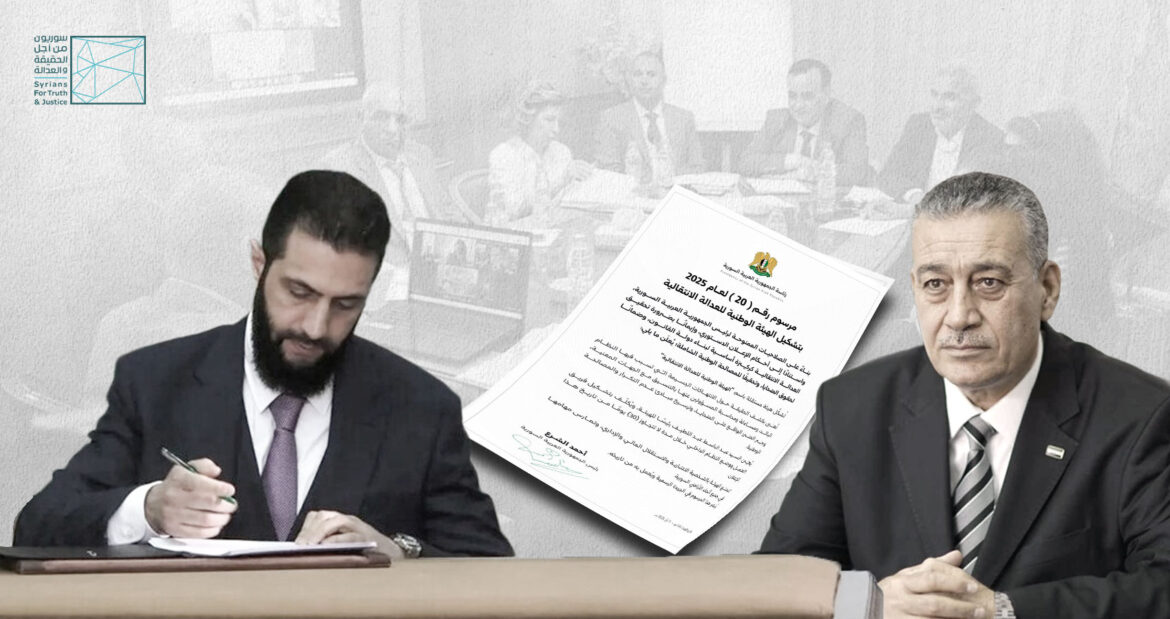
In March 2025, Article 49 of the Constitutional Declaration established a “Commission for Transitional Justice,”[1] followed by Presidential Decree No. 20, which formed an “independent body under the name of the National Commission for Transitional Justice.”[2] Yet both instruments disregarded violations committed after the fall of the Assad regime or by non-state actors, reducing the envisaged justice process to an essentially selective political tool rather than a comprehensive mechanism that safeguards the rights of all.
This paper therefore provides a critical analysis of Decree No. 20 of 2025 and its place within the transitional constitutional framework. It examines patterns of violations in Syria and the multiplicity of perpetrators, and highlights the key legal and procedural gaps embedded in the decree. The paper also addresses the continuation of grave forms of violence and abuse after the fall of the regime, revealing deep structural shortcomings in the current conception of transitional justice.
In addition to the legal analysis, the paper presents first-hand testimonies from victims across different regions who suffered abuses at the hands of non-regime actors but were excluded from the scope of transitional justice as defined by Decree No. 20. Their accounts demonstrate how such exclusion has reinforced feelings of injustice and discrimination. The paper further documents the implications of appointing individuals implicated in well-documented violations to official positions, and how this practice erodes the credibility of the justice process and the trust of victims in its seriousness. The paper concludes with practical recommendations aimed at ensuring a comprehensive justice process for all victims, grounded in international legal standards and capable of breaking the legacy of impunity and fostering social peace.
This report is issued approximately six months after the promulgation of Decree No. 20 (2025), establishing the National Commission for Transitional Justice, with the aim of assessing the extent to which it aligns with the principles of comprehensive justice and responds to the expectations of victims in Syria.
You May Read and Download the Full Report in PDF Format, by Clicking Here.
[1] Article 49 (1) of the Constitutional Declaration of the Syrian Arab Republic provides: “The National Commission for Transitional Justice shall be established and shall adopt effective, consultative, and victim-centered mechanisms to determine avenues for accountability, the right to truth, reparation for victims and survivors, in addition to honoring martyrs.”
[2] Syrian Arab News Agency (SANA). Presidential Decree No. 20 establishing the National Commission for Transitional Justice. 17 May 2025.