
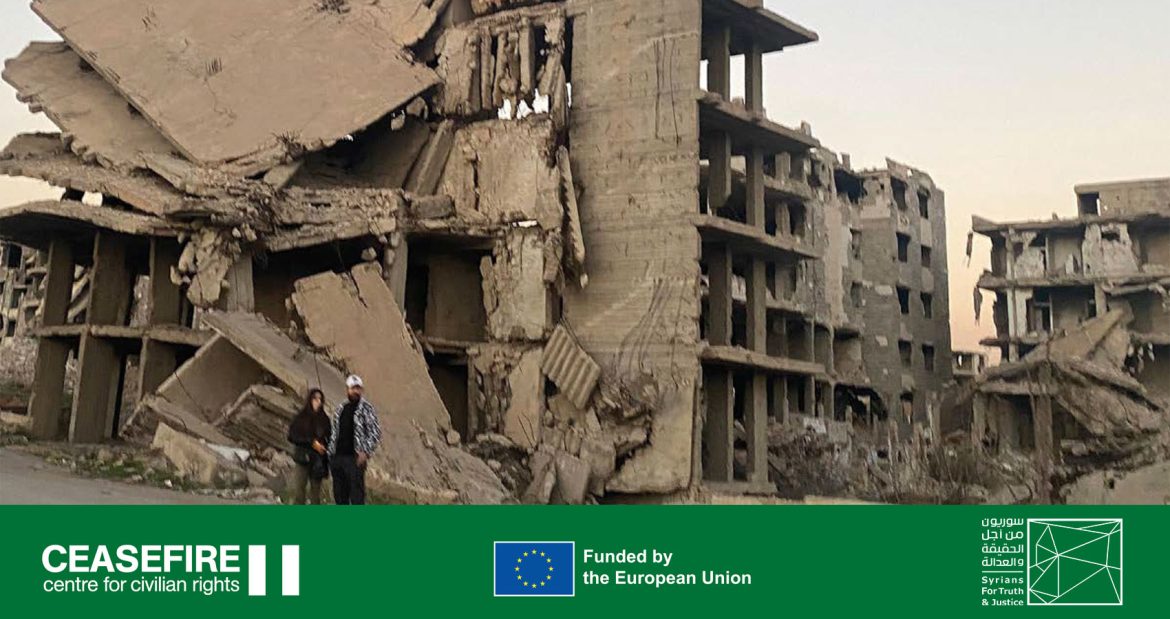
This publication was funded by the European Union, and in partnership with the Ceasefire Centre for Civilian Rights. The contents of this publication are the sole responsibility of Syrians for Truth and Justice – STJ/ the publisher and do not necessarily reflect the views of the European Union or the Ceasefire Centre for Civilian Rights.
1. Introduction
Syria has an opportunity that may not come again. After decades of authoritarian rule and more than 14 years of conflict, the fall of the Assad government in December 2024 opened a window for accountability that Syrians have waited for across generations. Whether that window stays open, and what passes through it, is the question this report tries to answer.
The report is grounded in fieldwork, including multiple visits to Syria and interviews conducted across the country and among diaspora communities, including direct conversations with Syrian officials, legal scholars, civil society activists, journalists and civilians who lived through the war from Damascus to Homs, Latakia to Deir ez-Zor. The picture that emerged is not the one official statements tend to project. It is more complicated, more urgent and in some ways more hopeful than many current accounts would suggest.
Syria has made progress since December 2024. The Constitutional Declaration of March 2025 gave transitional justice a legal foundation and a National Transitional Justice Commission (TJ Commission, the Commission) is now operational. Field consultations have reached communities across 12 governorates. And in April 2026, for the first time in Syrian history, a former Assad government official stood trial in a Damascus courtroom on charges that approximate to crimes against humanity. These achievements should not be minimized, but a distinction should also be made between the establishment of institutions and the conditions required for them to be effective.
The TJ Commission is operating without adequate resources, confined largely to Damascus and caught in a jurisdictional stand-off with the Ministry of Justice over the transitional justice law that was supposed to anchor the entire process. The Commission’s current mandate is limited to violations committed by the former regime and does not extend to victims of ISIS, foreign state actors, affiliated militias and other non-state actors. Communities in rural areas and among minority populations have little or no awareness the TJ Commission exists. The property and land crisis is already generating grievances that the formal mechanisms are nowhere near ready to address. The Syrian Penal Code of 1949, on which current trials depend, does not contain the legal categories required to prosecute war crimes or crimes against humanity in any internationally recognized sense.
This report addresses those gaps directly. It also examines the practical challenges in identifying Syria’s missing and analyses the accountability gap in relation to foreign state actors and other parties, whose conduct falls almost entirely outside the Commission’s current mandate. It addresses the question of reconciliation and the fourth pillar of transitional justice, guarantees of non-recurrence, which the Syrian context demands but which has received insufficient attention in the emerging architecture. It also suggests further roles for civil society organizations that do not need to wait for the formal mechanisms to catch up before they start being useful.
None of this means the process has failed. It means that it is fragile and that the decisions made in the next year or two will determine whether what has been built to date becomes a genuine foundation or an elaborate façade. This report documents what those decisions are, where the gaps are and what can be done about them.