
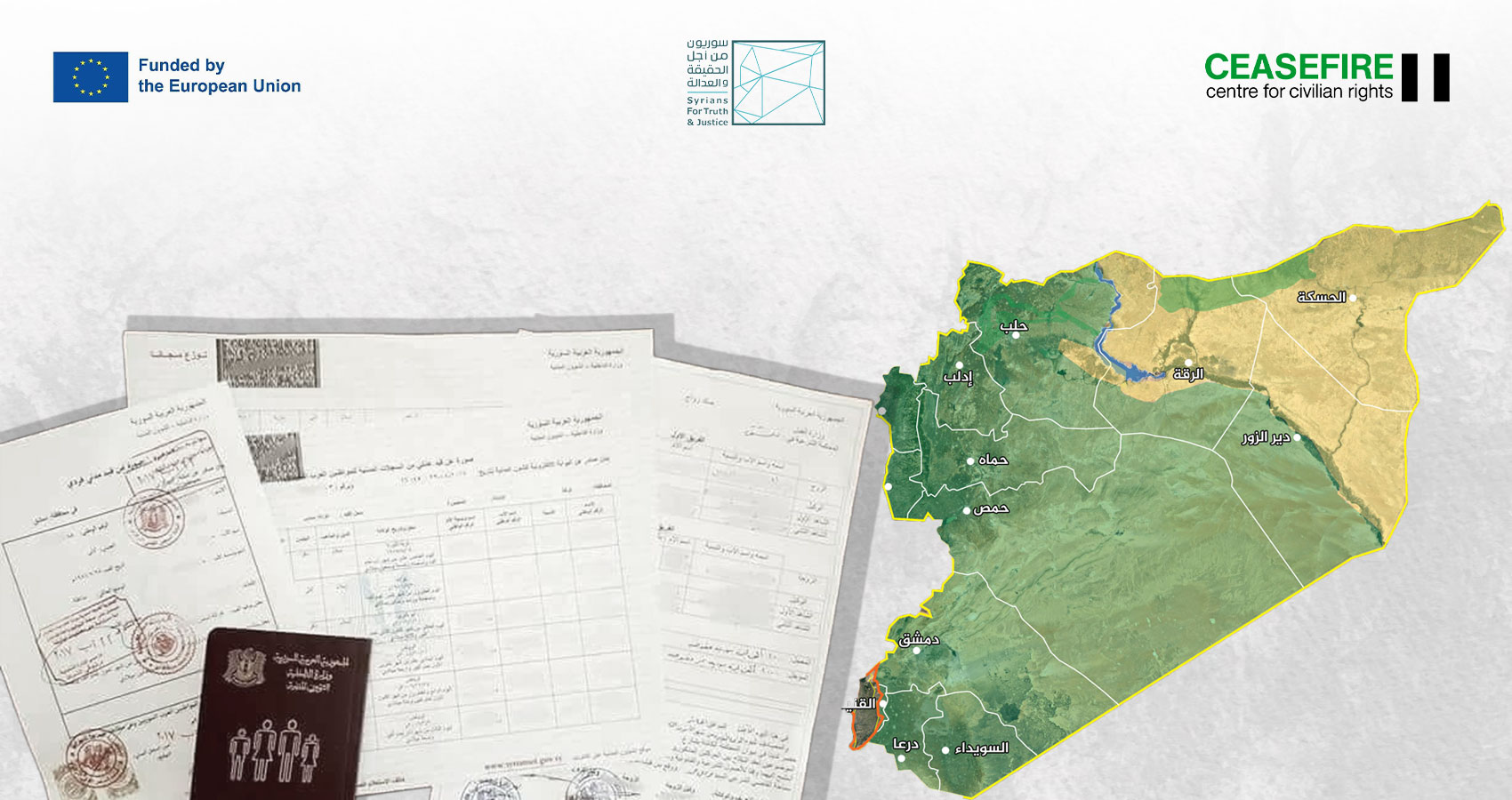
This publication was funded by the European Union, and in partnership with the Ceasefire Centre for Civilian Rights. The contents of this publication are the sole responsibility of Syrians for Truth and Justice – STJ/ the publisher and do not necessarily reflect the views of the European Union or the Ceasefire Centre for Civilian Rights.
1. Introduction
Following the fall of Bashar al-Assad’s regime on 8 December 2024, the functioning of several Syrian State institutions directly linked to fundamental civil rights —most notably civil status offices— came to a halt. While some of these institutions were gradually reactivated in a number of areas over the subsequent months, this partial resumption did not extend to Northeast Syria, where civil status offices have remained completely closed since the day of the regime’s collapse, with no reactivation up to the time of drafting this report.
Based on the testimonies collected for the purposes of this report, civil status offices in al-Hasakah Governorate operated under the former regime within what was known as the “security square,” and were effectively administered by central State institutions, with direct access to the government’s central civil registry database. After the regime’s fall, civil registry employees returned to their posts. However, the authorities exercising de facto control at the time —namely the Internal Security Forces (Asayish) affiliated with the The Democratic Autonomous Administration of North and East Syria (DAANES)— reportedly instructed them to suspend operations and temporarily close the offices until the broader national situation became clearer. This temporary suspension subsequently evolved into a prolonged shutdown, amid the absence of an understanding between the DAANES and the transitional government in Damascus.
In this context, and according to testimonies documented by STJ, the government later cut off the postal line servicing all areas under the DAANES, an essential link connecting al-Hasakah Governorate to the State’s central database and used by civil status employees to access and update central records. This technical disconnection effectively paralysed civil registry functions entirely, even where staff remained available, given these offices’ structural reliance on central connectivity to process any official transaction. Despite the complete suspension of services, civil registry employees have continued to receive their monthly salaries up to the time of drafting this report, as the transitional government in Damascus continues to disburse salaries through an application known as “Sham Cash.”
2. Background
In tracing the circumstances that led to the suspension of civil status offices in Northeast Syria and the onset of their institutional disruption following the fall of the former regime, STJ spoke with “Hisham,” a civil registry employee in Qamishli, about how the suspension began and its institutional nature. He described what happened as follows:
“We stopped working completely on the day the regime fell, when the Asayish forces took control of the government offices and asked us to return home until we were notified to resume work. But to this day, nothing has changed.”
The complete suspension of civil registry services —without any decision to reactivate operations or to establish alternative arrangements— has created a wide-ranging legal and administrative vacuum in the lives of civilians in the area. This vacuum has manifested in the inability to register essential civil status events and obtain civil documentation, resulting in a direct impairment of fundamental rights linked to legal recognition.
“Hisham” further described the implications of this disruption, stating:
“One of the consequences of the civil registry shutdown in the region is that thousands of births there still have not been registered to this day. Children who have reached the age of 15 have also been unable to obtain their IDs. In addition, hundreds of marriage contracts have not been validated in court, and many cases of death and divorce have not been recorded.”
This reality stands in contrast to other areas of the country where civil status institutions have resumed operations, including Damascus. Official authorities announced the resumption of civil registry services at Citizen Service Centres as of March 2025, including the issuance of civil extracts and other essential civil status certificates. This geographic disparity highlights a structural deficiency in the guarantee of civil rights across the country. At a moment when the political agreement announced between the Syrian government and DAANES in Northeast Syria on 10 March 2025 should have constituted an entry point to address this imbalance —given that it included general principles related to safeguarding rights, integrating civil institutions, and addressing files connected to basic services— testimonies indicate that the agreement “has not translated into practical progress on the civil status file” up to the time of drafting this report (January 2026).
To better understand the implications of this continued shutdown and its legal and practical effects on civilians in Northeast Syria, STJ conducted six in-depth interviews with lawyers, former civil registry employees, media workers, and individuals directly affected by the suspension of civil status services. Participants provided informed consent after being briefed on the voluntary nature of their participation and the intended use of the information provided, including the incorporation of excerpts in this report. All witnesses also requested that their identities and any identifying details be withheld. Accordingly, this paper uses pseudonyms when citing testimonies included herein.
3. Field Reality and the Consequences of Civil Registry Closure in Northeast Syria
Throughout 2025, access to essential civil documentation in Northeast Syria has shifted from a routine administrative service into an arduous process that imposes increasing financial and security burdens and, in many cases, produces a de facto legal vacuum. The testimonies relied upon in this report indicate that the core problem lies in the complete and ongoing suspension of official civil status offices, which directly affects individuals’ ability to register and formalize key life events —such as birth, marriage, death, identity status, and civil records— and the associated rights and legal protections.
In this context, “Alan,” a director of a transaction processing services company in Northeast Syria, described the fundamental shift in how civil services can be accessed:
“In the past, people used to go to al-Hasakah to obtain civil documents or passports… now they have to go to Damascus, and in most cases the person must be physically present to complete these procedures.”
This shift is not limited to the distance and burden of travel; it also extends to cost and the ability to pursue the process. “Alan” added:
“Authorizing lawyers to carry out such procedures requires extremely high costs, and as a result brokers extort people financially.”
From a rights-based perspective, making travel a de facto requirement for obtaining civil documents creates discrimination in access to civil rights, determined by an individual’s ability to pay and to assume risk. This undermines the principle of equality before the law and effectively transforms a right into a privilege.
These consequences become particularly acute in the birth registration, as the first gateway to legal recognition of the person before the law. “Renas,” a lawyer from Qamishli, explained:
“The closure of the civil registry has had negative impacts on most people’s lives, such as the inability to obtain official documents or to secure an ID card, and the difficulty of registering births and deaths… If this situation continues, it may lead to an increase in the number of unregistered persons, potentially creating a generation in which a high percentage lacks official civil records.”
These risks are reflected in the personal experience of “Mohammad,” a livestock trader from Qamishli, who described his attempt to register his child’s birth:
“There was no official authority to register my child in our family booklet, so I went to Damascus, because government offices in our areas are completely closed.”
He explained that he was forced to travel multiple times between Qamishli and Damascus after being informed that the birth notification form, he carried “belonged to the former regime and is no longer valid.” He added:
“They asked me to return to Qamishli, fill out the new form, and have it stamped by the supervising doctor, the pediatrician, and the hospital, then return to Damascus… and afterwards I was asked to have it signed by the Ministry of Health in Damascus.”
Legally, this process is not merely an administrative complication: delaying or impeding birth registration suspends legal recognition of the person and affects a range of subsequent rights, including education and freedom of movement, thereby undermining the very essence of the right to legal personality.
The disruption is not limited to birth registration; it extends to a wide range of civil status events. “Mohammad” confirmed:
“Anything related to official government departments in our areas requires going either to Damascus or Deir ez-Zor, such as marriage contracts, obtaining civil extracts, or passports. This is a major problem for people.”
The consequences are further aggravated in cases of death. “Hisham,” a civil registry employee in Qamishli, explained that the interruption of registration prevents the issuance of death certificates required for inheritance procedures, thereby directly obstructing heirs’ rights and the ability to dispose of property. He stressed the seriousness of this disruption:
“While the validation of a marriage may be postponed under certain circumstances, in practice the consequences of death, and heirs’ rights, cannot be deferred without directly affecting existing legal positions.”
These effects extend to property and real-estate transactions. Lawyer “Renas” noted that the shutdown of the civil registry directly affects the land registry and obstructs the transfer of ownership and the registration of real rights. “Azad,” a journalist from Qamishli, corroborated this field reality, stating:
“Home purchases are now being carried out through personal guarantees, in the absence of complete official proof, relying only on real-estate office contracts or private agreements between the seller and the buyer.”
This situation increases the risk of disputes, weakens legal protection of property, and creates contractual fragility affecting the stability of civil transactions.
Testimonies also reveal legal uncertainty regarding the recognition of documents issued by unrecognized local authorities. In this regard, “Azad” explained:
“We have documented cases where some citizens lost their personal IDs, which effectively restricts their movement within Syria… They are required to file an official report on the loss of the ID, but the absence of State police centres in the Northeast raises a fundamental question as to whether official departments in Damascus will recognize a report issued by the Asayish.”
In the absence of clear legal guarantees, “Ismail,” a media worker from Qamishli, expressed deep concern and uncertainty regarding the future of unregistered children:
“If no agreement is reached between the transitional government and DAANES, we are deeply concerned that children will remain without any identity or personal proof.”
“Renas” further warned that the continuation of this vacuum may “lead to the emergence of forged official documents.” As the intermediary economy expands, inequalities in access to civil rights deepen, consolidating economic-based discrimination and undermining the rule of law.
These risks assume heightened significance in Northeast Syria in light of the historical experience of the 1962 al-Hasakah Exceptional Census, which deprived thousands of Kurdish families of Syrian nationality and resulted in widespread violations of civil, political, and social rights.[1] The continuation of the current vacuum in civil registration evokes this historical suffering and compounds fears of long-term cumulative effects on the legal recognition of the population and their fundamental rights.
4. Existing Frameworks, Proposed Solutions, and Their Legal Limitations
In light of the continued closure of official civil status offices in Northeast Syria, a number of partial approaches have emerged over the past year in an attempt to address the existing administrative and legal vacuum. However, the testimonies relied upon in this report indicate that, despite their practical necessity, these approaches have remained constrained by shared legal and political limitations, preventing them from producing sustainable impact or providing civilians with genuine legal protection.
Lawyer “Renas” explained that DAANES sought to mitigate the consequences of the disruption through local measures, stating:
“DAANES can issue local documents to facilitate people’s daily affairs within its areas, and it can also document births, deaths, marriages, and divorces in special registries. The problem is that these documents are not recognized, and we cannot predict their legal future.”
This description captures the core of the problem: the absence of legal recognition not only limits the usability of such documents outside the region, but also undermines individuals’ confidence in the value of documentation itself and its medium- and long-term utility. In this context, journalist “Azad” raised a question reflecting broader public concern:
“Can the documents or family booklets issued by DAANES be relied upon to obtain a passport or personal ID, or to validate a marriage?”
“Azad” noted that this reality effectively places citizens before two equally costly options: either to rely on local documents that facilitate daily life without legal guarantees, or to shoulder the burden of travel to Damascus or Deir ez-Zor, along with the financial costs and security risks such travel entails.
In an attempt to bridge this gap, some of those interviewed by STJ proposed emergency solutions, including the establishment of temporary liaison offices linked to the central civil registry and the electronic archiving of civil status events pending an institutional settlement. “Renas” considered this option feasible in principle “if this data is officially transferred following an agreement between the government and DAANES.” At the same time, he stressed that any documentation not grounded in a clear legal mandate and a subsequent recognition mechanism would remain limited in effect and could generate additional complications rather than resolve the problem.
In another testimony, “Hisham,” (civil registry employee in Qamishli), emphasized that the obstacles begin with the absence of political consensus, explaining:
“The nature of the work depends primarily on the network linking the civil status office in al-Hasakah to the State’s central database. That link has been completely cut, which makes a return to work impossible even if staff are available.”
Taken together, these accounts demonstrate that proposed solutions remain dependent on the absence of legal recognition and binding institutional coordination. The continuation of this situation shifts the burden of safeguarding the right to legal personality from the State to individuals themselves, entailing risks of de facto discrimination, a gradual erosion of legal protection, and the undermining of equality before the law.
As civil registry institutions remain non-functional, thousands of Syrians living in areas outside government control find themselves in a suspended legal situation. The effects of lacking official documentation extend far beyond administrative inconvenience, reaching into the erosion of citizenship rights and exposing entire generations to the risk of legal invisibility.
5. Recommendations
The testimonies and facts presented in this report demonstrate that the continued closure of civil status offices in Northeast Syria constitutes a structural human rights crisis that affects the very essence of the right to legal personality and the recognition of fundamental civil status events. This situation has effectively redistributed access to civil rights on the basis of an individual’s ability to travel and bear associated costs and risks, creating an unequal reality and exposing large segments of the population to the risk of losing legal protection. The report further shows that local or emergency measures —despite their practical necessity— remain of limited effect unless accompanied by clear legal recognition and binding institutional coordination. It also finds that the absence of concrete implementing measures for announced political agreements has deepened, rather than resolved, the existing vacuum. Accordingly, there is an urgent need for targeted interventions that reassert the State’s responsibility to guarantee civil rights and prevent the accumulation of consequences that may prove difficult to remedy in the future.
5.1. To the Syrian Transitional Government
- Assume full legal responsibility for guaranteeing the right to legal personality by reactivating civil status offices in Northeast Syria, or by adopting officially recognized interim mechanisms pending full reopening.
- Ensure that fundamental civil rights are neither suspended nor restricted, nor used as leverage in any political dispute or negotiation, and guarantee the continuity of civil registry services as a legal obligation of the State.
- Issue a clear legal and executive framework recognizing civil status events that occurred during the period of disruption (births, deaths, marriages, divorces), without imposing additional burdens.
- Restore technical and institutional connectivity for civil registry services, ensure continuity of service delivery, and announce a transparent timeline for addressing the civil status file, with defined responsibilities and accountability safeguards.
5.2. To The Democratic Autonomous Administration of North and East Syria
- Continue documenting civil status events through organized and verifiable registries, while ensuring data protection and proper archiving to prevent loss, tampering, or misuse.
- Clearly inform the population of the limits of legal recognition of local documents and the implications of their use within and outside the region.
- Advocate for official recognition of documents recorded during the period of disruption through institutional negotiation channels with the transitional government.
[1] As a result of the 1962 al-Hasakah census, the population was divided into three categories:
- Syrian citizens: Those who retained full Syrian nationality and whose names remained recorded in the civil registry without change.
- “Al-Hasaka Foreigners” (Ajanib): Individuals whose names were removed from the citizens’ registry and transferred to a special register. They were issued distinctive red cards bearing the statement: “His name was not included among Syrian Arabs as a result of the 1962 census.” These cards did not entitle holders to travel, own property, or obtain employment, and served as a symbol of discrimination.
- Unregistered (Maktumeen): Individuals whose names were not recorded in any register whatsoever and who were not issued any official documentation. Legally, they were not even considered “foreigners,” but rather rendered civilly non-existent, without national identification numbers or birth or death certificates.
For further information, see: Syrians for Truth and Justice, “Strangers in Their Own Homeland”: The 1962 al-Hasaka Exceptional Census and the Path to Transitional Justice in Syria, 27 November 2025.