
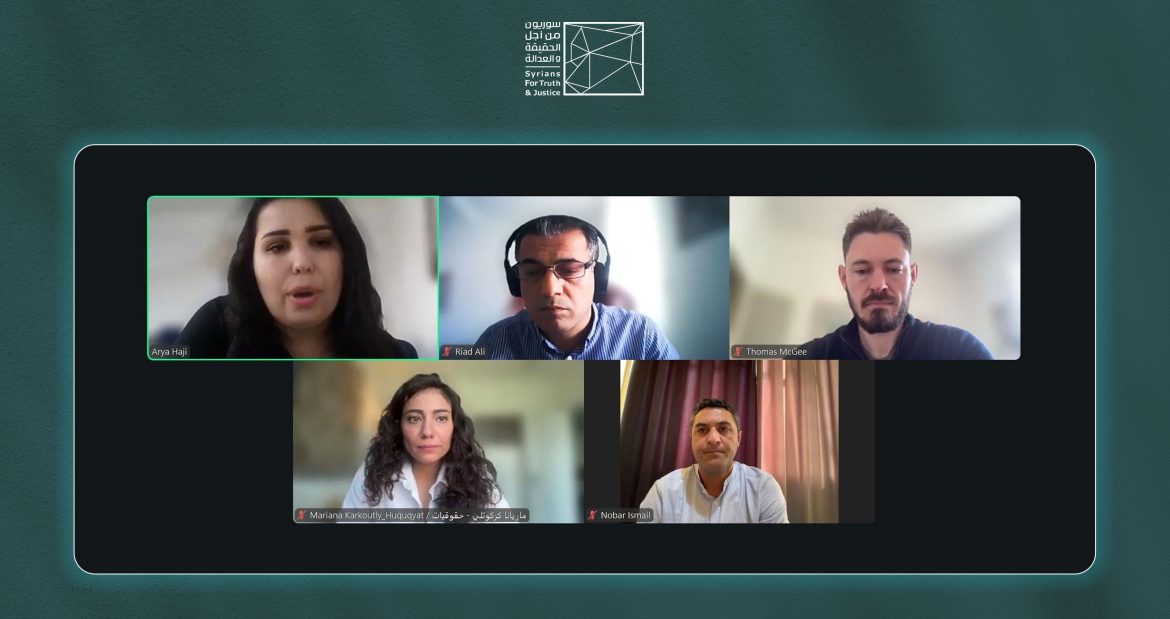
On 21 May 2026, Syrians for Truth and Justice (STJ) held a dialogue session addressing challenges related to nationality in Syria, beginning with the legacy of the 1962 exceptional census in al-Hasakah Governorate, which stripped tens of thousands of Kurds of their nationality, and continuing through the challenges imposed by years of conflict and up to Legislative Decree No. 13 of 2026.
The online discussion also examined discrimination against women in Syrian nationality law, the status of children born to non-Syrian fathers, and the role of local and international actors in addressing statelessness.
Former judge and Senior Legal Adviser at STJ, Mr. Riyad Ali, described Legislative Decree No. 13 as “a positive step in the right direction; however, it is difficult to regard it as sufficient, as the decree failed to address fundamental issues such as the Arab Belt project and property confiscations, nor did it address the policy of Arabization.” He stressed that these rights “are not a favor granted by anyone, but rather part of addressing a historical injustice that has affected this community for decades. They constitute a correction of a previous course of action, particularly since all international conventions and declarations, including the Universal Declaration of Human Rights (UDHR), the International Covenant on Civil and Political Rights (ICCPR), and the Convention on the Rights of the Child (CRC), affirm that no person may be arbitrarily deprived of their right to nationality.”
For his part, researcher and journalist Nobar Ismail, who was deprived of nationality for more than three decades, explained that “the current procedures require the submission of documents such as utility bills; documents that are fundamentally unavailable to Maktumi al-Qayd/maktumeen (unregistered). This occurs amid the continued dysfunction of government institutions in northeastern Syria, forcing those concerned to travel hundreds of kilometers to Damascus to obtain a basic right.”
Academic researcher Thomas McGee linked reform of the nationality law to the broader process of transitional justice, emphasizing that “gender-based discrimination compounds the impact of statelessness, as the combination of a father deprived of nationality and a mother unable to pass her nationality to her children results in an entire generation being outside the legal system.”
Legal researcher and investigator, and co-founder of the organization Huquqyat, Mariana Karkoutly emphasized that “discrimination against women in the transmission of nationality results in inherited legal vulnerability that directly affects children and hinders their access to education, healthcare, and official documentation.” She added that “nationality constitutes the gateway to legal existence and the key to all other rights,” and that “deprivation of nationality cannot be reduced to a mere administrative measure but rather represents a profound form of political and legal exclusion.”
The participants concluded that addressing the issue requires comprehensive legal and institutional reforms and that nationality must be recognized as a fundamental right, not a privilege. They further stressed that genuine transitional justice cannot be achieved without building a legal system that does not reproduce exclusion or deprivation of nationality.