
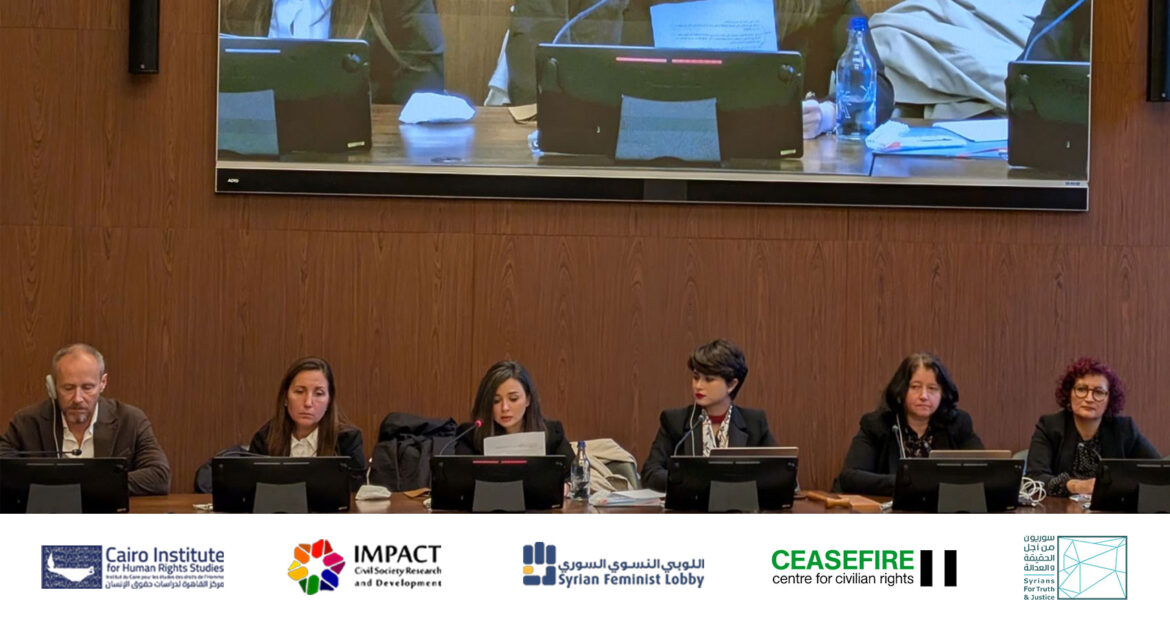
A group of civil society organizations organized a side event on the sidelines of the 60th session of the Human Rights Council in Geneva. The event was held physically at the Human Rights Council headquarter on September 26, 2025. It discussed the challenges of the implementation of a comprehensive model of transitional justice in Syria following the widespread violations and mass killings that the country has witnessed recently, including the Suwayda massacres of July 2025, and the accompanying extrajudicial killings, torture, sectarian violations, property arson and looting, abductions, and sexual violence.
The event, organized by Syrians for Truth and Justice, Impact Research and Development, the Cairo Institute for Human Rights Studies, the Syrian Feminist Lobby, and the Ceasefire Center for Civilian Rights, featured speakers with expertise in Syrian affairs and justice. The aim was to provide a comprehensive overview of the human rights situation in Syria and highlight the most prominent challenges hindering the achievement of transformative transitional justice.
During her briefing, Syrian activist and political analyst Farah Youssef emphasized the need for a comprehensive approach to disarmament, demobilization, and reintegration (DDR) related to a comprehensive transitional justice process. She said, “In March, the regime’s factions moved toward the coast under the pretext of fighting ‘Assad’s remnants,’ driven by sectarian incitement and a complete lack of transparency and humanitarian guarantees. The factions quickly turned to the Druze, carrying out similar practices, followed by a siege that continues until now. This has left deep rifts throughout Syrian society and led to many groups losing confidence in the ruling authority”.
Youssef emphasized that any political process, whether a national dialogue or a founding conference that includes all Syrians, requires a safe environment that allows free and real participation. “In the absence of such environment, the dialogue will remain governed by fear and the balance of armed power, which will reproduce the logic of exclusion, not the logic of participation,” she asserted. “Hence, Security Council Resolution 2254 becomes an indispensable reference. It establishes a clear framework for a Syrian-led political transition under UN auspices and emphasizes a transitional governing body with full power. Herein lies the necessity of forming a transitional military body under UN auspices, with broad local participation. It will be responsible for collecting weapons, maintaining security, and reforming the military establishment, in parallel with the transitional body’s work on political reconstruction and dismantling the war economy.”
For her part, Syrian writer and activist Hanadi Zahlout spoke about the crimes committed against her brothers and friends in the village of Sanawber, Latakia Governorate, during the events of March 2025. “More than 1,400 people were extrajudicially executed, including my three brothers, Ahmed, Abdul Mohsen, and Ali, and my Arabic teacher, Anan Khair Bek. Ironically, those same people who taught me the alphabet are the ones I stand among you today to illuminate their memories and speak about their innocent lives,” she said.
“Perhaps the worst thing that happened to the survivors of the coastal massacres is that the nightmare they experienced was repeated in Suwayda against the Druze, and that hope of finding a true Syrian homeland was lost. This time, the stab was fatal,” She added. “Syria cannot continue to escape justice. Settlements with the killers cannot produce peace, but instability and tension, making massacres more likely to occur every day. Syria needs to create the conditions for a true national conference, where Syrians can sit at one table and raise their concerns and fears. The country needs to be led by a transitional governing body and a military council capable of confining weapons—every weapon—to a national army,” She emphasized.
Regarding the recent events that took place in the city of Suwayda, writer, feminist, human rights defender, and executive director of the Syrian Feminist Lobby, Rima Fleihan, said, “The depth of what happened in Suwayda is linked to a major flaw in the transitional political process. It is linked to a takfiri faction with a long record of violations and stifling any opportunity for genuine national dialogue, real participation, and serious political transition within the roadmap outlined by Security Council Resolution 2254.”
Regarding the violations committed since July 2025, she said, “The violations included extrajudicial mass executions, in which men, young men, and the elderly were documented being taken from their homes and executed on the spot. Cases of executions in front of family members (wives and daughters) were also documented. The violations also affected women of all ages, including the targeting of a 3-month-old child. Sniping incidents in the streets were recorded, and doctors were targeted while trying to reach the National Hospital.”
Fleihan emphasized that achieving stability and civil peace today depends on the existence of a comprehensive, genuine, transparent, responsible, and gender-sensitive transitional justice process. “The transitional justice process is complex, multi-dimensional, and multi-tooled, aiming to address the legacy of grave violations committed during the conflict or the Assad authoritarian rule, as well as the subsequent violations under the transitional authority. Therefore, the decision to establish the Transitional Justice Commission must be amended to include all violations committed by all parties before and after the fall of the regime. There can be no true justice without justice for all victims and accountability for all criminals,” She added.
For her part, feminist politician and co-director of the Dodri organization, Alise Mofrej, gave a briefing in which she emphasized that “any international agreements to end the recent cycle of violence require a radical solution, in which Suwayda is a key party in any negotiation process under UN supervision that guarantees the protection of the population from any acts of revenge.” She pointed out that if pressure is not applied to the transitional authority to negotiate seriously and to take immediate and direct measures to build trust, “the negotiation process will only waste time and exacerbate the suffering of Suwayda.”
Mofrej listed a set of demands for the transitional government, most notably “acknowledging the massacres and holding the authority directly responsible, through its military, security, and tribal forces; lifting the partial siege and securing the Damascus-Suwayda Road; the release of the kidnapped and detained women and men, revealing the fate of those forcibly disappeared, and stopping arbitrary arrests of Suwayda residents.” She concluded, “Justice will not be achieved for all without holding all perpetrators of violations accountable.”
In response to a question about the fate of hundreds of thousands of documents and evidence collected since 2012 by Syrian human rights activists and UN mechanisms, which concerns about fair trials and the death penalty may prevent the new transitional authorities in Syria from access to, as the example of neighboring Iraq demonstrates, Mark Lattimer, executive director of the Ceasefire Center for Civil Rights, said, “The evidence demonstrates the gross violations committed by the Assad government, as well as by armed opposition groups. If justice is to be comprehensive, it must be applied equally to all perpetrators, and to all victims of violations to obtain redress.”