
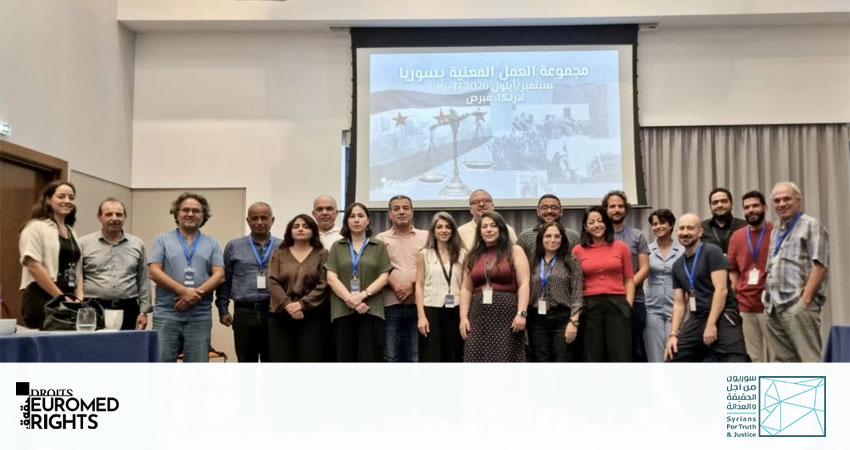
Syrians for Truth and Justice (STJ) participated in the Syria Working Group meetings, convened by the EuroMed Rights 16 and 17 on September 2026, in Larnaca, Cyprus. The meetings brought together researchers, legal experts, and Syrian and international organizations working on transitional justice and human rights.
Over two days, the meeting addressed several key areas, including political developments and the regional context; transitional justice, detention, and enforced disappearance; the situation of refugees and returnees; inclusion and minority rights; youth participation and civic space; and a strategic advocacy planning session.
Transitional Justice: A Pillar of the New State and the Social Contract
During the session on Transitional Justice, Detention, and Enforced Disappearance, Riyad Ali, STJ’s representative and first legal officer, presented on “State Responsibility, Accountability, and the Transitional Justice Commission.” He addressed the current state of the transitional justice process in Syria and the state’s responsibility.
Ali emphasized that Syria is in an exceptional phase in which transitional justice legislation and institutions are taking shape and constitute a fundamental pillar in determining the form of the transitional state and the new social contract. He stressed that the function of transitional justice is not limited to addressing past violations; rather, it is primarily aimed at building trust in institutions, foremost among them the judiciary, and consolidating the rule of law.
He noted that, despite the initial establishment of accountability mechanisms, a critical review of the current process reveals significant structural gaps that risk producing “selective justice” and stripping this rights-based process of its substance.
From the Stagnation of Resolution 2254 to the Interim Constitutional Declaration
Ali also addressed the stalled implementation of UN Security Council Resolution 2254, explaining that it was effectively replaced by de facto terms such as “revolutionary legitimacy” and the “Victory Conference,” followed by the convening of the “National Dialogue Conference” through an expedited process that lacked genuine representation of civil forces.
He also noted that the Interim Constitutional Declaration issued in March 2025 concentrated broad powers in the transitional president and extended executive dominance over the three branches of government (legislative, executive, and judicial), including the appointment of members of the Supreme Constitutional Court and the determination of its functions, as well as the appointment of members of the People’s Assembly, thereby undermining the principle of separation of powers and obstructing the establishment of an independent judiciary.
Gaps in Decree No. 20 of 2025
In the context of transitional justice, Ali highlighted shortcomings in Decree No. 20 of 2025, which established the National Commission for Transitional Justice. He explained that the decree has been criticized for limiting its scope to violations committed by the former regime while overlooking ongoing violations by other parties.
He stressed that genuine transitional justice must be grounded in the nature and gravity of the violation and in the victim’s rights, without discrimination or political framing.
The State of the Judiciary: Executive Dominance and Institutional Discrimination
Regarding the state of the judiciary, Ali explained that the Syrian judiciary suffers from executive dominance and the continued appointment of religious figures and judges who lack the competence and experience needed to address international crimes. He also highlighted institutional discrimination and attempts to exclude women judges and lawyers.
Recommendations and Requirements for Reform
Ali concluded by presenting a set of recommendations and requirements for reform, most notably:
- Explicit recognition: Explicitly acknowledge significant shortcomings in the current transitional justice process and the need to address them.
- Constitutionalize transitional justice and leadership responsibility: The permanent constitution should enshrine the principle of non-impunity, exclude international crimes from the principles of non-retroactivity of laws and the statutes of limitations for all parties to the conflict, and strengthen the rule of law.
- Amend current legislation: Amend Decree No. 20 to adopt a neutral, comprehensive definition of victims and to codify international crimes in accordance with the Rome Statute.
- Enforce the Anti-Torture Law through strict procedural measures, advance the proceedings before the International Court of Justice initiated by Canada and the Netherlands, and accede to the Optional Protocol to the Convention against Torture.
- Strengthen international cooperation: Expedite signing memoranda of understanding with the International, Impartial and Independent Mechanism (IIIM), the Independent Institution on Missing Persons (IIMP), and the International Commission of Inquiry (COI-Syria); and initiate accession procedures to the Rome Statute and the International Convention for the Protection of All Persons from Enforced Disappearance (ICPPED).
- Participate in safeguarding the independence of the judiciary and civil society: end executive dominance, involve survivors’ and victims’ associations in drafting legislation, and ensure a peaceful transfer of power while respecting the principle of separation of powers to prevent the entrenchment of authoritarianism or a spoils system.