
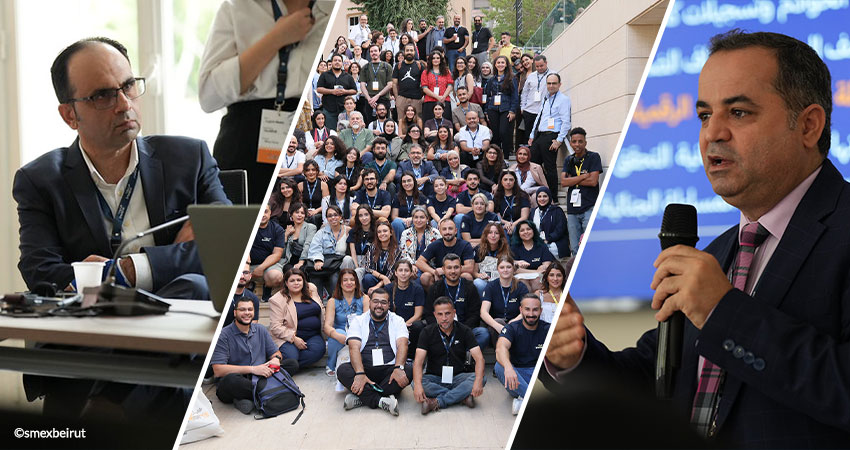
On 14 October 2026, as part of the Bread&Net Forum, held in Beirut, Lebanon, from 14 to 16 October, Syrians for Truth and Justice (STJ) hosted a session entitled “From Surveillance to Accountability: Why Digital Rights Must Be Part of Transitional Justice in Syria.”
The session featured STJ’s Executive Director, Bassam al-Ahmad, alongside Judge Riyad Ali, the STJ’s expert and Senior Legal Advisor, and its Security and Protection Officer. The conference hosted a series of dialogues and interactive discussions, bringing together dozens of speakers and participants from diverse backgrounds, including technology professionals, journalists, academics, policymakers, students, and others.
The session, delivered by STJ, explored how states emerging from conflict or authoritarian rule can redesign their digital systems to safeguard rights and prevent the re-establishment of surveillance and control tools.
The discussion highlighted that the future of the state’s digital governance is often neglected in conversations about political transitions. It also warned that continuing with the existing digital infrastructure without a thorough review could result in the ongoing presence of surveillance mechanisms and violations of digital rights, even if the state’s political structure undergoes changes.
During his intervention, al-Ahmad outlined the trajectory of transitional justice in Syria following the fall of the former regime in December 2024. He traced the key developments, beginning with the National Dialogue Conference in February 2025 and the Interim Constitutional Declaration in March 2025, followed by the two decrees establishing the National Commission for Transitional Justice and the National Commission for Missing Persons in May 2025, and culminating in the trials of several prominent figures from the former regime and the announcement of some verdicts in August 2026.
He also addressed digital rights as a set of rights, freedoms, and safeguards associated with the use of technology and the digital space. He explained that these rights extend beyond freedom of expression and the protection of personal data, intersecting directly with the core pillars of transitional justice, including providing redress to victims, uncovering the truth, preserving national memory, supporting criminal accountability, and reforming institutions.
Digital Evidence: Vital for Uncovering the Truth
Al-Ahmad noted that after the collapse of the former regime, discussions and campaigns primarily focused on safeguarding paper documents, many of which had already been looted, burned, or destroyed in detention centers and public institutions. In contrast, the critical issue of securing digital evidence, such as data stored on servers, CCTV footage, and other electronic records, was largely overlooked.
He explained that the lack of specialized strategies for managing digital evidence, or the inadequacy of existing ones, risks losing crucial evidence and leads that are essential for uncovering the truth and providing redress to victims. Al-Ahmad emphasized that digital evidence is strategically important for three main reasons.
First, this type of evidence helps overcome challenges in accessing crime scenes, particularly when physical evidence has been deliberately destroyed, lost due to negligence, or degraded over time. Second, digital evidence can illustrate that violations were not isolated incidents; rather, they were part of a coordinated effort directed by senior leadership, especially in situations where instructions were given verbally. Finally, it can assist in identifying both perpetrators and victims.
Al-Ahmad stressed the need for effective methods to protect, document, and preserve digital evidence and electronic data. He highlighted that ensuring the integrity, authenticity, and verifiability of this information is crucial, as it significantly supports transitional justice processes and reinforces efforts for criminal accountability.
A National Digital Archive to Preserve Memory and Protect Victims’ Privacy
Al-Ahmad advocated for the creation of a national digital archive in Syria during the transitional period. This archive would compile documents, testimonies, photographs, recordings, and other relevant materials, making them accessible to the public. Access would be governed by regulations that protect the privacy of victims and preserve the integrity of the evidence.
He emphasized that the role of digital technologies should extend beyond merely collecting evidence and documenting violations. He explained that such an archive could play a crucial role in preserving national memory, enhancing the right to access information, and combating the denial of crimes and efforts to distort history.
He concluded that digital transitional justice should include the creation of rules and procedures for data preservation and access, as well as the protection and promotion of privacy. It must also ensure accountability for any misuse or violation of data. Therefore, its scope should go beyond simply using digital information as evidence in individual trials, documenting past violations, or commemorating the victims of those violations.
Towards a Rights-Based Digital Transformation
The session concluded with three joint recommendations: reforming the legal and institutional framework, protecting inherited archives and data, and establishing people-centred digital governance.
The session concluded with a key message: “Changing who governs the state is not enough; we must also reform the rules regarding the data collected by the state, the tools used for surveillance of individuals, and the mechanisms that hold those who misuse these tools accountable.”
Supporting Safe and Sustainable Digital Transformation with Digital Bridges
Amid digital transformations and Syria’s reconstruction needs, STJ is launching the Digital Bridges project as an independent initiative and advisory platform to support safe and sustainable digital transformation in local communities and recovery settings. It does so by bringing together technical expertise, policy analysis, and cybersecurity strategies. The initiative responds to the growing technological needs arising during Syria’s reconstruction phase.
The initiative’s work is structured around four key thematic areas: digital governance and policymaking; cybersecurity and cyber defence; digital rights and freedoms; and the intersection of technology and society.
Its vision is to emerge as a leading regional initiative advancing safe digital transformation through sustainable solutions that safeguard rights and promote innovation. Its mission is to translate complex technical knowledge into practical strategies and effective tools for digital protection.
In addition, the initiative delivers a range of community-oriented services designed to strengthen local capacities and promote digital resilience. These include digital security clinics, practical digital safety guides, and initiatives aimed at raising awareness of and advancing digital rights.