
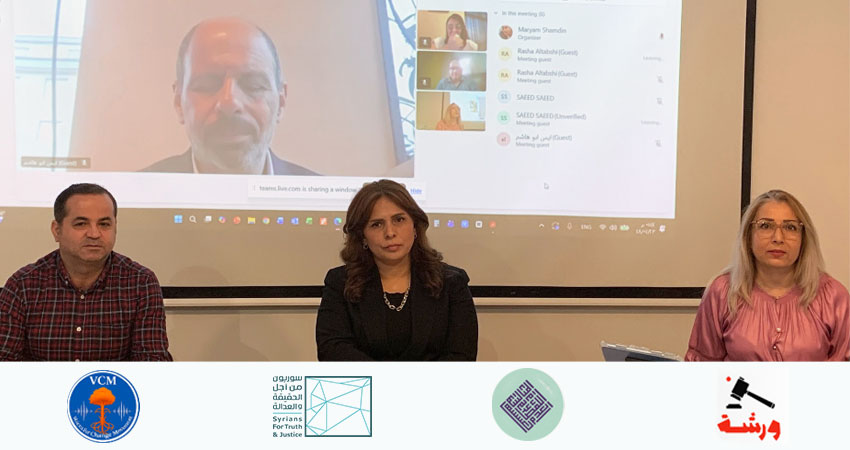
On Sunday, 4 October 2026, the French city of Strasbourg hosted a dialogue entitled “Citizenship and Nationality in Syria: From the 1962 Census to the Challenges of Equality and Equity.” The event was organized by Voices for Change Movement (VCM) in partnership with Syrians for Truth and Justice (STJ) and the Warsha team, with the participation of Warsha’s “My Nationality Is Their Right” initiative. It formed part of the AGORA | VCM Civic Dialogue Series – PARRHESIA Edition.
The discussion took as its starting point the special census conducted in al-Hasakah Governorate on 5 October 1962, which deprived tens of thousands of Syrian Kurds of their nationality and left legal and social consequences that have persisted across generations.
Building on this historical context, the discussion broadened to address nationality and citizenship in Syria more generally. Topics included equal rights for women and men to transmit nationality, naturalization policies, and the legal status of Palestinians in Syria. Participants also examined the principles that should underpin any future reform of the nationality law to strengthen equal citizenship and the rule of law.
The session was moderated by Maryam Shamdin, founder and President of VCM. Speakers included Bassam Al-Ahmad, co-founder and Executive Director of STJ; Rasha Al Tabshi, journalist, feminist researcher, Executive Director of the Warsha team, and founder of the “My Nationality Is Their Right” initiative; Ayman Fahmi Abo Hashem, lawyer, legal researcher, and President of Palestinian Jurists Association in Syria; and Wafaa Alasaad, lawyer, human rights and social activist, and founding member of the Legal Family Association.
The session covered four themes: the context and consequences of the 1962 special census in al-Hasakah and subsequent legal measures to address them; Syrian women’s right to transmit nationality to their children; naturalization policies in Syria and the legal status of Palestinians; and the foundations of a nationality law based on citizenship and equality.
Addressing the first theme, Bassam Al-Ahmad presented findings from STJ’s documentation. Citing statistics the organization obtained in 2018 from a source within the Civil Affairs Directorate in al-Hasakah, he stated that the cumulative number of Syrian Kurds affected by deprivation of nationality had reached approximately 517,000 people by 2011, including more than 171,000 maktoumeen (unregistered persons), according to the figures he presented during the session. He also cited STJ’s estimate that approximately 150,000 Syrian Kurds remained deprived of nationality as of 2024.
Al-Ahmad also addressed the situation of individuals for whom naturalization decisions had been issued following Decree No. 49 of 2011, some of whom had been unable to complete the process of obtaining official documents. He also discussed Decree No. 13 of 2026 and new legal measures concerning the status of Syrians of Kurdish origin and unregistered persons.
His presentation also examined the legal debate over the use of “granting nationality” as opposed to “restoring nationality.” This raised questions about responsibility for the harm caused by decades of deprivation and the need for an approach that goes beyond resolving individuals’ immediate legal status to address the accumulated consequences for their education, employment, social lives, and civil rights.
In the second part of the session, Rasha Al Tabshi addressed Syrian women’s right to transmit their nationality to their children and the inequalities between women and men in this regard under Syrian nationality law and Legislative Decree No. 276. Her presentation drew on her research experience and the work of the “My Nationality Is Their Right” initiative on this issue.
In the third part, lawyer Ayman Fahmi Abo Hashem examined naturalization policies in Syria and the legal status of Palestinians. He addressed related questions concerning the criteria for acquiring nationality, civil and legal rights, and the relationship between residence, nationality, and citizenship.
In the fourth part, lawyer Wafaa Alasaad discussed the principles that should underpin any future reform of the nationality law. These included equality and non-discrimination; protection of the right to a nationality; clear and transparent rules governing its acquisition, restoration, and loss; and legal safeguards and institutional oversight for decisions concerning nationality.
The main presentations were followed by an extended discussion with the audience, who raised questions and offered different perspectives on nationality, citizenship, and legal reform.
The discussion also revealed differences of opinion on certain issues concerning the granting and transmission of nationality, particularly in complex legal cases involving the children of Syrian women married to foreign nationals, as well as cases involving marriages to foreign fighters. The exchanges reflected a range of legal and human rights perspectives. The session did not result in a unified position or joint recommendations on all the issues raised.
The session formed part of the civic dialogue series organized by VCM in Strasbourg to provide spaces for human rights advocates, legal practitioners, and civil society actors to discuss citizenship, rights, and legal reform in Syria.