
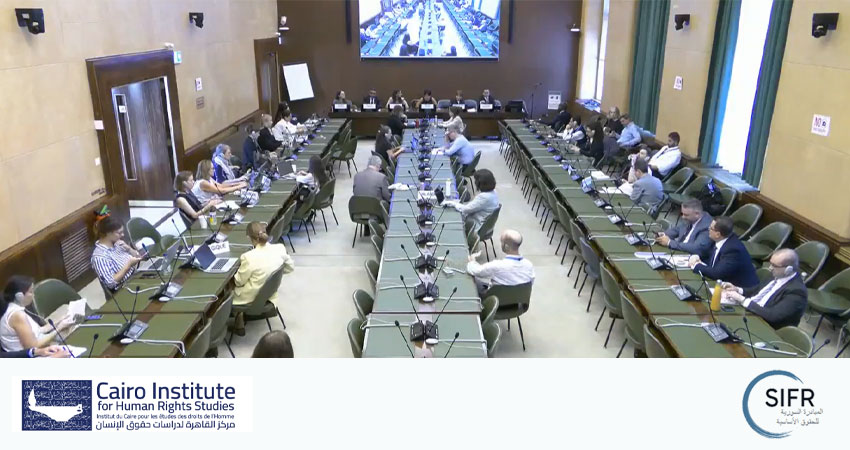
The Syrian Initiative for Fundamental Rights, in partnership with the Cairo Institute For Human Rights Studies, organized a joint side event on the margins of the 63rd session of the Human Rights Council in Geneva. The event, held in person at the Human Rights Council premises in Geneva on 7 September 2026, examined the state of the transitional justice process in Syria nearly two years after the fall of the former regime, amid growing debate over whether the process is participatory and whether it can deliver genuine societal accountability, rather than allowing it to remain an administrative exercise conducted behind closed doors.
The session was moderated by Maysa Asheq of the Cairo Institute for Human Rights Studies. Participants included Salome Fridli of the Huquqyat Organization, Salma Daoudi of the Syria Justice and Accountability Centre (SJAC), Jalal Al-Hamad of Justice for Life Organization (JFL), and Bassam Al-Ahmad of Syrians for Truth and Justice (STJ), along with Commissioner Mounia Ammar of the Independent International Commission of Inquiry on the Syrian Arab Republic (COI Syria).
Maysa Asheq opened the session by emphasizing that Syria stands at a crossroads. On the one hand, there is a historic opportunity to build a justice process rooted in victims’ experiences and in the accumulated expertise of Syrian civil society, developed over years of documentation and advocacy. On the other hand, there are genuine risks that the process could be taken away from its rightful stakeholders.
The session addressed inclusiveness and participation in drafting the Transitional Justice Law. Salome Fridli stated:
“When consultation is successful, one of two things happens: either the text moves closer to our recommendations, or someone explains to us why it does not. But for the text to move in the opposite direction and reflect none of our recommendations, that is what should not happen.”
She noted that the process lacks transparency about the comments submitted by civil society and the mechanism for selecting those consulted, and added that structural questions about the law were raised far too late:
“We were asked to comment on the provisions and wording, rather than on the structure underpinning the law. These questions should be raised before drafting, not after the law has been issued.”
She also noted that the crime of enforced disappearance was entirely absent from the draft law at the outset and was added only later at the families’ request. She linked the lack of protection for women survivors to the obstruction of women’s meaningful participation:
“When protection is unclear, participation is obstructed before it even begins.”
For her part, Salma Daoudi addressed the continuity of the repressive legal and institutional legacy inherited from the previous era, explaining that crimes committed by the former regime are being prosecuted under a Penal Code that contains no explicit provisions criminalizing crimes against humanity, war crimes, enforced disappearance, or command responsibility. She said:
“Today, we are prosecuting the crimes of the former regime using legal tools that, in essence, are its own.”
She explained that repressive legislation remains in force and is still used to restrict freedom of expression and assembly, citing the arrest of activists under the Cybercrime Law and the notification regulating demonstrations, as well as documented cases of deaths in detention facilities showing signs of torture. From this platform, she called for:
“Repealing or amending the legislation used to restrict freedom of expression and assembly, and finalizing the Transitional Justice Law to explicitly criminalize international crimes.”
In his intervention on the transitional justice process and the draft law, Jalal Al-Hamad warned of discrimination among victims and between the parties responsible for violations. He said:
“The result is that there will be victims who deserve justice and victims who will not.”
He noted that the relationship among the National Commission for Transitional Justice, the National Commission for Missing Persons, the Ministry of Justice, the Public Prosecution, and the courts remains entirely unclear, and that the draft law does not address any violations committed after 8 December. He stressed that:
“Without justice for the wronged, we cannot speak of unity.”
He also described his monitoring of the ongoing trials as revealing major shortcomings, ranging from the absence of a clear legal characterization of the crimes to weak guarantees of the right to defense. He warned against the application of the death penalty in the context of a fragile judicial system:
“We are dealing with a fragile judicial system, in which the possibility of error is very high… It is important to suspend the enforcement of the penalty during this period.”
He concluded:
“The disagreement over the transitional justice process is not a technical disagreement but a disagreement over the social contract itself, because if we do not correct it now, it will never be possible to do so in the future.”
Bassam Al-Ahmad spoke about Decree No. 13 on Kurdish rights in Syria, drawing on his personal experience as someone who was deprived of citizenship for 29 years and as a former political detainee. He considered the decree a starting point, not an endpoint, for Kurdish rights:
“The decree can be considered a starting point for Kurdish rights, but it is not the final achievement in the new Syria.”
He highlighted gaps in its implementation, including the lack of clear mechanisms governing the work of naturalization committees and the exclusion of Kurds living outside Syria from this right. He called for: “Ensuring that all those deprived of citizenship under the 1962 census obtain citizenship without any discrimination, including Syrian Kurds abroad, and establishing a dedicated program for material and moral compensation and redress.”
He called for ensuring the rights of all other Syrian communities, including Syriac Assyrians and Turkmen, based on equal citizenship within the framework of the country’s unity.
For her part, Commissioner Mounia Ammar discussed the Commission’s work and its advisory role alongside the Syrian government in reviewing draft transitional justice laws, emphasizing that equal treatment for all victims remains fundamental:
“Establishing the truth is not an end in itself. It must serve a broader purpose: reforming institutions, determining responsibility, restoring dignity, and, above all, preventing recurrence; otherwise, it will not achieve the justice sought.”
She stressed the need to involve civil society in all processes, not only in transitional justice, and added:
“In numerous meetings, we have emphasized the need to involve civil society in all processes, not only in the transitional justice process.”
She noted the continued occurrence of grave violations against civilians in areas witnessing foreign intervention, particularly in southern Syria, ranging from restrictions on access to property to arrests and detentions outside Syrian territory without families’ knowledge. She stressed the need for civil society to play an active role not only in exposing violations but also in contributing to solutions for the future.
The session included an open discussion with attendees, which concluded that the success of the transitional justice process in Syria requires genuine participation and transparency in decision-making, effective protection for survivors and witnesses, completion of the legislative framework, and ensuring equality before the law for all, without excluding any component of Syrian society.