
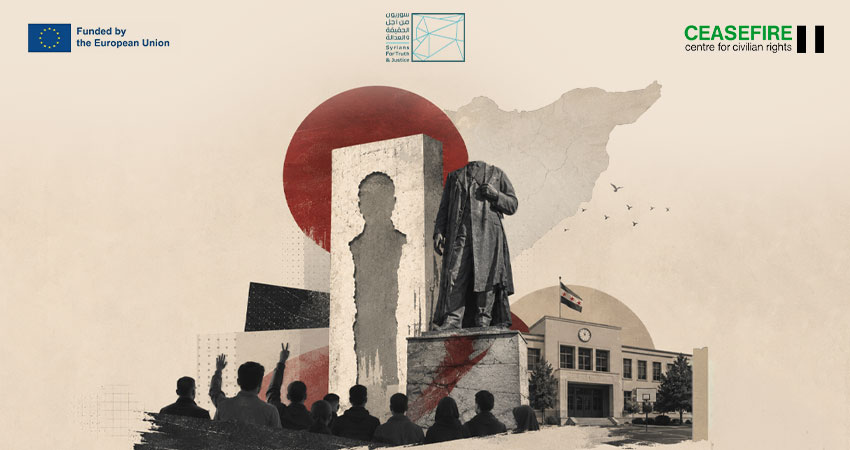
This publication was funded by the European Union, and in partnership with the Ceasefire Centre for Civilian Rights. The contents of this publication are the sole responsibility of Syrians for Truth and Justice – STJ/ the publisher and do not necessarily reflect the views of the European Union or the Ceasefire Centre for Civilian Rights.
Since assuming power, the Syrian transitional government has adopted a series of measures that affect Syria’s public, symbolic, and cultural sphere. These measures have included abolishing certain national holidays and introducing new ones, renaming hundreds of schools, and revising school curricula. While these decisions differ in their nature and the mechanisms used to adopt them, they converge in their impact on collective memory, the construction of national identity, and the redefinition of public symbols.
This report proceeds from the premise that decisions about national holidays, the names of educational institutions, and school curricula are not merely administrative or educational measures. Rather, they constitute an integral component of memory policies, which play a pivotal role in transitional periods as instruments of symbolic reparation, guarantees of non-recurrence, and mechanisms for building a new social contract grounded in the recognition of diversity and the strengthening of a shared sense of belonging.
Syrians for Truth and Justice (STJ) holds that the principal concern is not necessarily the substance of the decisions themselves, but the manner in which they were adopted. These measures were enacted without meaningful public participation or publicly articulated, transparent criteria, despite directly affecting symbols that carry historical and cultural significance for Syria’s diverse local communities. The report argues that any reconfiguration of such symbols in a transitional context should be grounded in the principles of participation, representation, and recognition of pluralism, thereby fostering public trust and preventing the reproduction of the exclusionary practices that characterized the past.
On this basis, STJ recommends establishing institutionalized mechanisms for public consultation before adopting any decision that affects collective memory or shared public symbols. It further calls for a review of cases in which the practical implementation of official decisions has exceeded or diverged from their stated objectives.
Methodologically, this report is based on a review and analysis of presidential decrees and official administrative documents published online, as well as five interviews with residents of governorates, cities, and neighborhoods where schools had been renamed, to capture the perspectives of affected local communities. Researchers obtained informed consent from all participants after explaining the voluntary nature of their participation and the purposes for which the information would be used, including publication in this report. At participants’ request, pseudonyms have been used throughout, and any identifying details have been withheld to mitigate potential security risks.
The report examines these decisions through the lens of transitional justice principles, using them as a normative analytical framework rather than as a legal basis for establishing a specific violation of law.
1. Introduction and Background
Over decades of rule by Hafez and Bashar al-Assad, national symbols in Syria were systematically politicized and stripped of their collective meaning. Rather than serving as symbols of the nation and its diverse communities, they became the exclusive political property of the ruling authorities. These symbols were deployed as instruments of ideological engineering to impose a singular official narrative while marginalizing and criminalizing alternative accounts. Schools, streets, and public squares were named after members of the Assad family or figures closely associated with the regime, while national commemorations and historical events were reframed through a discourse that glorified the ruling establishment.
The fall of the regime created a historic opportunity to reclaim these symbols as part of a broader effort to build an inclusive Syrian national identity that recognizes the country’s diversity, strengthens social trust, and contributes to the development of a new social contract grounded in the principles of citizenship and equality. However, the policies pursued by the Syrian transitional government point to a different trajectory. Rather than fostering an inclusive and participatory reimagining of national symbols, these policies have involved dismantling existing symbols and replacing them with new ones in a manner that – regardless of the motivations or justifications advanced – has, in many instances, marginalized Syria’s social and cultural pluralism and reproduced the same unilateral approaches that characterized the Assad regime.
2. Decisions Affecting Collective Memory Adopted Without Public Participation
Since Hay’at Tahrir al-Sham (HTS), led by Ahmed al-Sharaa, rose to power and established its caretaker government in December 2024, followed by the formation of the transitional government in March 2025, STJ has documented a series of decisions affecting three distinct dimensions of the public sphere through which collective memory and national identity are expressed:
- The national calendar: through the abolition of commemorations of the October 1973 War and of Martyrs’ Day, observed annually on 6 May.
- The educational institutional sphere: through the renaming of hundreds of schools.
- Educational content: through revisions to school curricula.
Despite differences in their legal nature and the procedures used to adopt them, these decisions share several defining characteristics. Each affects symbols with deep historical and collective significance that are rooted in particular local communities before they are associated with the state. Moreover, all were adopted without publicly articulated, transparent criteria for selection and, most importantly, without involving the affected communities or providing them with a meaningful opportunity to participate in shaping the proposed changes.
While reassessing the symbolic legacy of states emerging from conflict is a common feature of transitional justice processes, the legitimacy of these efforts depends on their inclusiveness, transparency, and capacity to accommodate multiple historical narratives and social identities. These safeguards are essential to ensure that a dominant official narrative is not merely replaced by another.
The following sections examine how these three sets of measures, taken together and viewed in light of their shared direction, produce a coherent pattern of impact. Presidential Decree No. 188 of 2025 removed Martyrs’ Day from the national calendar, while revisions to the school curriculum eliminated references to the executions of 6 May 1916, carried out by the Ottoman authorities against prominent figures in the Syrian and Lebanese national movements. That historical event formed the basis for the annual commemoration of Martyrs’ Day as a national occasion honoring their sacrifice and legacy. At the same time, the institutional landscape of public education has been reshaped through the renaming of schools in ways that do not reflect the diversity of the local communities they serve. Collectively, these measures shape collective memory from three interconnected angles: by determining what is commemorated, where it is commemorated, and how its history is told.
The significance of public symbols, educational curricula, and national commemorations extends beyond expressing a society’s identity or preserving its collective memory. They also serve as key vehicles through which the state transmits the values and historical narratives it seeks to pass down to future generations.
In transitional justice contexts, remembrance and the preservation of collective memory are recognized as essential guarantees of non-recurrence. They help build a shared understanding of the past while fostering democracy, a culture of human rights, citizenship, and respect for pluralism. From this perspective, decisions about public memory have implications that extend well beyond the interpretation of past events; they shape society’s vision of its future and the values on which it is founded. This underscores the importance of ensuring that such decisions are inclusive of all societal groups and do not marginalize particular historical narratives or lived experiences.
In this regard, the United Nations Special Rapporteur on the promotion of truth, justice, reparation and guarantees of non-recurrence has emphasized that remembrance processes play a vital role in preserving knowledge of gross human rights violations and transmitting it to future generations, thereby strengthening efforts to prevent their recurrence.
2.1 The National Calendar: Abolition of Martyrs’ Day and the Commemoration of the October 1973 War
In October 2025, Ahmed al-Sharaa, President of the Syrian Transitional Administration, issued Presidential Decree No. 188 of 2025, repealing Decree No. 474 of 2004, which had governed official public holidays in Syria. The new decree abolished the public holiday commemorating the 8 March Revolution; the anniversary of the Ba’ath Party’s seizure of power in 1963, along with Martyrs’ Day, observed annually on 6 May, and the commemoration of the October 1973 War, observed on 6 October.
At the same time, the decree established two new national holidays: Syrian Revolution Day, observed on 18 March to commemorate the outbreak of the 2011 protests against the Assad regime, and Liberation Day, observed on 8 December to mark the anniversary of the Assad regime’s fall.
Martyrs’ Day traces its origins to 6 May 1916, when the Ottoman governor Jamal Pasha, widely known as Jamal Pasha al-Saffah, ordered the execution of a number of Syrian and Lebanese intellectuals, political figures, and nationalists in Marjeh Square in Damascus and in Burj Square in Beirut. Those executed included Muslims and Christians alike, united by their advocacy for their countries’ independence and opposition to the Ottoman policy of forced Turkification. They were sentenced by summary military tribunals that fell far short of even the most basic guarantees of a fair trial.[1]
The events of 6 May 1916 hold a significant place in Syria’s shared national consciousness. They constitute a unifying site of collective memory that transcends sectarian, religious, and ethnic affiliations.
The decision to abolish Martyrs’ Day raises serious questions the transitional government has yet to address. The decree offers no publicly stated justification for removing this national holiday. Nor was it preceded by consultations with civil society organizations, cultural and religious institutions, local community representatives, or the communities for whom these symbols and the associated historical memory hold particular significance.
Some observers have suggested the decision was intended to downplay historical tensions with Türkiye. Regardless of the underlying motivation, the central concern remains the same: changes to symbols of such profound historical and societal significance were introduced without meaningful public participation and without a transparent official explanation.
The decision to abolish the commemoration of the October 1973 War differs in important respects from the abolition of Martyrs’ Day, as it gives rise to two perspectives, each of which carries considerable weight. On the one hand, the Assad regime appropriated the war’s legacy for decades to legitimize its continued rule. The conflict itself became officially known as the October Liberation War, a designation deeply embedded in Ba’athist political discourse, leading many Syrians to view the decision to discontinue its official commemoration as justified. On the other hand, hundreds of thousands of Syrians participated in the war, and for many of them its memory exists independently of the regime’s political appropriation. In that sense, the war constitutes a historical event of genuine collective significance in its own right.
The central issue is therefore not which of these competing perspectives is more persuasive. Rather, Presidential Decree No. 188 abolished the commemoration of the October 1973 War using the same procedural approach as the abolition of Martyrs’ Day: without providing any official justification, without publicly articulated criteria, and without consultation or meaningful public participation. When decisions affecting the national calendar are adopted in this manner, it becomes impossible to distinguish between measures grounded in principled transitional justice considerations and those driven by undisclosed considerations.
2.2 Renaming Schools: The Official Procedure and Documented Gaps
On 25 September 2025, the Ministry of Education announced a standardized mechanism for renaming selected schools across all governorates, stating that the measure was intended to align with the state’s approach to “overcoming the legacy of the previous period and removing names associated with symbols of the former regime.” According to the announcement, four criteria would govern the selection of new names: the name of the local area; the religious, cultural, and historical heritage of Syrian society; national figures and influential scientific and cultural personalities in Syrian history; and names that inspire students and strengthen their sense of national and human belonging.
However, the announced procedure confined decision-making to the Directorate of Education and the Governor, without providing for any form of public consultation or meaningful participation by the affected local communities.
The renaming initiative spanned most Syrian governorates. In Daraa, the Director of Education, Mohammad al-Kafri, announced that 172 schools had been renamed after the Ministry of Education approved the new list of names. In Aleppo, the Directorate of Education issued an administrative order on 21 September 2025 to rename 128 schools. In Hama governorate, in cooperation with the Directorates of Education and Religious Endowments (al-Awqaf), a plan was launched to rename approximately 500 schools.
A comparison of the officially announced criteria with their implementation reveals two significant gaps. The first concerns the absence of public participation. The official mechanism contains no provision for consulting the students’ parents, educators, or local cultural bodies. This gap is further widened by the Directorate of Religious Endowments involvement in developing Hama’s school-renaming plan. The second gap concerns the initiative’s expansion beyond its stated scope. Although the government declared the objective limited to “removing the names associated with symbols of the former regime,” implementation demonstrated otherwise. The renaming process also affected schools named after historical, cultural, and national figures with no meaningful connection to the Assad regime, including Djamila Bouhired, the Algerian anti-colonial activist; Aisha al-Dabbagh, the Syrian writer and former member of parliament; Khaled al-Asaad, the renowned Syrian archaeologist; and Abdul Salam al-Ujayli, the distinguished Syrian physician and novelist.
Testimonies collected by STJ indicate that objections were less about the new names themselves than about the exclusion of local communities from decisions affecting symbols that are part of their shared memory and identity. In this regard, a lawyer from Homs stated,
“The name of Hamdan Mahfouz Secondary School in the Ekrama neighborhood of Homs was changed without warning, and the decision had a profound impact on many of us. Hamdan Mahfouz, from Homs Governorate, was killed during the October War in the 1970s. For us, the school’s name was never just a sign above the entrance, it was part of our collective memory and identity and a symbol of an entire period of our lives. That is why it was difficult to accept the decision to change it, especially since Hamdan Mahfouz was not a figure associated with the former regime but rather someone who gave his life defending Syrian territory.”
In the As Suqaylabiyah city in the Hama countryside, where the population is predominantly Christian, schools named after local figures, Salim Haddad and Suhail al-Maqdisi, two figures whose names have long been linked to the city’s history and educational institutions, were renamed Noor al-Bayan (Light of Eloquence) and Bawabat al-‘Ilm (Gateway to Knowledge). Although these replacement names may appear linguistically neutral, that neutrality does not make the decision neutral. Removing names that reflect the local community’s identity and historical memory and replacing them with names that lack the same local significance effectively erases that community’s cultural presence from the city’s institutional landscape. This illustrates the broader concern arising from the absence of consultation and meaningful participation by the affected community before such decisions were made.
Most of the individuals interviewed by STJ felt alienated by the new school names. Notably, their concerns were closely tied to the abrupt manner in which the changes were introduced. One interviewee, born in 1980 and the father of six, described the experience as follows,
“When we returned to pick up our children from school, the first thing we felt was a sense of rupture with our memories. The name that had been part of our collective memory had suddenly disappeared, replaced by a new one that meant nothing to us.”
2.3 Curriculum Modification: A Top-Down Narrative of History
In its report, “Syria: Curriculum Reform… An Ideological Unilateral Decision Lacking Legitimacy,” STJ documented a series of revisions to the Syrian school curriculum during the transitional period. These changes went beyond the presentation of historical events to encompass the underlying concepts themselves. Most notably, the revised Islamic education curriculum redefined martyrdom from “sacrifice for the homeland” to “sacrifice for God.”
The significance of this amendment extends beyond the abolition of Martyrs’ Day, which commemorated the executions of May 1916. Rather, it represents a broader redefinition of the very concept of martyrdom, a concept that had historically enabled the commemoration to serve as an inclusive national symbol, transcending religious affiliation. By shifting the concept from a civic and national framework to an explicitly religious one, the amendment reshapes the symbolic foundation of that shared memory.
Among the most significant and symbolically charged revisions in this context are those made to the history textbook for the third year of secondary education (literary stream), in which the sentence “the execution of leaders of the national movement on 6 May 1916” was removed. In parallel, expressions such as “Ottoman oppression” and “under a tyrannical Ottoman rule” were deleted from the third-year secondary textbooks in both the literary and scientific streams. The term “Ottoman occupation” was also replaced with “Ottoman rule.”
Taken together, these amendments reveal decisions made in a top-down, hierarchical manner, guided by a consistent logic: redefining the Ottoman period and erasing references to the May executions from educational content. This trajectory aligns with Presidential Decree No. 188, which also removed the commemoration of these same figures from the national calendar.
3. In Light of Transitional Justice Standards
International literature classifies the renaming of public spaces, the establishment of memorials, the designation of commemorative dates, and the design of educational curricula as symbolic reparations, alongside guarantees of non-recurrence. These measures constitute a core pillar of transitional justice because they acknowledge victims and help build an inclusive national narrative.
Broad-based public participation in designing public memory policies is considered a fundamental requirement for restoring trust between the state and society and for strengthening a shared sense of belonging.
The Basic Principles and Guidelines on the Right to a Remedy and Reparation, adopted by the United Nations General Assembly in 2005, further stipulate that symbolic measures are part of the “satisfaction” owed to victims and should be implemented in a manner that serves both victims and society as a whole.
Memory and commemoration policies constitute a symbolic dimension of transitional justice. Their function is not limited to preserving past events or honoring victims; they also help determine which events, individuals, and values are granted prominence in public memory. National holidays, school names, educational curricula, and monuments and museums reflect the state’s and society’s understanding of what deserves remembrance and who is recognized within a shared national narrative.
Accordingly, decisions about these symbols go beyond administrative or educational matters, becoming part of a broader process of redefining collective identity and shaping the relationship between past and future in societies emerging from conflict or authoritarian rule.
It is important to note that these principles are guiding rather than legally binding treaty-based. This report therefore invokes them as a normative framework of reference, rather than as a basis for establishing legal violations.
In this framework, the restorative value of symbolic measures is closely tied to how they are produced. A symbol imposed from above, without the participation of the affected communities, loses its capacity to rebuild trust and may instead become a source of renewed division. This implies that decisions affecting the collective memory of specific communities should be subject to meaningful consultation, ensuring that they do not, in practice, exclude those very communities.
4. Recommendations
Based on the above findings, STJ recommends the following,
To the Syrian Transitional Government:
- Establish a permanent mechanism requiring that any decision affecting the public symbolic and cultural sphere be reviewed by a transitional justice body composed of representatives of Syria’s diverse societal components and mandated to issue a reasoned opinion before the decision is adopted. Issuing decrees followed by ex post facto justification should not be considered sufficient.
- Introduce a mandatory public consultation step in the school renaming process, involving parents, teaching staff, and local cultural bodies, before approving any new name, with particular attention to communities with diverse cultural compositions.
- Review cases in which implementation has exceeded the stated objective of “removing symbols of the former regime,” and communicate the findings to the affected communities. A formal, publicly accessible channel should be established to allow these communities to submit substantiated requests for review.
- Refrain from adopting any naming decisions that affect the collective symbolic dimension of a local community without prior, meaningful consultation, and ensure that naming practices reflect the cultural and historical diversity of society.
To civil society organizations and independent media:
- Continue monitoring and documenting ongoing changes in the public symbolic and cultural sphere and systematically archive them. Independent reports and studies should be used to identify and expose practices that may lead to the marginalization of certain local narratives or identities, thereby preserving local memory, strengthening public accountability, and contributing to the formation of an informed public opinion.
[1] Eugene Rogan, The Fall of the Ottomans: The Great War in the Middle East, 1914–1920, Basic Books, 2015.