
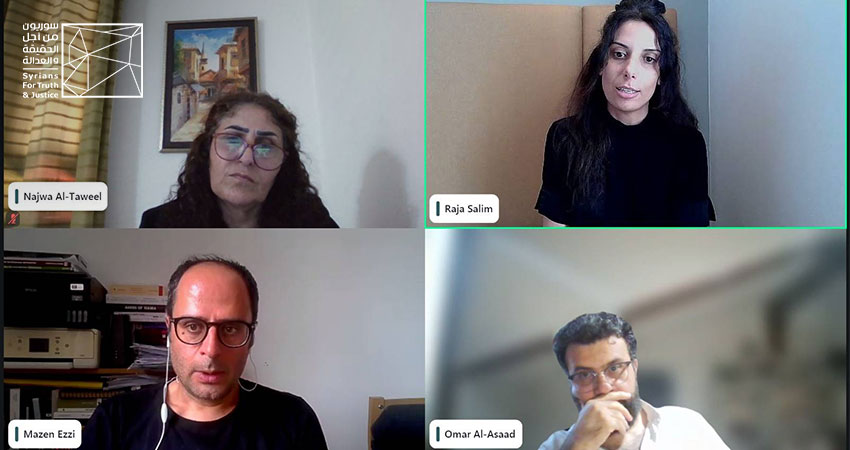
On 15 July 2026, Syrians for Truth and Justice (STJ) convened a panel discussion titled “One Year After the As Suwayda Massacres: Justice, Accountability, and Reparations as Priorities,” marking the first anniversary of the tragic events that engulfed As Suwayda Governorate in July 2025. These events are among the deadliest episodes of violence in Syria in recent years.
The session was moderated by journalist Raja Salim and featured contributions from civil society and feminist activist Najwa al-Tawil; journalist and researcher Mazen Azzi; and writer and journalist specializing in contemporary Syrian studies, Omar al-Assad.
The events in As Suwayda were accompanied by grave violations of international humanitarian and human rights law, including killings and extrajudicial executions, abductions and enforced disappearances, arbitrary detention, torture and other forms of ill-treatment, forced displacement, and the destruction and seizure of property, as well as violations targeting civilian men and women based on their identity.
One year after these events, thousands of families continue to endure their devastating consequences amid a lack of accountability, the ongoing suffering of families of the missing and abducted, and increasingly complex property rights and ownership issues.
The discussion focused on three principal themes: reparations from the perspectives of victims, survivors, and their families; property rights and the restitution of property; and the issue of missing and abducted persons. Participants underscored the imperative of placing victims’ rights at the heart of any transitional justice process in Syria.
Journalist and researcher Mazen Azzi presented an overview of the situation of detainees from As Suwayda, noting that several individuals had been arbitrarily detained without legal safeguards. He stated,
“In many instances, the detentions that followed the events in As Suwayda were arbitrary, carried out without judicial warrants or clearly articulated charges, and detainees were deprived of their most fundamental legal guarantees.”
He further noted that several detainees had resorted to hunger strikes to protest their continued detention, emphasizing that,
“Clarifying the fate of all detainees and abducted persons and ensuring full respect for due process and legal safeguards constitute an essential step toward restoring trust and paving the way for any meaningful process of justice.”
For her part, Najwa al-Tawil stressed that any transitional justice process must be grounded in the needs and rights of victims and their families, stating,
“Reparation begins with the return of the missing and abducted and with establishing their fate, as this issue remains an open wound that continues to affect society as a whole.”
She added,
“There can be no genuine justice while civilians are abducted and subsequently used in prisoner exchanges with combatants. Determining the fate of the missing is not a political demand; it is a fundamental and inalienable right of their families.”
In the same vein, Omar al-Assad warned against the recurrence of violence in Syria in the absence of justice and accountability, stating,
“What occurred in As Suwayda bears striking similarities to events we have previously witnessed on the Syrian coast, and I fear that such atrocities may recur unless serious steps are taken to ensure justice and accountability.”
He further noted that the events in As Suwayda targeted a particular community on religious and ethnic grounds and included extrajudicial killings, forced displacement, and the destruction of the Druze community’s material and intangible heritage and livelihoods.
Al-Assad also pointed out that the attacks displaced approximately 140,000 people, and many residents remain unable to return to their villages or inspect their homes, which were subjected to arson and looting. He added,
“The violations did not stop with the displacement of the population; they also included the destruction of the very foundations of life, from dismantling small factories and olive presses to sabotaging water wells and mills.”
Concluding his remarks, al-Assad stated,
“A sustainable peace in Syria cannot be built without genuine justice, and genuine justice cannot be achieved so long as impunity persists.”
As the session concluded, participants emphasized that addressing the legacy of the As Suwayda events requires a comprehensive approach that places victims at the center of any transitional justice process. Such an approach must include uncovering the fate of the missing, ensuring the safe and voluntary return of displaced persons, safeguarding property rights, and holding those responsible for violations accountable, thereby guaranteeing that such atrocities are never repeated.