
1. Introduction and Background
In this report, Syrians for Truth and Justice (STJ) documents patterns of human rights violations committed in the city of Tartous, including the neighborhoods of al-Raml, al-Faqassa, al-Ghamqa, and al-Mashrou’ al-Sadis (Sixth Project), as well as in several villages in the Safita countryside, namely al-Muntar, Yahmour, Umm Housh, Kharbat al-Ma’za, and Bayt Imran Zeina, between December 2025 and April 2026.
The documented violations were committed by armed individuals who are strongly believed to be affiliated with security agencies operating under the Syrian Transitional Authority. These violations include arbitrary arrests in public spaces, including along the seafront Corniche (promenade), on main roads, and in front of commercial establishments, based on sectarian identity; sexual harassment; theft and extortion accompanied by sectarian rhetoric; and abuse of authority at security checkpoints.
For this report, STJ conducted 11 interviews with witnesses and victims who directly experienced the documented incidents. STJ researchers obtained informed consent from all participants after explaining the voluntary nature of their participation and the intended use of the information they provided, including in this report. At the interviewees’ request, pseudonyms have been used, and any identifying details have been withheld due to potential security risks.
The testimonies reveal a recurring pattern across several documented cases, in which the armed perpetrators justified their actions by asserting that “the property, blood, and honor of Alawites are lawful”, presenting this as a legitimate religious justification for their conduct. The accounts also consistently describe the same vehicles used by the perpetrators across multiple independent incidents in geographically separate locations.
At the same time, the majority of interviewees reported that the police and judicial authorities failed to take meaningful action to provide redress or accountability, fostering a climate of impunity. This, in turn, has contributed to the expansion of such violations and has driven a significant segment of the population toward silent forced displacement.
The documented practices during the reporting period coincided with the widespread proliferation of hate speech and sectarian incitement across Syria. They also unfolded against the backdrop of continued extrajudicial killings targeting Syrians from the Alawite community following the March 2025 massacres on the Syrian coast, as well as an escalation in the targeted abduction of Alawite women and girls. These developments have occurred in a context where victims have been effectively deprived of access to effective legal remedies.
This report is part of the ongoing documentation efforts by STJ to record violations committed during Syria’s transitional period throughout the country. STJ’s documentation is guided by a human rights-based approach that centers victims’ rights and is carried out irrespective of the identity of the alleged perpetrators.
2. Documented Patterns of Sectarian Targeting
2.1 Arbitrary Stops and Interrogation Based on Sectarian Affiliation
In this report, STJ documented a series of incidents in which Syrian citizens from the Alawite community were arbitrarily detained in public spaces while engaged in daily activities. In most of the documented cases, the first question posed by armed individuals was: “Are you Alawite or Sunni?” The victims’ responses to this question determined how they were treated.
In an interview with STJ, Nawras (a nutrition specialist born in 2004) described being stopped in early April 2026 while walking with his female friend along the Tartous Corniche. According to his testimony, four young men who identified themselves as members of the Internal Security Forces intercepted them. They were traveling in a Hyundai Santa Fe with an “Idlib Test” license plate, and its registration number was deliberately obscured.
The armed men questioned Nawras about his sectarian affiliation, recorded the personal details of both individuals, and compelled him to contact his companion’s family as part of what they described as an inquiry into their relationship. The witness further stated that several of his friends had experienced similar incidents in other neighborhoods of the city.
Another victim, Rawad (born in 2006, a pharmacy student), told STJ that he and three fellow students were assaulted while sitting on the Tartous Corniche on the night of 24 April 2026. According to his testimony, they were stopped by two armed men who claimed affiliation with the General Security and were traveling in a black SUV with an “Idlib Test” license plate numbered 08917 (see Figure 1). The two armed men physically assaulted the students, threatened to kill them, and hurled sectarian insults and abusive language.
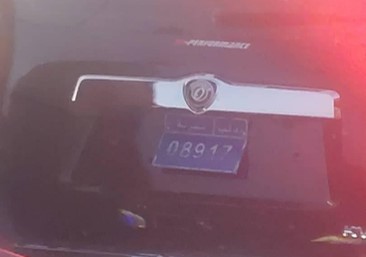
Figure 1. License plate of the vehicle from which the assailants who attacked the witness Rawad exited. Credit: STJ.
In two additional testimonies documented by STJ, both Samir (born in 1999, a civil engineer) and Firas (born in 1988, a taxi driver) reported seeing a similar Hyundai Santa Fe with an “Idlib Test” license plate during two separate incidents of interception, assault, and sectarian abuse in the al-Faqassa neighborhood on the evening of 9 April 2026, occurring within a short interval of one another. The consistency in the vehicle’s description, coupled with the close temporal proximity of the two incidents, indicates coordinated activity within a defined geographical area rather than isolated or spontaneous acts by individual perpetrators.
2.2 Sexual Harassment and Gender-Based Abuse
Sexual and gender-based violations were a distinct feature of several documented incidents. This pattern is particularly evident in the testimonies of Firas and Rama.
Firas (born in 1988, a taxi driver) described how armed men stopped him on the evening of 9 April 2026 while he was driving a friend’s underage daughter home. According to his testimony, the armed men ordered him out of the vehicle, questioned him about his relationship with the girl, and instructed him to call her father and demand that he come to the scene.
While they waited, one of the armed men opened the rear door, sat beside the girl inside the vehicle, and began sexually harassing her by touching her. When she screamed, he slapped her across the face. As Firas attempted to intervene, he was severely beaten by the four armed men. Both victims subsequently required hospital treatment for their injuries.
Firas recounted,
“The four armed men surrounded me, and one of them said: ‘Your property, your blood, and your honor are lawful for us, you Alawite pigs.’ They then all began beating me. While this was happening, my friend, the girl’s father, arrived. One of the armed men, who was wearing the uniform of the General Security, turned to him, slapped him across the face, and said: ‘Welcome, welcome to the pimp who lets his daughter go out with a man who is not her mahram’.”
Rama (born in 1992, a pharmacist) described how two armed men stopped her vehicle around midday on 6 April 2026 while she was accompanied by her four-year-old son. According to her account, the interrogation included sexually degrading and humiliating questions directed at her, as well as an explicit threat to present her as a “concubine” to their amir (commander). One of the armed men also terrorized her child by threatening to slaughter him. As a result of the psychological trauma he experienced during the incident, the child was referred for specialized psychological care.
Rama recalled,
“One of the armed men forcibly took my phone and began searching through it, my personal photographs and private conversations, while saying, ‘Damn you, you pigs.’ He then showed my photographs to his companion and asked, ‘What do you think? Shall we summon her husband, kill him, and present this slave girl as a gift to the Amir?’.”
2.3 Pillage and Extortion Under the Guise of Sectarian Rhetoric
STJ documented at least four incidents of outright theft or destruction of private property, accompanied by explicit sectarian justifications from the perpetrators.
Samir (born in 1999, a civil engineer) reported that an armed man forcibly seized items he had just purchased from a shop near his home, smashed them on the spot, shouted “Alawite heretic,” and then repeatedly slapped him.
In another case, Amer (38, a mechanic) was allegedly subjected to an attempted immolation after he demanded payment from two armed men who had taken fuel from his workshop without paying. According to his brother Ammar’s testimony, the perpetrators explicitly justified their actions by declaring that “the property of Alawites is lawful [for us].”
Anwar (born in 1989, an automotive paint technician) also told STJ that after completing repair work for two armed men at his workshop, they refused to pay him, saying, “Leaving you alive is your payment.” When he insisted on receiving the wages owed to him, the two men opened fire on his merchandise.
Anwar recounted,
“I told them, ‘You forgot to pay me for my work.’ The driver laughed mockingly and replied, ‘No, we did not forget, we already paid you.’ I asked him, ‘Where is my payment?’ He said, ‘We left you alive.’ When I tried to object, the man beside the driver stepped out and fired at the cans of paint on the shelves. I did not say another word. I stayed silent until the two armed men left the workshop.”
3. Absence of Accountability and Impunity
At least seven of the eleven testimonies in this report describe victims’ attempts to seek official accountability. Collectively, these accounts reveal a multi-layered system of impunity.
At the security level, police officers in multiple cases refused to register formal complaints or recorded them as against “unknown perpetrators,” despite victims providing detailed descriptions of the assailants and, in some instances, vehicle registration numbers. In Rawad’s case, discussed above, the responding police officer’s conduct suggested prior knowledge of the perpetrators, an impression later corroborated by one of Rawad’s friends. In another documented incident, the official complaint report was torn up in front of the victim and was only rewritten after an informal intermediary from Idlib intervened.
Firas recalled,
“The police officers at the hospital refused to believe that we had been assaulted by individuals affiliated with the security forces. They accused us of lying and claimed that we had simply been involved in a street fight over the girl, my friend’s daughter.”
At the judicial level, an experienced lawyer offered particularly significant testimony based on his daily practice at the Tartous Palace of Justice. He stated that the judiciary had become systematically biased and that filing a complaint against members of the security forces would expose complainants to risks that outweigh any realistic prospect of obtaining justice. He therefore explicitly advised his client not to pursue legal proceedings.
Notably, eight of the witnesses and victims interviewed stated that the violations they had experienced, along with the repeated targeting of others in their community, had led them to make the firm decision to leave Syria. One interviewee is awaiting a work contract in Qatar; others reported that their children are studying German in preparation for relocation to Europe; and another has decided to sell his possessions and permanently close his business before emigrating.
4. The De Facto Authorities and Their Responsibility to Ensure Protection
The violations documented in this report occurred in areas under the effective control of the Syrian Transitional Government, headed by Ahmed al-Sharaa, which exercises governmental authority over Tartous Governorate through an integrated network of civilian, security, and military institutions.
At the national level, Minister of Interior Anas Khattab exercises direct oversight of the internal security agencies deployed throughout the governorate, while Minister of Defense Murhaf Abu Qasra holds overall command of the military units operating in the area.
At the local level, Governor Ahmad al-Shami and his deputy, Sami al-Zakh, are responsible for administering Tartous Governorate. Colonel Abd al-Al Mohammad Abd al-Al commands the Internal Security Directorate in Tartous, while Brigadier General Munir al-Sheikh commands the 56th Division, assisted by Asaad Hammoud al-Turkawi (Abu Shihab), who is from Hama. More specifically, along the Tartous–Safita axis, where several of the violations documented in this report occurred, Ahmad al-Sheikh Youssef, Director of Internal Security in Safita, bears direct operational responsibility for the security checkpoints along that route.
5. Legal Characterization of the Documented Violations
5.1 Under International Human Rights Law
- The Right to Equality and Non-Discrimination (Articles 2 and 26 of the International Covenant on Civil and Political Rights (ICCPR): Stopping and questioning civilians in public spaces solely on the basis of their sectarian identity clearly violates Articles 2 and 26 of the ICCPR, which require States to ensure equality before the law and protection against discrimination. This violation is evidenced by the documented practice of armed individuals directly asking passersby, “Are you Alawite or Sunni?” and determining how they would be treated based on the answer, as illustrated in the case involving Nawras and his companion.
- The Rights to Life, Liberty, and Security of Person (Articles 6 and 9): Arbitrary detention of civilians and their sudden interception in public places, such as the incident involving Rawad and his fellow students on the Tartous Corniche, constitute serious violations of the rights to liberty and security of the person. Likewise, explicit threats to kill or slaughter victims, including threats directed at Rama’s four-year-old son and a threat to kill her husband, amount to grave infringements of the right to life protected under the Covenant.
- The Prohibition of Torture, Cruel, Inhuman or Degrading Treatment, and Sexual Violence (Article 7): The prohibition against torture and cruel, inhuman, or degrading treatment or punishment applies directly to the documented severe group beatings inflicted on Firas and Rawad. The same legal characterization extends to gender-based violations, including the direct sexual harassment of girls (such as the assault on Firas’s friend’s minor daughter), the psychological intimidation of women, and threats of sexual enslavement, exemplified by referring to Rama as a “concubine” to be presented to the perpetrators’ commander. These acts constitute cruel, inhuman, and degrading treatment that violate human dignity.
- Freedom of Thought, Conscience, and Religion (Article 18): Forcing victims to endure sectarian hate speech that denigrates their religious identity or beliefs constitutes a serious interference with the right to freedom of thought, conscience, and religion. This is particularly evident when perpetrators explicitly sought to justify the abuses with sectarian ideological rhetoric, using statements such as “Your property, your blood, and your honor are lawful [for us],” “Alawite heretic,” and “pigs” during the assaults.
- Under Syrian Domestic Law
- Crimes Against Persons and Property: The documented conduct not only breaches the constitutional guarantees of equality contained in Syria’s Constitutional Declaration but also constitutes a series of criminal offenses punishable under the Syrian Penal Code. The forcible seizure and destruction of Samir’s belongings, as well as the shooting of Anwar’s merchandise after the perpetrators refused to pay for his work, fall within the legal characterization of robbery accompanied by violence and unlawful destruction of property. Likewise, the attempted immolation of Amer constitutes conduct amounting to attempted murder, or, at a minimum, the intentional infliction of serious bodily harm under Syrian criminal law.
- Incitement to Sectarian Hatred and the Entrenchment of Impunity: The repeated refusal of police authorities to register victims’ complaints, or their decision to record them as against “unknown perpetrators” despite the availability of tangible evidence, including detailed vehicle descriptions and license plate information, constitutes a clear breach of the legal duties incumbent upon the judicial police. Such conduct amounts to a denial of justice and facilitates impunity for the perpetrators. Furthermore, the documented practice of tearing up police reports in front of victims, coupled with death threats issued by security officers against those considering filing complaints, effectively prevents the Public Prosecution from initiating criminal proceedings for offenses supported by credible evidence, including incitement to sectarian hatred and unlawful deprivation of personal liberty. This pattern of institutional acquiescence renders the security and judicial authorities effective participants in perpetuating a system of impunity, which, as reflected in the testimonies documented in this report, is driving members of the affected population toward silent forced displacement
6. Recommendations
6.1 To the Syrian Transitional Government
- Issue clear and unequivocal orders at all levels of command prohibiting the stopping, questioning, or subjecting of civilians to any security measure based on their sectarian or religious affiliation or any other cultural identity. All security personnel should be required to comply with the obligations set forth in the March 2025 Constitutional Declaration, particularly Article 3, which guarantees freedom of belief.
- Conduct prompt, independent, and impartial investigations into the incidents documented in this report in which police officers refused to register complaints or recorded them against “unknown perpetrators” despite the existence of material evidence. Investigations should also address the documented incident in which an official police report was publicly torn up, and those responsible should be held accountable. In addition, the authorities should introduce officially numbered, sequentially numbered police report registers, authenticated by the commanding officer of the relevant police or security unit, to prevent the arbitrary destruction or removal of official records.
- Establish an independent and effective complaints mechanism that enables individuals to safely report discriminatory violations without having to submit complaints through the same security agencies alleged to have committed the abuses. In parallel, all police officers and mobile security personnel should be required to display clearly visible identification badges bearing their names while carrying out their duties in public spaces.
- Provide comprehensive and mandatory training for police and security personnel, particularly those whose duties involve direct interaction with civilians, on human rights-compliant law enforcement practices and the appropriate treatment of members of the public. Such training should include the Code of Conduct for Law Enforcement Officials, adopted by the United Nations General Assembly in 1979, and that Code should be formally incorporated into the legal and regulatory framework governing the conduct of Syria’s police and security forces.
6.2 To the United Nations Mechanisms on Syria
- Include the violations documented in this report within the scope of ongoing United Nations investigations into violations committed during Syria’s transitional period, and reaffirm that these violations should not be treated differently from those committed during the previous period with respect to the obligation to ensure accountability.
- Preserve all evidence relating to the violations documented in this report, together with any additional relevant evidence collected by United Nations mechanisms, in a manner that ensures its availability for future accountability and judicial proceedings.
- United Nations Special Rapporteurs whose mandates encompass the violations documented in this report should undertake country visits to Syria that extend beyond Damascus to include other affected areas, to assess the human rights situation firsthand. They should also communicate with the Syrian authorities regarding the documented violations and issue thematic reports addressing these patterns of abuse and the measures required to prevent their recurrence.
6.3 To States and International Actors Supporting Syria’s Transitional Process
- Condition any support to Syria’s transitional security institutions on clear, measurable benchmarks for the protection of civilians and the prevention of sectarian violations. Donors should also establish mechanisms to verify that such assistance does not reach units credibly implicated in human rights abuses.
- Ensure that sectarian and ethnic-based violations in Syria are addressed across all dialogue frameworks and support mechanisms with the Syrian Transitional Government. Preventing such violations and ensuring accountability for those responsible should be considered a fundamental requirement, not a secondary consideration, within the transitional process.
- Support independent Syrian civil society organizations that document these violations and monitor the conditions of vulnerable communities, ensuring the continuation of this essential work despite the restricted, high-risk operating environment in which these organizations operate.