
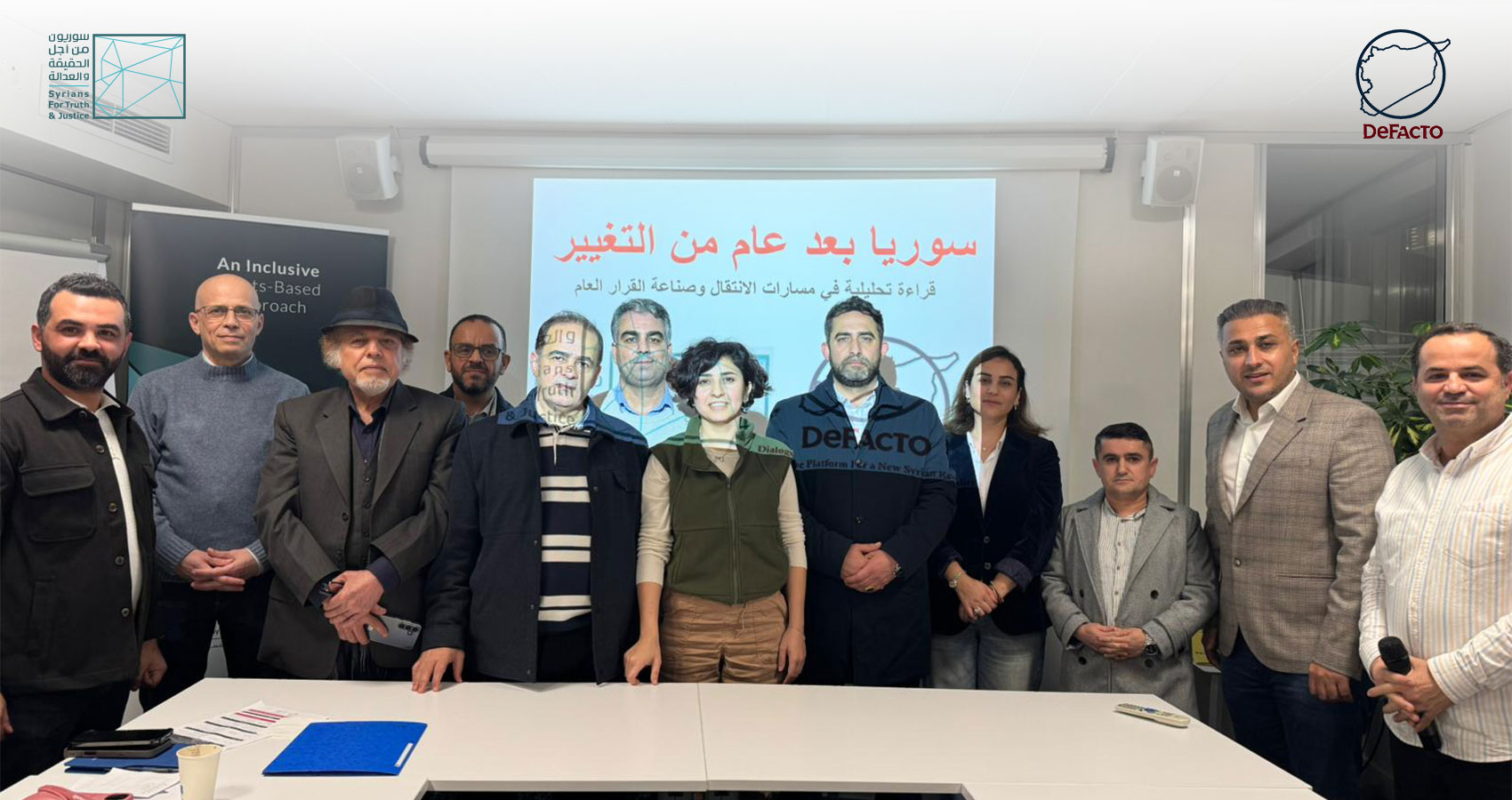
The DeFacto Platform for Dialogue and Development, in partnership with Syrians for Truth and Justice (STJ), hosted a dialogue workshop in Paris on 11 December 2025, to discuss the changes Syria experienced during the year following the political shift on 8 December 2024.
Over the past year, Syria has experienced significant political, administrative, security, and social changes that have directly affected relations between the transitional authorities and local communities, shaped patterns of public governance and service delivery, and influenced social cohesion and community stability.
Amid substantial differences in how these changes are interpreted, there is a growing need for a calm and focused dialogue space to analytically review the events of the first year of change based on facts and practical experience, while avoiding political bias and conflicting narratives.
The workshop gathered local actors, legal experts, researchers, and representatives of civil initiatives and emerging institutions to discuss four key issues that developed over the past year and became central to public discourse in Syria.
The first topic covered political, administrative, and security changes and their effects on local governance, service delivery, and the relationship between central authorities and the regions, including the 10 March agreement between the transitional authorities and the Syrian Democratic Forces (SDF), as well as developments in the coastal areas and As Suwayda.
The second topic examined the Provisional Constitutional Declaration as the governing framework for the transitional period, evaluating how it structures this phase, its ability to address Syria’s current complexities, and the gaps related to representation, the separation of powers, and the protection of rights and freedoms.
The third topic addressed the challenges of governance and the state’s structure considering ethnic, religious, and regional diversity, as well as institutional strategies to decrease centralized authority and promote local participation.
The fourth topic discussed transitional justice in the Syrian context, examining the opportunities and obstacles of achieving it after decades of serious violations, especially considering the establishment of the National Commission for Transitional Justice under Decree No. 20. It also looked at the connection between justice and social peace, and the role of local communities and victims in forming justice processes, accountability, and reparations.
The workshop aimed to go beyond theoretical talks and focus on practical, experience-based analysis by encouraging the exchange of expertise among participants and showcasing local initiatives that have tackled challenges related to governance and justice.
At the end of the workshop, a set of key findings and practical recommendations was prepared for relevant authorities, decision-makers, and local actors to help create a more stable and equitable transitional environment.