
This publication was funded by the European Union. Its contents are the sole responsibility of (Ceasefire centre for civilian rights/STJ) and do not necessarily reflect the views of the European Union.
1. Introduction
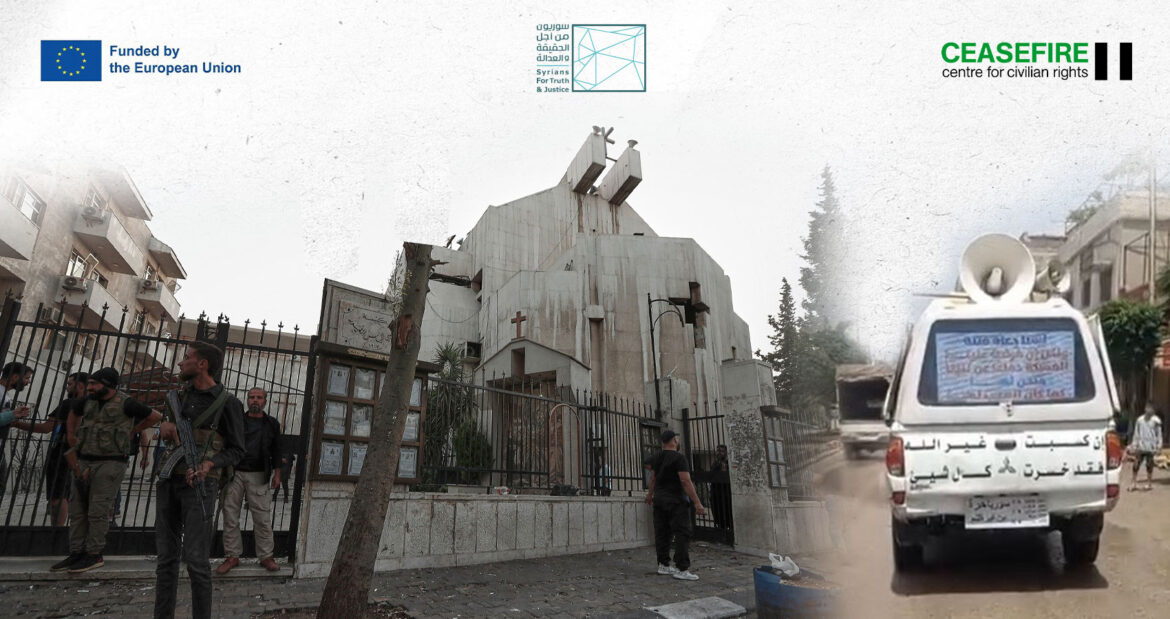
On the evening of Sunday, 22 June 2025, while hundreds of worshippers were gathered inside Mar Elias Church in the Dweilaa neighborhood of Damascus,[1] a terrorist bombing occurred, killing 26 people and injuring more than sixty others —all of them Christian civilians, including women and children.
Contrary to expectations, the Syrian transitional government’s response to the incident appeared limited both symbolically and procedurally. Syrians for Truth and Justice (STJ) monitored the official statements issued by the government and its ministers, noting that the only official visit to the church was made by the Minister of Social Affairs —the sole Christian member of the Minister’s Cabinet— while senior officials refrained from visiting the bombing site, despite the symbolic and serious nature of the event, particularly during this transitional period. The official statements were also limited to general expressions, lacking clear guarantees regarding the transparency of the investigation or the mechanisms for accountability.
In contrast, the official state-run media reflected the event through a narrow political and security narrative that was imprecisely framed, thereby exacerbating public tension and division instead of fostering societal solidarity. The report also documents serious mismanagement of the crime scene, where journalists and civilians were allowed to enter the site in the early hours before evidence was collected or the area secured, undermining trust in the seriousness of the investigation.
The early announcement —released less than an hour after the bombing— that ISIS was responsible for the attack, issued before any mention of a criminal investigation or presentation of material evidence, sparked widespread doubt about the credibility of the official account. These doubts were further fueled by the absence of any ISIS claim of responsibility in its media outlets, and the appearance of a statement by a group called “Saraya Ansar al-Sunna” that claimed responsibility for the bombing —a group the authorities later described as fictitious.
The report places this incident within a broader pattern of violations targeting Christian citizens in Syria in recent months. It also highlights growing concerns that such attacks —if left unpunished— may signal a dangerous trend of systematic targeting of Christians on religious or sectarian grounds, and a deepening culture of impunity. This calls for urgent action by the authorities to ensure these violations are not repeated, to hold those responsible accountable, and to rebuild trust among all components of Syrian society.
For this brief report, STJ conducted 7 in-depth interviews online[2] —6 through secure messaging applications and one in person. All interviewees were informed of the voluntary nature of the interviews and how their information would be used, including in the publication of this report. Three of the interviewees requested anonymity out of fear of retaliation against themselves or their families; thus, pseudonyms were used.
In addition to the interviews, the report draws on other testimonies available from open sources and examines the aftermath of the bombing and the unresolved questions surrounding the perpetrators.[3]
The report recommends that the Syrian transitional government take urgent actions to ensure justice, foremost among them initiating an independent and transparent judicial investigation into the bombing of Mar Elias Church that adheres to international standards and includes forensic experts and human rights organizations. It also calls for respect for detainees’ rights, the guarantee of fair trials, the protection of places of worship, and efforts to combat sectarian hate speech through both legislation and awareness campaigns. The report emphasizes the need to empower civil society and victims to participate in protection strategies and to avoid politicizing investigations in order to enhance public trust and preserve social cohesion in Syria.
You May Read and Download the Full Version of the Report in PDF format by Clicking here.
[1] The Dweilaa neighborhood is located in the southeastern part of the capital, Damascus, and is administratively part of the al-Shaghour district in the Damascus Governorate. The neighborhood is characterized by a diverse population, with a Christian majority alongside Muslim families. Throughout the years of conflict, the area did not witness direct military confrontations like those seen in nearby neighborhoods such as Tabbaleh, Jobar, Ayn Tarma, and Tadamon. Conversely, since 2011, Dweilaa has received a large number of displaced families from areas affected by armed conflict, which has contributed to an increase in its population density and diversity.
[2] One of them occurred prior to the incident and involved restrictions imposed on Christians.
[3] See, for example:
Testimony of Milad Hallak (a church chanter), published by Al-Araby Al-Jadeed, 24 June 2025.
Eyewitness video from outside Mar Elias Church in Dweilaa, Rozana Radio, 22 June 2025.
Video testimony of Father Malatios Shtahi, Sawt al-Asima, 22 June 2025.
Video testimony of Father Youhanna Suleiman Shehada, pastor of Mar Elias Church in Dweilaa, recorded at the crime scene, Al-Hadath, 22 June 2025. A second interview was conducted on 24 June 2025 via the YouTube channel “Live.”
Eyewitness video, A Facebook Page, 22 June 2025.
Video of an injured survivor recounting the first moments of the Mar Elias Church bombing in Damascus, Enab Baladi, 23 June 2025.