1. Executive Summary:
On the morning of Monday, 26 October 2026, approximately 200 displaced Kurds from the city of Tell Abyad/Girê Spî and its surrounding countryside headed to the District Directorate building, carrying documents attesting to their ownership of lands and properties from which they had been displaced several years earlier due to the Turkish military operation known as Operation Peace Spring, launched in October 2019.
Syrians for Truth and Justice (STJ) learned that official government entities in the Raqqa Governorate had asked individuals wishing to return to obtain a “Real Estate Statement” and a “Land Area Statement” from the Raqqa Directorate of Real Estate Interests to prove ownership. They were also required to complete an application for the restitution of real estate property, available at the entrance to the Tell Abyad Courthouse.
The displaced individuals complied with these requirements, most hoping that, after completing the paperwork, they would be able to reclaim their properties and return to their villages immediately, following years of severe hardship caused by forced displacement.
In exclusive testimonies given to STJ, returnees stated that they arrived at the Tell Abyad District Directorate building on a date scheduled by the District Administration, expecting to be escorted to their lands and properties to reclaim them.
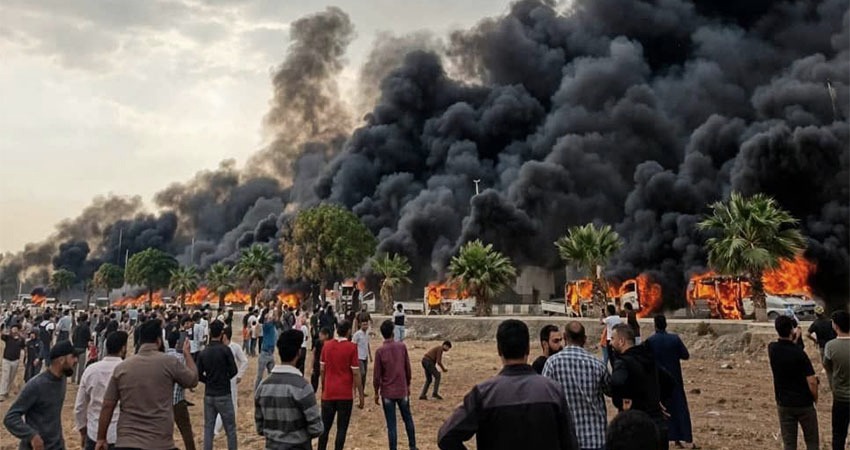
However, a protest gathering of Arab residents formed outside the building, where demonstrators threatened the returnees and demanded that they leave. Some members of the gathering then began attacking, smashing vehicles and setting others on fire.
As a result of these attacks, a large number of returnees, including women and children, were forced to remain inside the District Administration premises for several hours. They were eventually transported in security vehicles to other areas, including the very areas where they had spent years enduring forced displacement.
Raqqa Deputy Governor Mohammed al-Hamidi, in a statement to Welat TV, had previously attributed part of the tensions to what he described as a “lack of coordination.” He also cited “concerns” among some local residents about the presence of individuals he claimed had “previous outstanding disputes.”
However, witnesses and sources interviewed by STJ expressed dismay at the decision to assemble the returnees at the agreed date and location without ensuring adequate protection or implementing the necessary security measures that should have preceded their arrival. This was particularly concerning given that, according to the sources, the returnees had received assurances that they would be able to reclaim their properties.
In his testimony documented by STJ on 27 October 2026, Ciwan Sherif, one of the returnees, stated that the number of security personnel and vehicles present was “small”. He added,
“The security forces also did nothing and did not even prevent the attackers from assaulting residents’ vehicles. They simply stood by and watched.”
Another witness, identified as Luqman Mashu, whose testimony was documented by STJ on 27 October, told the organisation that General Security personnel were present while the vehicles were being set ablaze. He stated,
“We asked several personnel to fire a few rounds into the air to stop them from burning our cars, but they refused, claiming that they had no orders to fire.”
This was not the first incident in which displaced Kurds faced attacks while attempting to access their areas of origin. In March 2026, two Kurdish civilians were assaulted in the city of Tell Abyad/Girê Spî during a visit in which one of them sought to inquire about the status of commercial premises belonging to his family.
Similarly, on 10 August 2026, the arrival of the first convoys of displaced persons in Ras al-Ayn/Serê Kaniyê and the surrounding countryside was accompanied by attacks and threats. These incidents prompted the Displaced Persons Committee to suspend preparations for a subsequent convoy until adequate security guarantees were in place.
The circumstances surrounding these incidents and the parties involved vary. Taken together, however, they point to the persistence of serious concerns facing many displaced Kurds, particularly when considering returning to their areas of origin or attempting to reclaim their properties, despite the publicly announced “return arrangements.”
The exclusive testimonies obtained by STJ reveal an intersection of disputes over houses and land with political accusations and remarks targeting returnees based on their Kurdish identity or alleged affiliations with Kurdish political actors. These developments unfold against a backdrop of accusations by some Arab residents of the area against the Syrian Democratic Forces (SDF), whom they accuse of handing over their sons to Iraqi authorities, who detained them on suspicion of affiliation with the Islamic State (ISIS).
This briefing examines the circumstances of the three incidents, what they reveal about the transitional authorities’ failure to protect returnees and address property disputes, and the measures announced in response to previous attacks.
It also assesses whether investigations, promises of compensation, and commitments to accountability have led to tangible action, and what, if anything, has changed for displaced persons who continue to await their return to their areas of origin.
Furthermore, the briefing examines the interrelationship among safeguarding the right to return, addressing property-related violations, and holding those responsible to account, treating these as interconnected imperatives to redress harm, rebuild trust, and prevent violations from recurring.