
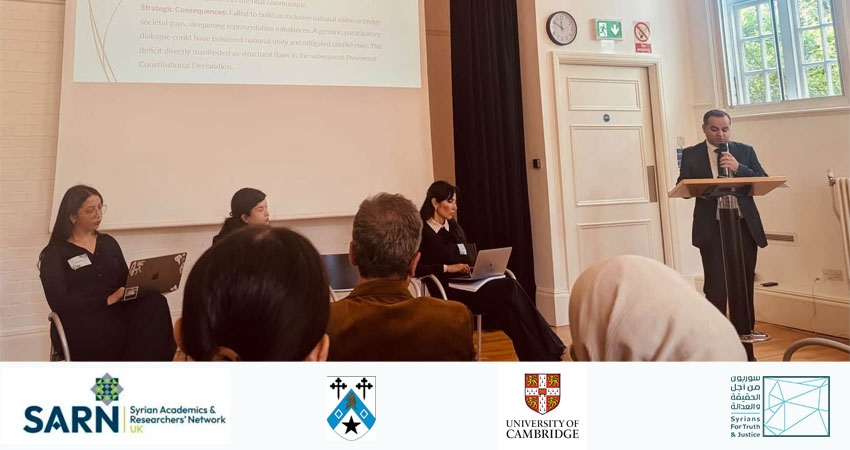
Bassam Alahmad, co-founder and Executive Director of “Syrians for Truth and Justice”, participated in the annual international conference of the Syrian Academics and Researchers’ Network in the UK (SARN 2026), held on 17 and 18 September at Newnham College, University of Cambridge, in the United Kingdom. The conference was convened under the title: “Syria in Transition: Knowledge, Memory, and the Everyday Aftermath”.
On the first day of the conference, Alahmad presented a summary of the research paper entitled “Selective Transitional Justice and the Reproduction of Impunity in Post-2024 Syria”, one of the papers presented and discussed during the conference, which brought together leading Syrian and international academics and researchers.
A Research Paper That Is First a Personal Testimony:
Alahmad opened his intervention by stressing that, although the question of transitional justice is central to “STJ’s” work, for him it goes beyond his professional role and represents “an issue with a personal dimension and a profound impact”. As a Syrian Kurd, he was deprived of Syrian nationality for 29 years. His detention took him through Air Force Intelligence (Mazzeh Military Airport Prison), the Fourth Division centre, the Military Police, and Adra Central Prison. He described his experience as involving enforced disappearance and torture, before he was forced to seek refuge in Turkey and then France.
He said that the discussions and contributions at “Cambridge” had inspired him to begin work in earnest on an idea that had come to him after December 2024: a project documenting a journey that combines his personal experience and professional trajectory. It begins with his prolonged deprivation of nationality, followed by his experience of the March 2004 uprising in Qamishli, then his political activity following the period of the ‘Damascus Declaration’ while studying at Damascus University and his involvement with the Kurdish movement in Syria and the Syrian opposition. It then covers his extensive experience in documentation and human rights, beginning with his joining the ‘Violations Documentation Center in Syria’ (VDC) in 2012 following the Syrian uprising, and continuing through detention, seeking refuge, and then study in the United States of America (the Leaders for Democracy Fellowship in 2015 at Syracuse University/Maxwell School), and the founding of the organisation ‘Syrians for Truth and Justice’, a project that continues to this day during Syria’s transitional justice period.
Legitimacy Without a Popular Basis:
Alahmad examined how “legitimacy” in Syria had shifted, after the fall of the regime, from reliance on Security Council resolution 2254, adopted in 2015—the binding international framework for redefining the legitimacy of the authorities, despite its non-implementation—to what he called “revolutionary legitimacy”. This term gained currency following the “Victory Conference”, convened by “Hayat Tahrir al-Sham” in late January 2025 in cooperation with the “Military Operations Command”, which brought together the leaders of 18 military factions, including factions formerly affiliated with the Turkish-backed “Syrian National Army”.
He explained that the ‘conference’ had appointed Ahmad al-Sharaa as transitional president with broad executive and legislative powers, dissolved the Ba’ath Party, the National Progressive Front, and the People’s Assembly, abolished the 2012 Constitution, and restructured the security agencies and the regular army to build new institutions. Alahmad quoted a phrase used by supporters of the new authorities in response to any criticism: “Whoever liberates decides.”
He added that the National Dialogue Conference, held less than a month after the “Victory Conference”, had been conducted through rushed procedures that lacked even the most basic standards of transparency, and had failed to formulate an inclusive national vision for the transition. This deprived Syrians of a vital opportunity to discuss fundamental issues such as justice and accountability openly—a lost opportunity for a genuine dialogue that could have generated national unity, bridged gaps between different communities, and reduced the risks of violence and conflict at this sensitive stage.
A Constitutional Declaration Behind Closed Doors and Authority Without Limits:
Alahmad revealed that the interim Constitutional Declaration issued in March 2025 represented a constitutional process lacking genuine Syrian participation. Following the abolition of the 2012 Constitution, the document was drafted by a committee of seven “like-minded” experts, without transparent procedures, broad national debate, or diverse political and social representation—weakening its foundational legitimacy.
He noted that the declaration’s most prominent feature was the substantial concentration of power in the hands of the transitional president, in conflict with the principle of separation of powers. The president directly appoints the government and one-third of the members of the People’s Assembly, and forms the Higher Committee that oversees the selection of the remaining two-thirds (Articles 24 and 35). His influence extends to the judiciary, as he appoints all members of the Supreme Constitutional Court (Article 47). Alahmad also pointed out that the declaration lacked clear rules on democracy and popular sovereignty, disregarding the principle that power belongs to the people—leaving the constitutional future dependent on the will of the executive rather than the popular will.
Decree No. 20: An Incomplete Mandate and Eroding Credibility:
Alahmad criticised the National Commission for Transitional Justice, established under Decree No. 20, issued in May 2025. Although its stated task is to uncover the facts about the former regime’s violations, it disregards widespread violations committed by other parties, breaching the principle of equality and leaving a large segment of victims outside its mandate. According to Alahmad, this fosters an environment of impunity that has allowed grave violations, such as extrajudicial killings, enforced disappearance, and sexual violence, to continue even after the fall of the Assad regime, particularly against Alawites in the coastal region and Druze in Suwayda.
He affirmed that the Commission had not adopted any comprehensive international definition of “victim”, noting that the UN Special Rapporteur and the draft laws in circulation raise questions about the scope of the Commission’s work and confirm that accountability and compensation will exclusively address the former regime’s crimes during the period 1970–2024, constituting explicit discrimination between victims on the basis of the perpetrator’s identity.
The Massacres in the Coastal Region and Suwayda:
In one of the paper’s most harrowing sections, Alahmad documented how, in March 2025, government forces and armed factions accompanying them carried out systematic house raids in predominantly Alawite villages in Tartous, Latakia, and Hama. The question “Are you Alawite?” determined a person’s fate between life and summary execution in the field, leaving behind mass graves and devastated communities.
In July of the same year, bloody violence swept through Suwayda Governorate, claiming the lives of more than 1,700 people, most of them Druze civilians, and displacing approximately 200,000 people, with mass executions, torture, and gender-based violence documented. Alahmad stressed that these atrocities, alongside violations continuing after the transition, such as arbitrary arrest, enforced disappearance, and abduction motivated by sectarian considerations, underscore the urgent need to hold those responsible for these violations accountable, regardless of their affiliation, including leaders whose responsibility for them is established, and for the state to fulfil its duty to protect civilians. He emphasised that hate speech remains a key driver of these violations.
The Decree Recognising Kurds: An Incomplete Step:
Alahmad pointed to Presidential Decree No. 13 of 2026 as a significant milestone for its explicit recognition of Syrian Kurds as an integral part of the people, its annulment of the consequences of the exceptional 1962 census for the purpose of granting nationality, its recognition of Kurdish for use in education, and its designation of Nowruz as an official national holiday.
However, he explained that the decree had been issued in a complex political and security context, coinciding with violations during military operations in north-eastern Syria and in the Sheikh Maqsoud and Ashrafieh neighbourhoods of Aleppo, which prompted divergent local Kurdish positions on its timing. He also noted that the decree had overlooked deeper grievances that persist, including the Arabisation of village names, the “Arab Belt” project, and historical injustices such as the confiscation of land during the construction of the Euphrates Dam. He regarded it as only a “starting point”: its implementation must be integrated into the transitional justice process, and it must be enshrined in the permanent constitution.
“Selective Justice” Threatens Civil Peace:
Alahmad concluded that defining victims according to the identity of the perpetrator, rather than the nature of the violation itself, does more than distribute the right to truth and compensation unequally. It also constructs a selective public memory: the suffering of some victims is recognised, while others are written off as “remnants of the former regime” or sympathisers of particular parties to the conflict. This reproduces societal polarisation, undermines trust in the institutions of the new state, and weakens the prospects for sustainable peace.
Recommendations:
Speaking on behalf of “Syrians for Truth and Justice”, Alahmad stressed that a successful transition requires seriously addressing the structural gaps that have accompanied the domestic political process and the transitional justice process to date, and ensuring broad societal participation in decision-making, with the aim of supporting the transition, strengthening accountability, protecting victims’ rights, and consolidating the democratic foundations of a future Syrian state. He called for:
- Expanding the mandate set out in the decree establishing the National Commission for Transitional Justice and the related law to include all victims without exception.
- Ensuring victims’ effective participation, guaranteeing compensation, and protecting public memory.
- Subjecting security and military formations to civilian oversight and building a non-sectarian national army.