
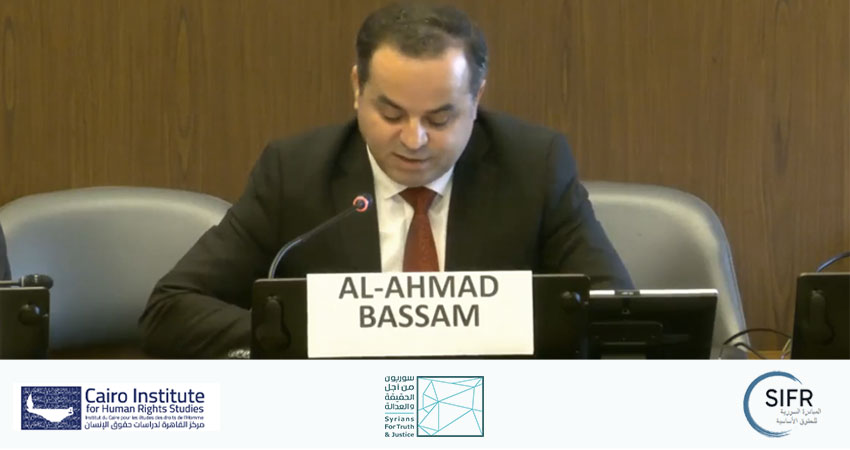
The Syrian Initiative for Fundamental Rights, in partnership with the Cairo Institute for Human Rights Studies, held a side event on the margins of the 63rd session of the Human Rights Council in Geneva on 7 September 2026.
During the event, Bassam Al-Ahmad, co-founder and Executive Director of Syrians for Truth and Justice (STJ), delivered an intervention on the current status of Decree No. 13 concerning Kurdish rights in Syria. He spoke in his capacity as a representative of STJ and as one of the Syrian Kurds who was stripped of his Syrian citizenship for 29 years in a country where he had lived for only 30 years. He was subsequently forced to leave the country and seek refuge abroad after being subjected to arbitrary detention, torture, and enforced disappearance by the Assad regime.
He said:
“The deprivation of citizenship from Syrian Kurds is a key provision of Decree No. 13, issued by Transitional President Ahmed al-Sharaa in mid-January 2026. The decree was issued against an extremely complex political, security, and military backdrop and coincided with widespread human rights violations during the partial military incursion into the northeast of the country and the full-scale incursion into the Sheikh Maqsoud and Ashrafieh neighborhoods. This led to divergent views among local Kurdish communities about the decree and the timing of its issuance, particularly after the disappearance of approximately 800 people was documented, according to the Independent International Commission of Inquiry on the Syrian Arab Republic (COI Syria).”
He added that the decree “recognizes the cultural and linguistic identity of Syrian Kurds as ‘an integral part of Syria’s pluralistic and unified national identity.’ However, this formulation will lose its value if there are no genuine, effective guarantees on the ground that reflect this language and translate it from theory into practice.
Therefore, the decree may be regarded as a starting point for Kurdish rights, but it does not constitute a final achievement in the new Syria. Its implementation must therefore be incorporated into the ongoing transitional justice process in Syria and enshrined in the Constitutional Declaration and the permanent Syrian Constitution.”
Regarding the Kurdish language, he noted that the decree “also recognized Kurdish as a ‘national language’ and provided for its teaching in public and private schools,” but stipulated that Kurds must constitute a “significant proportion of the population” in areas where Kurdish would be taught. This vague formulation could deprive thousands of Kurds of the opportunity to learn and speak their mother tongue.
He further noted that recognizing Kurdish as a “national language” without recognizing it as an “official language” could genuinely obstruct “education in the Kurdish language,” rather than merely “the study of the Kurdish language.”
He called for “the development of a comprehensive national plan to develop curricula in Kurdish at various educational levels, including the university level, while enabling Syrian Kurds to conduct official transactions and access official documents in their mother tongue.”
He also addressed citizenship, noting that the decree “stipulated the repeal of ‘all exceptional laws and measures resulting from the 1962 census in al-Hasakah Governorate,’ and the granting of Syrian citizenship to ‘all citizens of Kurdish origin residing in Syrian territory, including those whose civil status was unregistered (maktumeen).’ However, it did not set out clear procedures for the relevant committees, so many unregistered individuals failed to apply for citizenship.
In one case documented by STJ, a Syrian Kurd was able to register his civil status with the committees but was unable to register his children and was told, ‘You can register them later.’ Cases were also documented in which the registration of some applications was refused on the grounds that there was no proof that the applicants had resided in Syria.”
He called on “the transitional authorities to ensure that no man, woman, boy, girl, or family is left without citizenship, and to expedite the reactivation of all government offices in Kurdish areas, particularly civil affairs and civil registry offices, in order to complete the naturalization process and issue official documents, such as identity cards.”
He warned that “the continued absence of state institutions in the Kurdish areas to date is compounding the suffering of those whose civil status is unregistered and those who have been deprived of citizenship. After obtaining citizenship, they still need to regularize their status with all official authorities, including the land registry, to have their properties registered in their own names, as these properties had previously been registered in the names of other Syrian citizens; to obtain student certificates; to register marriages; to obtain death certificates for the deceased; and to register children in the case of births.”
He recommended that “a dedicated body be established to regularize the status of those whose civil status is unregistered and of those deprived of citizenship after they obtain Syrian citizenship.”
He also noted that “persons who have been deprived of citizenship and are residing outside Syria still have no clear means of submitting applications to have their rights restored, as the decree grants this right only to ‘Kurds residing in Syrian territory.’” He called on “the transitional authorities to ensure that all persons deprived of citizenship as a result of the 1962 census are granted citizenship without discrimination, including Kurds living abroad, and to establish a dedicated program for material and moral compensation and reparations for those deprived of citizenship.”
He concluded by stating that STJ “considers Decree No. 13 a step and the beginning of a long road toward eliminating all the injustices to which Kurds in Syria have been subjected.” He added that “Since the decree concerns Kurdish rights in Syria, it should have addressed the Arabization of the names of Kurdish villages and cities and the project commonly known as the Arab Belt Project, and the injustices that resulted from it, affecting not only Kurdish citizens but also people whose lands were seized during the construction of the Euphrates Dam.”
He concluded his intervention by emphasizing that “a genuine national dialogue based on rights and community consultations would provide a fair basis for resolving the Kurdish issue and the other issues facing Syria,” and by calling for “the rights of all other components, including Syriac-Assyrians and Turkmen, to be guaranteed on the basis of equal citizenship within the framework of the country’s unity.”