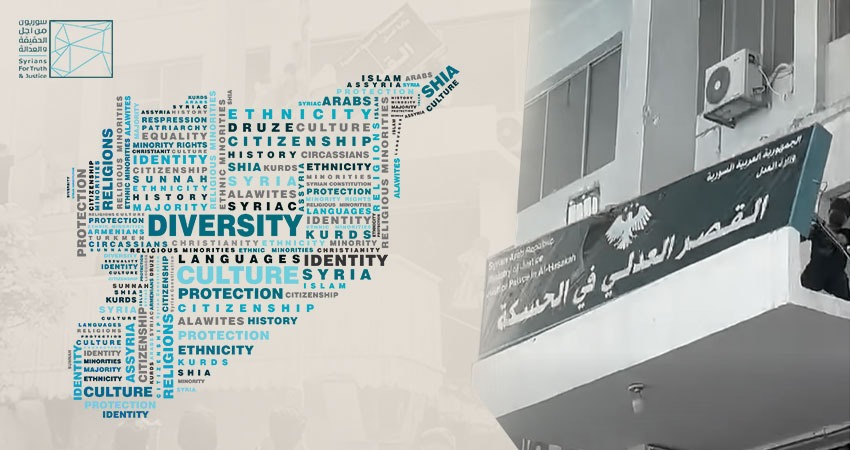
The undersigned Syrian organizations are following with deep concern and strong condemnation the attempts by the transitional authorities in Damascus to restrict the use of the Kurdish language in al-Hasakah Governorate. This was recently demonstrated at the Justice Palace in the city center, where the Syrian government insisted on excluding the Kurdish language from the main external signboard.
This unjustified act has provoked widespread disapproval and raised genuine concerns regarding the seriousness of the transitional authorities’ commitment to respecting linguistic plurality, particularly given that only one language was used to identify an official institution in a city characterized by ethnic and cultural diversity and inhabited by Arabs, Kurds, Syriacs, and others.
The undersigned organizations consider that the recent practices of the Syrian authorities stand in stark contradiction to the International Bill of Human Rights, as well as to the principles and provisions of the Interim Constitutional Declaration, which explicitly states that the State shall “guarantee the cultural diversity of Syrian society in all its components, and the cultural and linguistic rights of all Syrians” (Article 7). These practices also contradict Article 2 of Decree No. 13 concerning Kurdish rights.
The exclusion of the Kurdish language from public space reflects the persistence of exclusionary and culturally hegemonic policies that Syrians, particularly Kurds, have endured for decades through systematic measures aimed at denying their national, cultural, and linguistic identity, and erasing their presence from public life.
The undersigned organizations recall the importance and centrality of preserving cultural and linguistic diversity in building a sustainable peace in Syria founded on acceptance and respect for diversity. They further stress that such preservation constitutes a fundamental safeguard against the recurrence of conflict in a country that has endured 14 years of devastating violence and decades of authoritarianism and oppression against Syrians, including Kurds, Syriac-Assyrians, and others.
Out of concern for the success of the transitional process, and to ensure that cultural and linguistic marginalization does not become yet another factor contributing to instability, the spread of hate speech, the reproduction of tensions and divisions, and the undermining of civil peace in Syria, we call on the authorities to comply with their international obligations and respect the International Bill of Human Rights, which prohibits policies of discrimination and exclusion.
Constitutional and legal recognition of the Kurdish language as an official language constitutes the restoration of a natural right following decades of Kurdish political and human rights struggle aimed at preserving the language and securing its official recognition. It also reflects the extent to which the current Syrian government is genuinely committed to ensuring the participation of all Syrian components in shaping the future of their country during the transitional period.
Accordingly, the undersigned Syrian organizations call on the transitional authorities to:
- Constitutionally recognize the Kurdish language as an official language of the country, and ensure its use in public space, education, and official transactions.
- Ensure that all State institutions support and promote the use of local languages in Syria, including through the adoption of relevant laws and legislation.
- Issue immediate directives requiring respect for Syria’s diversity and promoting the use of languages in public space without exceptions, while refraining from adopting any exclusionary or discriminatory policies prohibited under international human rights law.
- Comply with Syria’s international obligations and provide the appropriate environment and necessary support for the preservation of the languages spoken in Syria, including the Kurdish language, while guaranteeing their free and unrestricted use.
- Constitutionally guarantee the right of all Syrian communities to learn and teach their mother tongues, and integrate this right into the educational and cultural policies of the Syrian State.
- Criminalize attempts to forcibly assimilate diverse languages and cultures into a single linguistic or national identity, classify such acts as forms of racial discrimination, and recognize linguistic and cultural diversity as a source of strength and richness for Syria.
- Amend the Interim Constitutional Declaration to explicitly recognize Syria’s cultural and linguistic diversity and ensure its incorporation into the permanent
Signatory organizations:
- ASO Consultancy & Strategic Studies
- Ahrar – Syrian Libral Party
- The Union of Intellectuals
- The Humanitarian and Development Cooperation Organisation (HDC)
- ACHTI Center
- Ahlam Saghira
- Artist Team
- Ambassadors for People With Disabilities
- Analysis and Strategic Studies
- Ella Organization for Development and peace building
- PÊL – Civil Waves
- Environmental Green Tress Association
- Dar Association for Victims of Forced Displacement
- Syrians for Truth and Justice (STJ)
- Synergy Association for Victims
- RÊ for Rehabilitation and Development
- TEVIN. Independent Think Tank for Kurdish Affairs
- Shawishka Association for Women
- Mbader Association for Community Development
- Ronî Peywend for Community Leadership
- Peace She-Leaders Network
- Kobani Organization for Relief and Development
- Malva for Arts and Culture
- Rose Organization for Support and Empowerment
- Nextep Organization
- Yalda Community Center
- HÊZ Awareness