
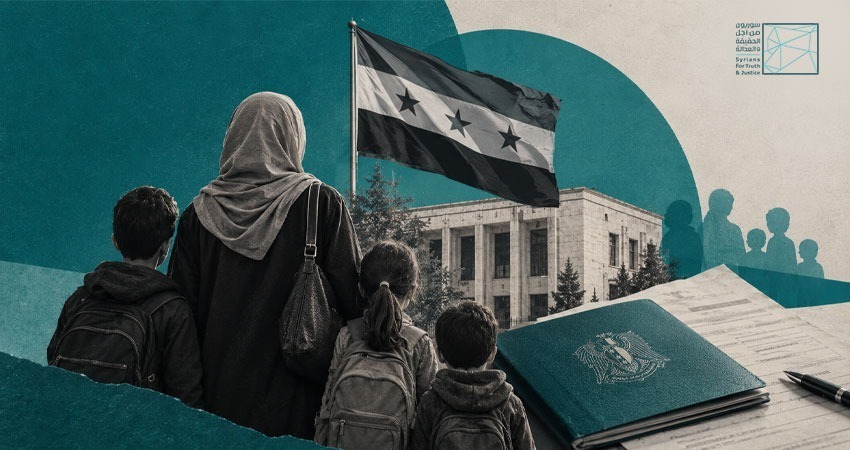
All Syrian men and women are entitled to equal citizenship rights, free from any discrimination. Grounded in this principle, legal justice,the needs of recovery, and the promotion of civil peace necessitate addressing inherited legislative gaps that have become a major obstacle to establishing the rule of law and consolidating socio-economic stability in Syria.
At the forefront of these legal gaps is the continued application of Legislative Decree No. (276) of 1969, which does not grant Syrian women a right equal to that of Syrian men to transmit their nationality to their sons and daughters automatically and by operation of law. This restriction is no longer merely a matter of legal discrimination; rather, it has become a direct cause of thousands of sons and daughters being deprived of legal protection and official recognition, and exposed to the risk of statelessness, particularly in light of the loss of documentation, absence of fathers, and lack of registration of marriages and births resulting from years of conflict.
Continuing to force Syrian mothers to bear the burden of these exceptional circumstances, while denying them the ability to secure legal status for their children despite holding Syrian nationality, exposes a legislative defect that violates the principles of equality and citizenship. This defect demands a remedy that aligns with the Syrian state’s constitutional and international obligations.
Legal, Social, and Economic Impacts of Maintaining the Current Law
First: Conflict with Constitutional Principles
Maintaining the current law impedes the effective implementation of the 2025 Constitutional Declaration, particularly the principle of equality among citizens under Articles 10 and 21 and the protection of the family as the fundamental unit of society. This necessitates harmonizing in-force legislation with constitutional principles.
Second: Expansion of Legal Undocumentedness and Statelessness
Thousands of Syrian mothers face severe difficulties in registering their children due to the father’s absence, missing official documents, or the inability to register marriages during the years of conflict. This deprives these children of legal recognition and restricts their access to fundamental rights.
Third: Social Exclusion and Impaired Development
Treating the sons and daughters of Syrian women as foreigners in their own country and classifying them as foreign nationals restricts their ability to fully enjoy and access rights and services, including education, employment, property ownership, and healthcare. This further exacerbates social vulnerability and results in the loss of valuable human potential that could otherwise contribute to reconstruction and development.
Fourth: Administrative and Security Burdens
Maintaining the current law imposes an increasing burden on state institutions -particularly civil status, immigration, and passport authorities- due to repetitive procedures regarding residency, visas, and administrative vetting. Although the children of Syrian women share a genuine and permanent connection to Syrian society, these ongoing procedures constitute an administrative burden that serves no real national interest.
Reforming the nationality law is not merely a human rights issue; it is a constitutional entitlement and a national imperative to protect Syrian families. It is essential to prevent the fallout of legislative loopholes from extending to children who bear no responsibility for the circumstances of their birth or upbringing. Denying them legal recognition pursues them through every stage of life and directly impacts their fundamental rights, thereby undermining society’s capacity for recovery.
Furthermore, this reform represents an essential step toward reinforcing citizens’ trust in state institutions and building a more efficient and transparent civil administration based on clear legal rules. To achieve the desired impact, the upcoming legislative amendment should be complemented by clear administrative and executive pathways that resolve existing statuses and ensure a smooth transition toward a more just and stable legal system.
Accordingly, the undersigned demand the following:
First: Amending Legislative Decree No. 276 of 1969:
To explicitly guarantee the right of Syrian women to automatically transmit their nationality to their children by operation of law, free from any discriminatory conditions or restrictions. This is essential to achieve equality, end legislative discrimination, bolster the stability of the Syrian family, and protect the rights of the child.
Second: Adopting Measures for Legal and Administrative Redress:
By regularizing the status of children born to Syrian women before the law’s amendment and recognizing their vested rights, without imposing financial burdens or fines on their families stemming from past legal restrictions.
Third: Streamlining Birth Registration Procedures:
By providing accessible administrative and judicial pathways to register the children of Syrian women both within Syria and abroad, ensuring they obtain their nationality and legal rights without procedural complications.
Fourth: Adopting Urgent Transitional Measures:
Consisting of lifting discriminatory restrictions imposed on the children of Syrian women and enabling them to enjoy their civil, social, and economic rights pending the completion of legislative reform.
Amending the Syrian Nationality Law is a constitutional entitlement and a national necessity dictated by the interests of the new Syrian state. Comparative experiences in a number of countries, including Egypt, Tunisia, Algeria, Morocco, and Türkiye, have demonstrated the feasibility of recognizing a mother’s right to transmit her nationality to her children within clear legal frameworks. Such reforms have also contributed to reducing cases of statelessness, strengthening family stability, and improving the efficiency of civil administration.
Driven by the conviction that legislative reform is a shared national responsibility, the “My Nationality is Their Right” campaign calls upon Syrian women and men, academics, legal professionals, public figures, civil society organizations, and all who believe in the values of equal citizenship and the rule of law to support and sign this statement. This serves to reaffirm the right of every child of a Syrian mother to enjoy Syrian nationality and full citizenship rights without discrimination, thereby strengthening the unity of Syrian society and the future of its generations.
“For a cohesive Syrian family, a protected childhood, and equal citizenship.”